
Images


Two Approaches to Understanding S.F.R. Yugoslavia (2015, 5,800 words)
Posted in ..., 4. SFR YUGOSLAVIA
Leave a comment
ESTRANGEMENT AND COGNITION (final version 2014, 5,400 words)
Posted in 1. SF & UTOPIANISM
Tagged cognition, estrangement, literary genre, science fiction
Leave a comment
(With Sezgin Boynik) COMMUNICATING VESSELS: FORMS, POLITICS, HISTORY — INTERVIEW WITH DARKO SUVIN (2014-15, 18,700 words)
INTERVIEW WITH DARKO SUVIN* (18,700 words)
By Sezgin Boynik, May 2014, Lucca
[This piece is forthcoming in Rab-Rab {Helsinki] July 2015]
Sezgin Boynik: Can you tell in which way the discussions concerning Brecht and Formalist issues in late fifties and beginning of sixties were related to politics and to Marxist theories, in general and particularly in Yugoslavia?
Darko Suvin: I started writing about literature, fiction, poetry and drama roughly in the second half of the fifties. I finished my studies in ’55/56 and then went to army service. So I started to write somewhat as a student, but mainly after 1957. At that moment I didn’t know much about old battles (socialist realism versus modernism) that had been fought and won by modernism, more or less. If you read Sveta Lukić’s book Savremena jugoslavenska literatura 1945-1965 (published as a whole in 1968, but his theses were known earlier) you will see these things. The battle was won on the basis of a compromise between the Left intellectuals and the Party politicians. The political top was not much interested in arts or literature, they realised these were politically of secondary importance if you hold all newspapers, radio, and TV. So they offered a quid pro quo: as long as you writers and intellectuals don’t question present-day power; we will let you in peace to write in whatever form you wish. This implicit compromise had two components (of course I realised this retrospectively, I didn’t know it then): first of all there was a genuine revulsion against the arbitrary Stalinism, both on the top of the party (Kidrič, Djilas, Tito, Kardelj, probably also Ranković, but he never spoke much publicly, so you couldn’t guess what he really thought) and in the masses — not so much in between, in the middle party cadres where Stalinism was strongest. And second, the central Party Agit-Prop commission lost all effective power even during Djilas’s heading it in the early ‘50s, it was dismantled in the drive against USSR Statism, and especially after his ouster in 1954. Even though Agit-Prop commissions remained in each federal republic’s central committee, they didn’t do too much, they were more or less vatrogasci (they put out fires), but they weren’t good enough to start any fire on their own. I knew some guys in the Agit-Prop of the Croatian central committee, for example Marin Franičević, a good poet from Dalmatia in his youth, or Vojin Jelić, from Kninska Krajina, a very interesting and tormented novelist – but they just didn’t know what to do in cultural politics, and they had practically no research apparatus. Of course they were all in the Partisans and many of them, depending on age, in the Left underground movement even before the 1941 occupation by the Axis. They were all brought up on Lukács in the best case and Todor Pavlov (a Zhdanovian esthetician in USSR) in the worst case. The best knew also what Second International people wrote about culture, such as Plekhanov and Mehring, and some Lenin, as filtered by Stalinism. And they knew oodles of Engels, and of course of Stalin. Retrospectively, Engels is all that remains from those theories, and he never wrote specifically about the arts (though when he incidentally did, he could be illuminating, I remember a bit about Ibsen having the background of values from free Norwegian peasantry). I think also some Lukàcs about French realism remains; his really first-rate work up to the mid-20s we didn’t know, I discovered it in the 60s. Engels is a great genius in my opinion, but he was not applicable without great changes to a mutated capitalism and world: a great genius with great mistakes, such as finding dialectics in nature or believing in scientism.
In brief, the climate in SFR Yugoslavia was in the 1950s very open, right up to the late 60s, to all kind of neo-Marxism. We young ones were at that time calling it an ‘open Marxism’: I theorised the openness in theatre by using Brecht’s “open forms” (also the title of Eco’s first theoretical book, which I used). It was like a plant on which you could graft many new things — the Soviet selectionist genetician Michurin was very popular, also the American Burbank. For example, I remember one of the things which made me less than popular in the Faculty of Philosophy (that is, Arts) in Zagreb: we had a debate on the first theory of literature which was published in Zagreb, based on an introductory book by several hands coordinated and edited by two professors, Zdenko Škreb and Fran Petre – the former was a Germanist and the latter a real “cemented” or hard-line Slovenian Party member, follower of Ziherl, the Slovenian Zhdanov, who fortunately didn’t have that much power. So we had a discussion in Hrvatsko filološko društvo (the Philological Society, a kind of professional organisation of people dealing with “language arts”) at the beginning of the 1960s. I was then a young assistant in Dramaturgy and Theatre Arts, I stood up and said, “The whole book is based on the idea of difference and interaction between form and content, could you please explain to me how do these work in literature? Is it for example like a glass of water, the glass is form and the water is content? And if so, how we could differentiate the form from the content in the novel?” They were extremely offended, because they had no answer; and I suppose I got the reputation of a disrespectful extremist. What we learned actually is what every critic already knows, that you cannot disjoin these two. If you write about anything, say in my case about Krleža or Brecht, you start where you can, what struck you as salient when reading, because criticism is not a science but an art, and you go where you can, following certain protocols of evidence and consistency. The basic modernist idea, which was theorized by the Formalists, is that the izjava (the message) of any work of art is to be understood through its form, and at that point the relationship of form to content becomes uninteresting. You can say that what remains from content are themes, for example Balzac has a theme of avarice in Gobseck. But the same theme would have a totally different effect in another novel by Balzac, not to speak of Molière, because it was written up or about in different way: in other words, it had a different form.
My generation came to know about Russian Formalists through the work of Aleksandar Flaker in Russian studies, who was my personal friend. I knew him from political conferences before I came to university; he was a very active and engaged researcher. He published a fantastic book, Heretici i sanjari (Heretics and Dreamers) in 1954, which was an overview of all non-socialist-realist writings in Russia in twenties. Also there were other critical approaches which Škreb mediated from postwar West Germany, such as those by Wolfgang Kayser, maybe second-rate stuff but useful in order to know what is grotesque and such studies (it is actually important if you think that half of Krleža, our great writer, is grotesque, not to speak of Swift or satire in general). So there were no problems in grafting other plants on the sturdy tree of Marxism, we had no fear; we thought that truth will win because of its inner persuasiveness, we didn’t need a police, we just needed to upgrade the plant through its own inner juices. In short, the most important thing my generation learned – say in movies through Eisenstein — is that any statement about art, including the politics of art, is to be arrived at through form. Somewhere I wrote that this is “the ABC of any materialist approach to art,” but there are 25 other letters, then you go on, to DEF etc. But if you don’t begin with Formalism you don’t get anywhere, while if you do begin with this, you have more chances to deal with your material and ideological circumstances.
SB: While describing relation between Marxism and Formalism in Yugoslavia you said that you were then not scared by innovations, can you develop that?
A: Of course we thought of ourselves as the avant-garde, as friends of the novelty. We are the novelty in backward peasant and patriarchal Balkans, and therefore we were communists. That was the idea in the young Left intelligentsia. I theorised this later for SF literature by adapting for it Ernst Bloch’s Novum.
The problems in the Party were different; they had their hands full with economy and foreign policy. Also, culturally speaking the Party was very provincial in Yugoslavia; they just didn’t know what was happening in the world. For example I was a kind of protégé of Marijan Matković, a prominent middle generation dramatist who was editor of the Yugoslav Academy of Sciences’ periodical Forum in Zagreb where I published. He was a “krležijanac” (disciple of Krleža), formally rather a pre-Modernist realist, and an extremely loyal fellow-traveller of socialism. I gave him some stuff about Brecht, and he made a grimace and exclaimed, ‘Darko, Brecht in Yugoslavia!?!?’. This was ambiguous, maybe we weren’t yet up to Brecht, maybe he was too severe for us, but at any rate he was asynchronous to us (in his opinion; I disagreed). Or when I translated Peter Weiss’s Marat/Sade in the early 60s, he refused to print it: ‘I cannot spend socialist money for a piece against socialism’, was his reply. I tried to persuade him that the debate between Marat and Sade was exactly one of the things we needed to graft on our tree, but I failed.
Q: You have published in 1965 a text on Brecht where you say that in Yugoslavia there is still resistance toward Brecht …
A: The staid theatre people hated him, both the bourgeois and the Party…
Q: …yes, and you say that in Yugoslavia in the mid-sixties Brecht was thought of as too sociological, and not enough Formalist to be taken into consideration.[1]
A: Well that is my vocabulary. Because in Russia in the twenties there was a big battle between sociologists and Formalists. The synthesis of that was a kind of socio-formalism with people like Bakhtin and Voloshinov. You may know that Bakhtin, who was censored, has published much of his writing under the name of his friends Voloshinov and Medvedev; at any rate the decisive ideas in those books were his. Some reactionary US Bakhtinists say that these things published under the name of Voloshinov and Medvedev are Marxist and Bakhtin was anti-Marxist, so he wouldn’t have written them. But this is nonsense, Cold-War stupidity. Even Formalists like Eikhenbaum, Tinyanov, and Shklovsky were also interested in sociological aspects and Marxism. I think that both approaches in itself are insufficient, both Formalism and sociologism. In literary studies, sociology means relationship of writings to its own production and politics; Formalism means inner workings of writings (or art) in general. The inner workings of art apply in the moment of writing and in the moment of reading, so in the moment of production or in the moment of consumption. But of course these workings are shaped by so-called sociology, that is to say by ideology: what and how do you choose to write, what and how do you understand. Therefore you cannot have a Chinese wall and say, here is society and politics and there is pure art. Pure art sounds fine, but it is only a fin de siècle fantasy, at the end of 19th century, l’art pour art. I think this is intrinsically nonsense. There is a group of poems in English called “nonsense poetry”; that is great fun, but it’s not really nonsense, it is just a refusal of dominant sense. Or for example zaum poetry in early 20th-Century Russia; or even Alice in Wonderland, one of the greatest books in English literature. It does not make sense only in the sense of Dickens and George Eliot, or even worse of bourgeois and if you wish capitalist positivism. But surely there are other ways of making sense.
SB: Apart from not having sense, these limit cases of literature always have some social background. They are always somehow related to the ideology.
DS: Partly what they want to do is some experimental probing of limits of literature. For example, is it true that the limit of poetry is a word? Well maybe not, maybe it is a syllable. But at least it is a valuable experiment, even if it is proved as a negative experiment.
SB: In which way it was negative?
DS: A “negative experiment” in science is a failed one which is useful because it points out which way not to go further. And the limit of poetry is a word, not a syllable, because the syllable has no semantic dimension. But why not try it and see how it works, as say in Khlebnikov. I see no problem for anybody in power to let the kids play with these kinds of experimentations. By the way if you look at the political attitude of Futurists in Russia, they were communist sputniks .
SB: What do you mean by communist sputnik?
DS: The original Russian meaning of sputnik, before the little machine sending beep-beep from the sky in 1957, was “fellow traveller”: one who will go together with, accompany the Communist Party, in Croatoserbian suputnici. They were intellectuals, much too undisciplined (maybe fortunately, we have to say today) to be Party members, but agreeing with the Party line. I read in a book published in Russian in sixties, called Lenin and Literature, how Lunacharsky persuaded Lenin to go to a recital of Mayakovsky in 1921. After the recital Lenin said that it was very interesting; it was “hooligan communism” – khuligan in the very Russian sense as dangerous people on the margins of society, bohemians… Which I would gloss as: why not bohemian communism, each class should have their communism! If there is workers’ communism, intellectuals’ communism, why shouldn’t there be a bohemian communism? We are all alienated by class society, even the workers are no saints… So why not put together our fragments and hope something more coherent will emerge? Consider that bohemians as a social class were anti-bourgeois, they were poor for one thing and also despised (if you see the opera La bohème, taken from a French novel, they are all starving). They are poor because they still don’t want to or cannot sell their services to the bourgeoisie. Sometimes they are on the Right, mostly on a kind of anarchoid Left, but always against the dominant class. Considering this, we can talk about the contribution of the bohemian class to the revolution.
It would be interesting to examine swearword nouns in general, the obverse of your positive slogans. Bugger, say, the contemptible word for homosexuals, came from the French bougre applied to Albigensian heretics, whose religion was supposed to stem from Bulgaria (bogomils). Hooligan itself was adopted from Irish Gaelic as an English slur on the Irish rebels (houlihan). And loot is Hindustani slang for plunder, which entered English in 18th Century when the East India Company simply appropriated the Moghul emperor’s treasury, evaluated today at 273 million British pounds (of which the modest company chief in India Clive took personally only 8%). The same holds for thug, only it was Indian rebels that time (the “Thuggee” sect). By the way Lenin and the Dadaists met in Zurich in 1916 …
SB: I am not sure whether they met, but they were living in same quarter in Zurich in 1916.
DS: Well, yes, we have no data they met (except in Stoppard’s play).[2] But why were they living in same quarter? They were against the war, they were against imperialism and the whole old world, and they had to flee where they could. These two groups were what the surrealists would call ‘communicating vessels’. To refuse that kind of energy is one of the greatest mistakes of later Leninism, not to speak of Stalinism: it refuses the energies available to it, it refuses present energies from workers and from intellectuals, because the new class thinks it is enough to have power. Speaking in Gramsci’s terms, they had constraint by force, but they didn’t have a consensus. The communist party in Russia had a majority consensus in 1917/1918, and following the Civil War which they won, this consensus lasted until roughly 1926 or so. After that the party ruled mostly by police terror. Why? Because they lost the energies from below – of course, not only or even mainly from the marginals but from the workers and intelligentsia (the peasants were never wholeheartedly for communists in Russia, as different from Yugoslavia, where they were the pillar of communist power from 1942 to 1949, the ill-guided attempt at working cooperatives).
SB: My understanding of formalism is related to what you are explaining now. If intrinsic processes are not sufficient to explain the transformations happening to an art form, then in any case we will need some extrinsic factors such as a social field or ideology.
DS: I think that terms such as intrinsic and extrinsic are misleading. Adorno once said “The social is where it hurts”. That is a gloomy way to put it, but the social is primarily inside us.
SB: I agree with that. But I want to say that many formalists and socio-formalists were dealing also with explicitly political issues. For example LEF in 1924/5 published a special issue on‘Lanage of Lenin’, the Futurist Kruchenykh published one year earlier small booklet with same title, etc, which is somehow related to the limits of the language, what we were talking about earlier, but also with the effectiveness of that language. So in any case even intrinsic Formalists were not entirely interested just with the shape of the artistic forms.
DS: But these were only their personal opinions in politics. What matters is that if you want to understand anything in art, whether it is music, painting or especially literature, you have to talk about transformation. Writing is composed of the stuff of everyday life, because we use language in our everyday life communication, but it is composed in such a different way that it gains a cognitive autonomy: you can understand life in and around you better. When I was starting to write in fifties and in sixties the best people called this structuralism, or structuralist poetics. My dissertation on Ivo Vojnović has the subtitle ‘genesis and structure’, because I found I had to do a genesis, which I think is a very good thing in a dissertation. I would recommend to any doctorate to deal with the historical coming about of its subject-text: look at biography, letters, and all available material of its incubation period, which will help to understand the genesis. Then you understand in which situation it was produced, and then you can see what it is, how it reproduces and changes elements of its environment in what is actually a form, or structure. Structure is the sophisticated French version, maybe sublation, of form. Structure deals with limitations or inner constrains of the formal properties (as Lévi-Strauss described them in his work on kinship relations). The problem with a rigid understanding of structure is that it evacuates history: how do structures then change? In fact, how did they originally even come about? This is connected with the issue of variations, to begin with in the Darwinist development of species. I have in literature – and especially in theatre performance, where this is a focus — always been fascinated by variants. What is an original, what is a variant? I have arrived at the position that I don’t think there is any original: this is a theological problem …
SB: I didn’t understand why it is a theological problem…
DS: Well in monotheism your origin is in God, all origin comes from God. By the way I am in a perverse way rather fond of some well-articulated theologies, such as some variants of the Catholic and even more the Buddhist ones. Some of these variants lasted for half a millennium or longer as the only way of systematic thinking available in important civilizations, so they got to some insights that shouldn’t be sneezed at but maybe taken over and re-functioned. But if you are atheist then there is no origin; there are just variations, Epicure’s aleatoric (that is, historical and situational) swerves of atoms.
SB: Isn’t that also one of the main questions of Formalism which is dealing with historical transformations, or historicism? But before that I would like to know what you think about Formalist involvement with the literary movements. Because I have an impression that the advancement of their methodological approach had partly to do with their involvement in the most advanced literary experiments. For example Jakobson wrote a book about Khlebnikov, Shklovsky on zaum, and so on, they were always engaged with the newest forms in artistic productions.
DS: They were a theoretical parallel to the Futurists, again a case of “communicating vessels”. But then they had also other interests. What was the supreme paradigm of Shklovsky in the novel? It was Laurence Sterne. Why? Because Tristram Shandy is always written in variants: my uncle Toby said that, and afterwards he said this, while this was happening, then it turned out like that, etc. It is sequence of variants or cases; it foregrounds what is hidden in a smooth pre-planned plot. In Aristotelian Poetics this is called episodes, situations not fully defined by the overall plot but with a certain autonomy, as in Brecht. All Formalists were fascinated by Gogol, a grotesque writer who proceeds by episodes, as Bakhtin was by Dostoevsky. The Formalists started by analysing and deconstructing phonetic features of poetry through Futurists and similar vanguardists, but then they had to invent their forebears. So who can serve better in Russian literature than Pushkin, Gogol or Dostoevsky? In the novel they reacted against realism, just as Mayakovsky’s plays reacted against Stanislavsky.
SB: Also they were against Symbolism, and especially literary theory coming from Symbolists.
DS: Symbolism is an inadequate response to realism. It’s a kind of uncle who tried to kill his brother but didn’t manage: they were not successful, we the sons we will kill the father (remember the Russian fascination for the Hamlet constellation!). Basically they downgraded the Tolstoy-Turgenev line, wrongly believing that even Chekhov fit into it (but that was so only in Stanislavsky’s interpretation of his plays, which Chekhov disliked). Now here is a dilemma: as you know, Lenin loved Tolstoy, and he wrote a very interesting essay about Tolstoy, regarding him as a “mirror” – the metaphor is dubious – of the peasants’ horizons in the budding of Russian revolution, which in my opinion is correct, though insufficient. It is a pity that Lenin didn’t have time to be a literary critic; he would have been a very good one. So we have (in Russia and elsewhere) in fact two vanguards in modernism: one is the Leninist party, and the other is Modernist artistic movements. It is very interesting to see the relationships between these two vanguards: except for a few examples, they generally refused to learn from each other, they were arrogant or suspicious. One exception on the political side is Gramsci, who understood the role of culture (in the widest sense, including advertising and brainwashing) very well, and was even a quite interesting theatre critic. Another exception on the intellectual side is Brecht, who tried very much to collaborate with worker choruses and the communist party. To my mind, the two most important Marxist thinkers after – and in the wake of but not confined to – Lenin of the 20th Century are in fact Gramsci and Brecht. I could add Benjamin but he is very much influenced also by Jewish mysticism and the Frankfurters: unthinkable without Marxism and very usable in it, but not quite inside it.
But who had the main influence in the workers’ choirs for whom Brecht was writing his plays? It was the social-democratic party, not the communist party. Both Brecht and Benjamin thought hard about becoming members of communist party, but in the end they did not formally join, they were sputniks. They didn’t want to be members of a party already rather ossified in 1928/29 when they were seriously thinking of joining. At that time and in the thirties the German Communist Party was in terrible shape, all good people were kicked out by Zinoviev and later Stalin, or they were exhausted by fractional sects and fights. But ideologically Brecht considered himself as communist; or, as one of his friends described Brecht in USA in 1941-1947: “a party consisting of one person, closely allied with the communists”. I think this good definition of a sputnik is the best political definition of Brecht. As the early feminists were talking about a failed marriage of Marxism and Feminism, in general here too we have a failed marriage of Marxist avant-garde and artistic avant-garde. Surely this has to do with arrogance on both sides: partly by politicians who didn’t have sufficiently sensitive antennas to understand Brecht and Benjamin, or Pilnyak, Belyi, and even Mayakovsky, who was rudely criticized for his theatre plays, which I think contributed to his suicide.
SB: I have looked at the index of ‘Lenin on Literature and Art’ book where Mayakovsky is mentioned five or six times in very contradictory terms. Sometimes Lenin got furious at his poems, and in another instance Lenin thought that his poems are a better contribution to economy than the dull economist is offering.
DS: That’s the poem about too many conferences, Perezasedavshiesia. It is a sociologically interesting but I think innocent little poem, not very important. Though I may be wrong, it has a wonderful Gogolian grotesque image of the bureaucrat splitting in half to go to two conferences.
SB: Going back to your previous answer that in fifties and sixties you were not afraid of novelties in merging Formalism and Marxism and that you were seeking for novel artistic expressions in Marxism, I would like to know what was for you a novel artistic expression at that time in Yugoslavia?
DS: Miroslav Krleža. He was the idol of us youngsters. In high school we were all krležijanci, anybody who thought about art at all, or about committed art and Left-wing art, was a krležijanac. We didn’t know much about painting.
SB: What about initiatives such as Exat, New Tendencies …
DS: Let me rephrase it this way: I didn’t know much about art. Even though I am very much interested in visual art, it is a new language to learn, and I never had time to do it systematically. Still, I am an inveterate goer to art events. For example if you look at my book covers, chosen by me, they are usually some art works or paintings. A book published in Belgrade has a painting by René Magritte, whom I like deeply, Nena and I went to several exhibitions of his all over the world (he too practices estrangement!). But at that time most energies were concentrated on literature. Some people at the Faculty of Arts in Zagreb had a review called Umjetnost riječi (word-art or Wortkunst), where I published a theoretical text on science fiction at the beginning of sixties. Those times were very active, with lots of contradictory positions. I concluded in my latest book, largely dealing with the self-management epoch in Yugoslavia (Samo jednom se ljubi, Belgrade 2014), that the golden age of self-management was between 1958 and 1968. Here I am talking about self-management in production related to economy and politics. But in culture, self-management started a bit earlier, though it was sabotaged by the party. The first attempts at autonomous periodicals in the beginning to mid-fifties, as one in Zagreb Faculty of Arts, also in Slovenia, were forbidden. Even though at that time first attempts at self-management were made in factory organizations, the cultural attempts were thought of, I believe wrongly, as a bit dangerous. What you don’t understand seems menacing. Thus you ossify.
However, from another aspect, the intelligentsia which was introducing the self-management experiments in culture was not “organic”, as Gramsci would say, to workers and peasants; it was the classical intelligentsia coming from petty or indeed, though rarely, from high bourgeoisie. Many of the best people from these classes decided to adopt the Popular Front version of Marxism (for example my father, a doctor who went with the partisans). However its majority was in favour of socialism because it benefited them in economic terms, they had financial privileges, also it was patriotic, and their professional work was prized. There were a few people, like the Praxis philosophers and sociologists, who really believed (so did I) that in SFR Yugoslavia we had a kind of Hegelian sublation of all the best in the bourgeoisie without the worst, that is to say the citoyen without the capitalism. That was the Party cell in the Faculty of Arts in Zagreb, people like Frangeš, Prelog or Gajo Petrović, hugely influential writers and teachers. All was then new and open, very contradictory. Petrović and the excellent sociologist Rudi Supek edited then the bimonthly Praxis, but this started just before I left. Of course I read and mostly shared its views, I think they were politically right to insist on self-management and energies from below and contest creeping Stalinism from above. On the other hand the philosophers were rather exclusive, they didn’t interact with us “art critics.” Furthermore, they went in for a weird symbiosis with Heidegger, thinking he supplied the philosophical horizon lacking in Marx, so they were forever talking about Being, Dasein, Sosein, ontic, etc. That was similar to Sartre’s thinking that Marxism applied to mass problems but not to individual problems, so it had to be compensated by Husserl and company, but to my mind (now retrospectively) much worse: Heidegger is the great reactionary thinker of the 20th Century, the brown Plato; his affinities to Nazism are not casual, I don’t believe you can combine him with any Marxist horizon. (This is I think proved by similar attempts in the French deconstructionists.)
Finally, in regard to the Faculty of Arts itself, the Praxis people didn’t have an adequate cultural policy. If you read my Memoirs of a Young Communist you will see that we in the Student Union had a cultural policy — I wrote a position paper about it which I still think was pretty good — that the upper echelon of professors was not happy about. We wanted to end the semi-feudal position of full professors (in Italy they call them barons). Those power relations were based on very concrete interests and a strong will to dominate, even in each little and unimportant field of culture and philology. There was so much libido involved in those fights, it was unbelievable. Whereas we in the Student Union said, let’s have a teaching collective in each section (Odsjek), and the head of collective would be elected each year, or each two years, he or she could be professor, docent (junior assistant professor) or anybody; normally it should be someone who has already published a book, so we acknowledged professional competence. This came to naught, the “barons” had much energy and the Party little for cultural matters, thinking it was all superstructure anyway, while we students and later young assistants were naive and easily deflected onto professional matters. The Praxis people thought in lofty general terms and didn’t want to waste their time on such piddling matters as pedagogy in the Faculty of Arts. So my relations to them were sympathetic but distant, they didn’t defend me when I was attacked. They behaved, maybe unavoidably, as an embattled little sect.
The main trouble with the Party was that, not having an adequate cultural policy, they didn’t know what to do with contemporary collective creativity. Instead they wanted to give the heritage of the past to the masses; so you had cheap novels of Balzac and Fielding and Tolstoy, you had free exhibitions, cheap theatres, literature, cinema, discounted visits for trade-union groups, etc.; however, everything shown was belonging to the past or to a present stylistically continuous with the past, that is, pre-Modernist (this changed in some fields from the mid-50s on). They knew how to deal with that, because Lenin liked Gorky, and Marx and Engels liked Balzac. But they didn’t know how to deal with the new stuff. So it was easy for the Zhdanovians to call Joyce, Proust or Kafka decadents. I must say in Yugoslavia there was little of that, maybe from 1946 to 1951.
SB: Are you talking about the post-1945 situation and the fifties?
DS: This begins in the workers’ movement even earlier. It is a philistine or subaltern tradition which passed from the Second International to the Third International, basically: let’s take the best that exists and give it to the masses. But what is the best in this case is what the bourgeoisie has done, sifted, and codified. Remember the huge laudation of the bourgeoisie in The Communist Manifesto: ‘the bourgeoisie built things more imposing than the Cologne dome, etc’ — that logic was still active in the fifties in Yugoslavia. But that logic of a productive bourgeoisie is not valid anymore, the bourgeois logic is entirely destructive now; it is responsible for imperialist wars, huge desolations, mass killings — just look at the two world wars, at the hundreds of “small” mass killings since 1945, at West Asia today. You can’t admire solid bourgeois virtues anymore, they don’t exist; now it is all suicidal. The First World War is to my mind the beginning of modern history, everything changes after that, violent barbarism is in command (which then infects “really existing socialism” too). The Left cannot any more seek anything affirmative in bourgeois horizons, though of course I am all for Enlightenment and citoyen virtues – but updated as socialist or communist.
SB: What was your cultural policy at that time? Concretely I would like to know how you thought of Krleža’s formal innovations in relation to cultural policy you were interested in.
DS: You have to know that Krleža begins his literary career as a quasi- or semi-Expressionist at the time of World War 1; he wrote long Whitmanesque unrhymed expressionist poems, expressionist plays and prose. In the thirties Krleža was involved in a conflict with the Socialist realists, that is the orthodox (illegal) communist party, regarding art and literature, known as “the literary conflict on the Left” (sukob na književnoj ljevici), and this was a reason why he never went to Partizans. He was generously rehabilitated after the war by Tito, not by Djilas who hated Krleža and even reportedly wanted his execution. (Djilas was a real maximalist; first he was a maximalist inside the party and later on he was a maximalist against the party. To my mind he was a good historical writer, by the way, but a very limited politician and bad political writer.) At any rate we didn’t know much about Krleža’s involvement with the 1930s cultural struggles, this was only clarified in the sixties. However, he learnt his lesson, and later didn’t meddle in non-artistic politics. After the war Krleža evolved this Enlightenment plan of summing up all knowledge about the Yugoslav lands in a Yugoslav Encyclopedia (Enciklopedija Jugoslavije), was given ample finances for it, edited this huge work, and wrote more novels and a play. I knew Krleža slightly, I visited him, and we had discussions. An example: a congress by the Union of Writers of Yugoslavia was due in Titograd in 1964. I went to Krleža and said, why don’t we organize some small group including you, Marijan Matković, and your disciples, and propose something about the current cultural policy. He looked at me with pity and said: ‘Have you seen the TV performance of my play Gospoda Glembajevi a few weeks ago?’ (One of the principal actors in it was Fabijan Šovagović, who was from rural Croatia; in his way not a bad actor, but not for drame du salon of Ibsenian provenience.) ‘They do not know how to wear a tuxedo!’
That response of his was the same as Matković saying ‘Brecht in Yugoslavia, Darko what are you thinking of? We are not ripe for it.’ Though I think he was wrong, we had a mass basis for understanding Brecht in self-management, had we had much support and patience to show the working people how to understand itself (maybe different from how we understood it). True, it was not a traditional working class; it was a peasant-derived new working class, lacking for example common workers’ traditions such as trade union organizations, etc. They had to be constantly lifted out of the momentary serious problems of personal and their enterprise survival, lodging in cities, education, and so on. And my elders and betters implied that first we have to do the job of the Enlightenment, and maybe after one generation we can get to the Brechtian, that is truly communist agenda. I disagreed, I thought both agendas were the same: communicating vesels again, or maybe the DNA double helix. And I think I may have been right: postponing communist elements means they never come.
SB: But isn’t this a contradictory position, to ask for cultural policy in such a situation; to insist for a cultural policy for workers who were lagging behind the self-management? Wasn’t the party behind the mass movement which initiated self-management?
DS: There would be no contradiction in cultural policy had the Party allowed changes to happen. To begin with, let me point out it was only one little group at the top of the Party who were in favour of self-management; it was proposed initially in 1948-1950, by people like Boris Kidrič, when they were afraid of Soviet invasion and they were still enemies with the West. So they needed a mass basis, to activate the people four or five years after the war, and they picked up the workers’ spontaneous idea to have factory councils. Basis democracy was the way to mobilize and motivate for reconstruction and unity very tired and exhausted people in the post-war situation. Later on Kardelj and Djilas claimed that they were mainly responsible for this idea, but whatever their input the genuine articulation was clearly Kidrič’s. And it worked for 10 or 20 years. Maybe they had difficulties in first five years to make people to understand what all this change was about. Then they passed a law in 1958 that it was possible to veto the director, the manager, and through such experiences self-management got a more concrete shape. Though we cannot talk about full workers’ management; it would be more appropriate to call it workers’ participation, but there was great participation: I calculated in my book on SFR Yugoslavia Samo jednom se ljubi that perhaps 25% of the 4 million workers at the time passed in a dozen years through membership of the Workers’ Concils.
SB: Even if there was a platform also to discuss art in relation to the self-management theory, it seems that there were not so many attempts to do that.
DS: There were two problems. Number one is kulturna zaostalost, which means that we were really backward, except some artists and writers around Krleža and the pre-war Belgrade Surrealists; people didn’t even know that somebody like Brecht existed (you must know that before post-1945 mass education the majority was illiterate or with a bare 3-4 years of elementary schooling). Maybe I better say the petty-bourgeois intelligentsia didn’t know, for when I published my book on Brecht in 1970 I got a letter of thanks from a woman worker saying she sang Brecht songs (I suppose with Eisler’s music) in the workers’ choir before 1941. Brecht means also Bloch, Benjamin, all Weimar culture; they only knew that Lenin disliked Mach, where actually he was half right and half wrong. Lenin was right on the political fallout of the Machists in Russia, but he was not right about Mach himself. There is no modern physics without Mach, and there is no Einstein without Mach; basically Leninists, as different from Lenin himself, never digested Einstein. What does Einstein mean? In science he means whatever his equations mean; but in philosophy he means that your situation co-determines your world, the place you are situated in (your locus).
SB: It radically contextualizes the position.
DS: Exactly. Here we get to the second problem, which is an ideological aberration. Engels and Lenin are always based on the assumption that there is a general and overarching scientific truth, but of course one which we don’t fully know yet, because we are fallible people who fell from Eden — or translated into Marxism, we fell into class society, so we cannot know the full truth — but we are getting there asymptotically. That is a method which can work, as Marx would say, in a society based on the steam engine (capitalist competition), but it cannot work in society based on electricity and electronics.
SB: You just mentioned asymptotic. I have read in your early article, published in journal ‘Delo’, on the asymptote in Krleža which opens up unforeseen possibilities or radical futurity, through Lenin. Can you say more about this?
DS: Well this is a fantasy Lenin – which doesn’t mean some important aspects of his cannot be caught in this way. These early plays by Krleža, the Legends, which I argued amounted to the image of an asymptote to infinity, were all written between ca. 1917 and 1920, nobody knew anything about Lenin, except either what the bourgeois press wrote about him, as a maniacal sadistic killer, or hymnic praise. Krleža accepted the “demonic” aspect, but turned it into the tradition of the fallen archangel, the rebel Lucifer; he uses the ‘lighthouses’ metaphor for Michelangelo, Goya, Lenin and Columbus. Krleža then visited Russia as you know in 1925, at the time when a very solid bureaucracy was beginning (there is a short story in his Glembayevs cycle, where one of them is a communist and goes to Russia and becomes part of the State trust). Krleža was very dubious about all kind of things going on in revolutionary Russia. I think he knew Stalinism from the inside, at the very beginning of it. I have a feeling that he was rather pleased with Bukharin but I don’t know. So the Party could not expect much politically from Krleža after 1945, he did what he had to do at the Ljubljana congress of Union of Writers at the beginning of fifties where he gave a great keynote speech about socialist misunderstandings of culture, which he camouflaged by talking about the Second International. Clearly he knew that there was continuity between Second and Third International, culturally speaking. Politically there was a big difference between them, indeed opposition: shall we make revolution or shall we not. But culturally they were living in the same world. Lenin was living in the world of Kautsky, more or less. Yet at the same time he was Einsteinian enough to forge the hypothesis of ‘weakest link’: the weakest links of imperialism are backward countries. That was totally Dadaist; everybody in the Second International told him he was crazy. It was a great flash of genius, and this is what happens: Russia, China and Yugoslavia are all proof that Lenin’s crazy idea could work. In other words, the working masses of Western and Central Europe, Germany, France, England and even USA, at least tolerated, and often supported, the World War of imperialists against other imperialists. So the Russian Revolution showed that Marx, who reasonably for 1848 and maybe even for 1871 claimed that the revolution will happen in the West, was wrong. This is the thesis of Gramsci in his article Revolution against Capital, which he wrote in 1917/18, that the Russian revolution is a revolution against Das Kapital. This was to say that Lenin had to change some basic concepts of Marx regarding revolution, but sticking to the main trunk of Marx (to go on with my botanical analogy), which was getting rather dry at that time. Lenin was grafting new stuff on that trunk which helped its energy to vitalize, to flow.
SB: How would you describe this main trunk, is it the concept of class struggle?
A: No, the main trunk is to me alienation and dis-alienation; it is the concept of freedom, self-determination of each and all. But in order to be dis-alienated, to gain the freedom, we have to have conscious class struggle. In my terms, dis-alienation is the horizon towards which to move, the goal; class struggle is the – alas — necessary vector of how anybody can move from the present alienated locus towards that horizon (see “Locus, Horizon, and Orientation: The Concept of Possible Worlds as a Key to Utopian Studies (1989)” in my Defined by a Hollow). As Brecht once wrote, in order to have a handful of rice, the coolie has to bring down three empires. Since we are living in the world of class struggles from top toward the bottom leading to huge barbarisation, we have to reverse this and turn it the other way around, as class struggle of bottom against the top and against barbarisation. This is actually an Einsteinian idea. In my opinion, Marx is the great forebear of Einstein as far as situated thinking goes. Marx still has some elements of the old, as “iron laws of society” in preface to Capital, which I think is more Newton than Einstein. This is actually Roman Law (lex), which Newton transferred to a physics based on eternal truths. Einstein deconstructed the eternal truths, just as Marx deconstructed the eternal truths of Smith and Ricardo and the bourgeoisie.
SB: We have skipped one topic that I would like to know more about; namely the concept of history and critique of historicism in the work of Russian Formalism. This anti-historicism, which is often discussed in Viktor Shkovsky as the zig-zag history of literary changes, etc. is somehow related to the discussions of Marxism.[3]
DS: I am not so sure about their anti-historicism, they were very interested in history inside literature but refused its mechanical dependence as a “superstructure” on an economic “basis” (which was right) and then exaggerated the autonomy. After all, they came from a very backward Russia and didn’t have the tools of a Williams or Jameson. Also, the Formalists are a very heterogeneous group, very much differing from each other. Shklovsky is different from Eikhenbaum, Tynyanov is different from Jakobson, and so on. But if we take a common denominator, I don’t think they were anti-historicist. They are against a certain dominant kind of historicism, that of Ranke who defines history as “wie es eigentlich gewesen”, as it really happened (he also wrote a book on Serbia and Bosnia). This typical German historicism is basically a laicized Protestantism, some kind of opus dei in Germanos, of God working by way of the Germans: a monolithic and determinist historical method, based on totally teleological conceptions. You have to understand that this concept of history is actually a quasi-delirious teleology, and its insistence on first-hand data is subordinated to that. Since Formalists have criticized these kinds of approaches to history thoroughly, me and my generation, as many others, have benefited immensely from them. In one of my first essays, published in Umjetnost riječi, on science fiction, I had used the Shklovskian theses you speak about, of inheritance from junior uncle to nephew (or niece), in order to propose a sophisticated way of treating the history of literary genres, and I still believe this is correct.[4] How do historical changes come about in Formalism? They come about when a dominated (or oppositional) style of yesterday – the junior uncle — becomes the dominant style of today. But how does that huge reversal happen? That is a class struggle for heaven’s sake, you only have to put a little bit of Marxism into it and everything is clear. Of course the Formalists didn’t say this, they were not interested in macro-politics. There is a wonderful apocryphal anecdote, which I like to quote, an imaginary dialogue between Shklovsky and Trotsky, the most intelligent Formalist and the most intelligent Leninist. Shklovsky said to Trotsky, and the first half is a real sentence of his, “I do not care what flag flies on the fortress, I am a literary critic and I don’t care about the war ,” to which Trotsky replies “But war cares about you.”
SB: But Shklovsky himself was in the war!
DS: Yes he was; he was SR [Socialist Revolutionary] commissar and commander of an armoured battalion, and afterwards he was for a time in Berlin. In his personal life he cared a lot about the war, and this dichotomy is interesting in a negative way, the dichotomy between a personal and official posture. When he is a Formalist, then the Holy Ghost comes down upon him and he does not care about war anymore…
But formalist historicism is all about that zigzag transformation of dominated to the dominant, which is about a real driving force in history. I would like to see a whole history of literature written through this dynamics. I tried to do that in my writings on science fiction. But concretely to trace and discuss these transformations, or to prove the theses of Formalists, you need a huge group of scholars, some kind of Einsteinian Socialist Academy of Science, which does not exist anywhere. Raymond Williams tried later to do this with his “Social Theory of Literature”.
SB: I was just going to ask about the concept of ‘residual elements’ in Williams, to whom you refer frequently in your texts.
DS: Exactly. Williams is my maitre à penser, not the only one. I have others too, Lucien Goldmann, Krleža, Brecht, Bloch, most important Marx, and so on. Finally my contemporary Jameson.
SB: Can you please schematize the relation between the historical concepts of Formalists and the Marxist sociology of Williams?
DS: Well, Formalists gave you a form, and Marx gave you classes.
SB: No, I meant the relation between the concept of ‘residual elements’ of Williams and the idea of uneven historical transformations in Formalists?
DS: The Formalists didn’t know enough about society, except when they were studying the history of their subject, for example the history of Russian poetry or something similar; but in general they didn’t have much knowledge of social history. When Shklovsky is writing about Sterne he does not care about England in 18th century, for him Sterne is an extra-temporal or eternal paradigm, an exemplum. Williams comes from a Left which was ideologically not Leninist. He began as a kind of Leftwing or Left Labourite modification of F. R. Leavis, an interesting literary critic, a petty-bourgeois rebel who fought against the dominant high bourgeois tastes (he loved for example D.H. Lawrence). At some point Williams read Marx, not through Lenin but through Leavis or through the class struggles that he knew very well in Britain, coming from a Welsh worker family. Of course you know that Marx himself got the idea of class struggle primarily from England and France. True, struggles between classes go on everywhere all the time, see for example Heine’s poem The Weavers or Brecht’s Questions of a Worker Reader; but in Germany they were masked by the (exactly “residual”) feudal elements. And when we talk about Williams we have to remember this historical importance of class struggle in England, from at least Cromwell’s revolution on. So I think that the concept of residual in Williams is coming from two sources. One is English or UK history, that is quite clear, the Non-conformists are residual; and second, it comes from Marx and Engels who said that Balzac by being on the Right and hating the bourgeoisie, understood it very well, and his descriptions could be used by the Left. What is Balzac? He is ideologically residual – not in his writing technique, his technique is on the frontline of the future, but his ideology is completely reactionary, a bourgeois monarchism. I found Williams very congenial, I read all he wrote before I met him while on sabbatical in Cambridge in 1970/71, he was then in Jesus College. Also I saw him in the seventies-eighties when he was teaching part-time at Stanford University, he would stop often in Montreal where we arranged a lecture for him, for example on Brecht’s St. Joan of the Stockyards we were performing at McGill. He was also interested in science fiction, he wrote even a novel of politics set in future and some historical novels, also an essay on utopian science fiction. But I think his magnum opus is The City and the Country.
SB: In your article ‘Can People Be (Re)presented in Fiction?’ you say that ‘Formalism is the A and B of any integrally materialist approach to art, from which should then proceed to C, D, and so on, ’ this C and D meaning dialectics.[5]
DS: Yes, I mentioned that earlier; also meaning semiotics and narrative analysis (agents, chronotope). I would today stress more this historical component, or dialectical component as understood by Marx (not by Hegel). As you know Marx took dialectical logic from Hegel but adapted it to the circumstances of capitalism, which means to a macro-historical situation. I have been struck by Braudel’s longue durée vs durée événementielle (long before Badiou). Duree événementielle is for example the French Revolution, it lasts ten, maybe fifteen years, as one generation. Longue durée is the key for solving the problem which Marx faced in his famous passage about Greek literature in the introduction to Grundrisse:.[6] how can we still enjoy the Greek tragedy? We can, I would say today, because we are in the longue durée of class society. That means that a duration of the last five thousand years is united by some macro-continuities, for example by dominant and dominated, killers and killed, exploiters and exploited. Of course there are big differences between the Homeric aristocracy and Wall Street today (the former risked their lives and the latter never do); but on the other hand, dialectically speaking, in this history there is also continuity; you can find this in Benjamin’s idea that ruling classes have their continuity. This could be seen very clearly in the transformation of the bourgeoisie: they entered the scene of history as anti-aristocratic, but soon started to act as an aristocracy, because they took the same role of a ruling class. This is a clear example of continuation of domination. In order for this to happen ruling classes need certain apparatuses of domination. Althusser didn’t invent the ideological apparatuses, discussion regarding ideologies and apparatuses existed before him, but maybe he, for the first time, put these two concepts together. For example the salons in and around Napoleon’s time are ideological apparatuses, as centres of a kind of power forging the tastes of what is acceptable or not in discourse – say, on art. If you adopt the key of longue durée versus the short duration versus the medium duration (one has to have a hierarchy of durations), then the way how we understand historical transformation will change. If you look at my book Metamorphoses of Science Fiction you will see that in the theoretical part there is one scheme describing how science fiction deals with time. Time/temporality is for me a very important issue.
SB: How do you treat these different temporalizations, distinct durées in your theoretical work? Do they co-exist, or are they in some kind of constant struggle, in kind of contradictory relations?
DS: They are in dialectical relations. Of course they co-exist. I would say today that of my three levels in agential theory, the actants are long duration and unchanging, half a dozen narrative functions. I can’t imagine any narration without actants, in history or pre-history or even species-specific, as Feuerbach would say. The types are probably a long duration of class history but they change according to major “geological” shifts – some become marginalised and a few new ones arise; and the characters are related clearly to the individualism, which begins partly the end of the Antiquity, as in Plutarch’s characters for example, Alexander the Great versus Caesar. Christianity adopted this as the concept of one single soul; whereas Greeks had many souls, or Socrates had his daimon speaking to him about his community, the politeia; but characters then got backgrounded until the Renaissance, the rise of the cities and merchants. So to answer your question I would say that dialectic is methodologically the starting point, but one must historicize, as Jameson said “always historicize!” This means that the durées sometimes mesh and more often are in contradictory oppositions.
SB: But I was speaking more of teleological historicism …
DS: As I argued earlier, teleological historicism is essentially a theological problem. If we are not willing to accept the theological answer, then we have to find an alternative to teleology. Either we get communism or we get savagery, to adapt Rosa Luxemburg. That is to say, instead of teleology you have a bifurcation, Hercules on the crossroads… It is a time and a vision of catastrophic choices. This also means social struggles never end. I have realized while writing my last book on socialist Yugoslavia, that I cannot imagine any society without politics, and I think Marx was wrong there (maybe we should say semantically imprudent).
SB: Can you clarify this …
A: Marx thought that politics was all about class conflict; so that after the abolition of class conflict there will be no politics. But if politics means primarily how society or any collective distributes its material resources, when, how much, for what and to whom, then it will always exist. There is a novel by Wells set in a future where all our problems are solved; but still there is a conflict between scientists and artists. The scientists want to go to Mars or Venus and so on, whereas the artists want something else here and now. I think that human wishes and desires will always be larger than our material bases. So, do we now build a huge expensive accelerator, or do we go to Pluto, or do we let the sea into Sahara? There must be politics to solve this. In class society you solve this with violence, and in classless society by argument: as Brecht said in The Caucasian Chalk Circle, with pencils, not pistols. But important problems to be solved will remain in classless society. In that case you need politics to solve them, as Montesquieu said by “pressures, checks and balances” — I am a big fan of Montesquieu.
SB: You describe this dialectics needed for an integrally materialist approach to art, referring to Bakhtin and Mukařovský, as social formalism.
DS: I would not call it that now. These are traces of my intellectual genesis.
SB: Then in the same text you offer a criticism of Greimas’s theory of actants by proposing instead a Marx’s model of history from ‘18th Brumaire’.[7]
DS: Marx speaks of “character mask”, which is a type: the capitalist, the worker, etc. In the 18th Brumaire you have the best description of how Marx characterizes the classes.
SB: What you find as most objectionable in Greimas’ model of actants is lack of any social and ideological context.
DS: I am less and less fond of the word ideological; I would rather say historical, and if you wish a lack of historical semantics. I mean by this even macro-historical: I think it is perfectly fine if you have chosen to talk about overarching transformations happening in the time span of one or five thousand years. But you must have some kind of fundament, what the French would call assiette, a place where you are seated, a seat in history. For us time is history, we don’t exist outside of that. This does not mean that you are Robinson on your island and history is an ocean, or any other metaphor in which you are here and history is there. History is in your language, in your dreams, in your body, everywhere. If you have grown up during the war and you ate badly, history is then in your bones – you will have trouble with your health when you are forty or fifty. Only when you are striking and the police shoot at you, history is at the moment outside and getting forcibly into your inside. The so-called biological inside or “inner environment” is 90% historical. That’s why I think that the discussion around genetics is one of the greatest bourgeois operations of ideological obfuscation. I have nothing against genes, but it is used in very reactionary ways to obliterate the importance of history. A good example of this is Dawkins’s book Selfish Gene. I rather like his conceit by which individuals are nothing but seed-pods for chromosomal propagation, but on the whole it is sheer nonsense.
SB: If we assume that history is everywhere, then any literary theory which avoids history is actually violence toward the literature it analyses. Could you say about Greimas that too?
DS: The basis for Greimas’s analyses and his system are Lithuanian folk stories. In Lithuanian folk stories the main agent is usually a Catholic priest; is that not historical!? Whereas a few hundred kilometres or years away that would be an orthodox or a protestant or an animist priest; which would make things completely different. I find Greimas very obnoxious, though he has one advantage: he has brought his system to the point where it becomes so self-contradictory and top-heavy that it is ready to collapse into materialism and history, which is what I try to do.
SB: When you discuss the text through three agential levels, then the problem of representation alters from the usual discussions which consider the artistic work as reflection of reality. Thus I would like to know your position regarding the discussions on realism?
DS: When Aristotle speaks about mimesis, he at some point asks, referring to zither I think, what kind of reflection is that when you represent somebody’s state of mind by musical sounds? It certainly is not a reflection in the ordinary sense of how a mirror works. The worst book Lenin ever wrote is Materialism and Empiriocriticism, or at least half of the book. The pars destruens is ok, as I said, but his pars construens is terrible, very Engelsian at his most reductive. I much like Gramsci’s finessing this in his Quaderno 11 (1930-32). He substitutes “translation” for Lenin’s infamous “reflection” as the basic principle of Marxist philosophy. This gets interesting: for him it is a principle of productive convertibility between two texts (so this is a general approach not confined to translating texts between two different languages, though he himself did that from German). His exemplum is that there must in fact exist a convertibility between the specific languages of philosophy, politics, and economics since all three share the same stance towards the world. This is then, I would say more precisely, a general epistemological principle that gives dogmatic priority to none of such languages: and though he doesn’t say so aloud, out goes the primacy of economic basis as against philosophical or political “superstructure”! For example, he situates Lenin’s term of “hegemony” into a translatory oscillation between philosophy and political practice (the Greeks would allot the latter to sofrosyne, practical wisdom).
You see, reflection is based on the metaphor of mirror, whether it is an ordinary mirror or a mirroring in water, as with Narcissus. But once you start to reflect on reflection, even the simplest reflection has seine Tűcken, as Marx would say, its complications or malices or vagaries: for example, left becomes right in mirroring. What did this mean; that a revolutionary party becomes right-wing in literature? Of course not (necessarily)! But you see it is a very complicated question, the change of shapes or anamorphism (much beloved by the Baroque). What Stalin and Zhdanov meant by reflection is some kind of imagined political correctness: to say good things about us, and bad things about enemies. That is a self-reflection – to reflect our own opinions, horizons, and point of views, to repeat and confirm them. In this case what is being reflected is nothing material, it is the apparatus idea of the ruling party; not the things or relationships between people. We have several questions here. There is a very good book written by another Lithuanian, Jurgis Baltrušaitis, an art historian who wrote on many different varieties of morphing, such as anamorphosis, metamorphosis, etc. Anamorphosis is describing distortions; like in the famous Baroque park Bomarzo near Rome, where all wall horizons are distorted. Well, in any mimesis, which is a metamorphosis (and it is not a coincidence that my best known book is called Metamorphoses of Science Fiction, which means changes of shapes in it), there are various way of producing distortions, such as one to one, one to two, upside-down, inversion, eversion, conversion, subversion, etc. Then there are convex and concave mirrors, as in fairgrounds (and one of my latest books is again not by chance called Defined by a Hollow). This business of mimesis is horribly complicated; just imagine imitating a state of mind by playing music, by having the chorus dancing. It is a simple fact that the dance does not imitate in any precise way the war before the Troy; it is a dance that must follow its own laws of a body traversing space – gravity, kinds of leaps and turns, etc., even if you give spears to the dancers. It is absolute petty-bourgeois stupidity to say that imitation is a kind of one-to-one relation. Let me take the canonic Socialist Realist example: Gorky’s Mother (a book I am sentimentally fond of, and it is not the author’s fault it got into such a canon). Gorky wrote about the mother of a revolutionary in Russia, because there were revolutionaries in Russia outside of literature. But not all revolutionaries, probably not even too many, had a mother that would carry on their work. So what Gorky did is to make a type, which is a Mother of the Revolutionary, and very near to an allegory, the Revolutionary Mother, if not indeed The Mother of the Revolution. If we agree that type is kind of form, then it has its own laws, just like distortion (say perspective) in painting has its laws. Therefore you must investigate the form, and that is the materialist part. Form is not, as my elder colleagues at Faculty of Arts would have said, the glass outside holding the water inside.
SB: Brecht said that if something had a good form we have to take its content. You are quoting this as well.
DS: All of us are children of our epochs. Brecht for example thought that he was doing anti-Aristotelian theatre. Because German Aristotelians, both in theory (such as Gustav Freytag, a theoretician of drama) and in theatre practice claimed their basis lay in Aristotle’s Poetics. In fact they were not Aristotelians, they were 19th-century bourgeois Positivists. So Brecht being anti-Aristotelian meant anti what was meant by Aristotelianism when he was young. Brecht is also a child of his time, of the discourse of his time. In fact if you read his poetics, in many ways he is Aristotelian as well, as I mentioned his overall structure is episodic, etc. Aristotle didn’t theorize enough the episodic nature of theatre, but he recognized it as such. Brecht wouldn’t have the concept without Aristotle. So if Brecht was speaking in terms of form and content, it is because he was raised in a German school in the first decade of 19th century, poor guy! And so were the listeners to whom he was trying to get something across.
SB: But it seems that he wanted to break from that legacy.
DS: Of course he saw the limits of that education very soon, he almost got kicked out of school when he wrote against the World War. But one question is centrally important here: what is estrangement (his Verfremdung), is it form or content? It’s a way in which form makes you look at your world.
SB: You write that the most formalized analysis can become precise, instead of formalistic, if only enters into feedback relation with the environment?
DS: I am great admirer of the feedback metaphor. This is a cybernetic metaphor which Marx didn’t have. I understand it as two entities which interact. A changes B then B changes A, which become A1, and so on.
SB: Feedback is possible because there is a flow of information from one source to another.
DS: Exactly: flow of information, or of anything else. This is a semiotic concept, which begins with thermodynamics.
SB: If we talk of reformulations of reproductions of agencies, then usually discussion goes toward the re-articulation of artistic text, which you also mention occasionally.
DS: You have here basically the old question: which one is first, chicken or egg? This is what some anthropologists, such as the interesting Gregory Bateson, called a double bind. Whatever you answer will be a wrong answer. The solution is that you have to step out of the double bind, that is, to say “I don’t agree with your question.” Thus, the question whether artistic work is a reflection or not, is also such a double bind. In some ways it is, in some it is not, and anyway what is meant by reflection is most imprecise and unproductive. We have to recognize it as such and refuse to recognize it as valid question.
SB: How is it possible to do that?
DS: By using imaginative freedom. My entire last book (Samo jednom se ljubi) has advanced to foregrounding this concept of freedom, meaning dis-alienation.
SB: Can you tell briefly how Brecht became your intellectual and artistic horizon in the fifties in Yugoslavia?
DS: Very simple, through student theatre. I was deeply engaged in student theatre, which was one of the democratic forms of self-expression in socialist Yugoslavia. First I was involved in the Zagreb Youth Cultural Society Goran Kovačić, which had its own theatre troupe. Later on it became the famous SEK (Studentsko eksperimentalno kazalište, Student Experimental Theatre), whose main director was my friend Bogdan Jerković. I was a kind of dramaturge (art director) of SEK, and we were part of the international body of Western and Central European student theatres, which was an incubating space for the ‘68 movement. You know the ‘68 youth and student movements didn’t come out of nowhere, they were incubating since the fifties. So we had four festivals each year, at Easter time in Parma, Italy; in middle of May in Zagreb, in June in Erlangen, West Germany, and in October, we had it first in Istanbul, but the Turkish police didn’t like that, so we shifted it to Nancy, in France. It was called UITU (Union Internationale des Théâtres Universitaires). The head of the student theatre and festival in Nancy, Jack Lang, later on became a famous Socialist Party minister of culture. At that time there was a big Brecht renaissance in two student theatres of West Germany, Frankfurt and Hamburg. This was in the fifties, the time of SDS (Sozialistischer Deutscher Studentenbund, people who were later demonstrating). They also produced some very interesting discussions, with theoreticians in Germany such as Karlheinz Braun or Claus Peymann (who much later became intendant of Brecht’s Berliner Ensemble), and in France some like Chéreau who later went to direct films. They were focusing mostly on the peripheral Brecht; not Galileo, not Mother Courage, but Lehrstűcke (his 1930s’ “plays for learning”), the early Drums in the Night, Der Tag des Großen Gelehrten Wu, one of his school’s adaptation in 1940s from Chinese, and mostly on early anarchist Brecht. After I saw these plays I started reading Brecht.
We had a huge scandal in Erlangen when Brecht’s son-in-law, the great actor Ekkehard Schall, came as a guest and recited some of Brecht’s most communist poems in 1961 just after the Berlin Wall; right-wing students in the audience booed it with hate, a real theatre scandal in a nice 19th-century theatre. I was vice-president of UITU, an organization consisting mainly of Western Europe countries and Yugoslavia. The Russians were outside that organization; only in some exceptions, Polish student theatres would come to UITU events. Therefore the Student Union of Yugoslavia forbade me to be president, they were afraid of Russian disapproval; it was part of Tito’s balancing policy. So, to answer your question, I haven’t met Brecht inside Yugoslavia, but in Germany, Italy or France; as you know Brecht’s greatest world success was with Mother Courage in 1954 in Paris, when Roland Barthes and a whole group of intellectuals became Brechtians. After that I was collecting books and publications related to Brecht. I was spending my per diems of 25 DM for buying books while abroad in these UITU meetings. These festivals had also debates. I was head of the debate programme of the Zagreb May IFSK festival (Internacionalni festival studentskog kazališta), which I have eternalized by putting into my mentioned book the cover-image of our publication, made by Mihajlo Arsovski, famous Macedonian graphic designer in Zagreb. I was editing the IFSK Bulletin with these debates, heavily influenced by Brecht. For us Brecht was anti-Stalinist and anti-capitalist, that is to say totally analogous to socialist Yugoslavia.
SB: Were you at that time then drawing this parallel between Yugoslavia socialist self-management and Brecht?
DS: No, then I was not thinking about the Yugoslav situation as a problem. I was, as all of us, very naïvely of the opinion, quite wrong, that the revolution had happened, we have solved all antagonistic problems, and we are left only with material difficulties, cultural backwardness, and remnants of the past that would be solved due to science, our wise leadership, and all that. OK, that was crap, we all had to mature! But I think Brecht was identical to the furthest horizons of the Yugoslav revolution, that is to say radical refusal of alienation. Verfremdung actually is a refusal of Entfremdung – the estrangement counteracts alienation. By the way this was very well discussed by Ernst Bloch in his essay Entfremdung /Verfremdung.[8]
In the student theatre there was a very interesting fight between formalists and nihilists, say the Brecht wing and the Grotowski wing; Grotowski was soundly beaten. Then he went to New York and became world-famous by being followed by US theatre people such as Schechner and company. And he beat Brecht worldwide just based on American ideological export. Of course Grotowski has some interesting things, he is a great director of actors, he knew quite a bit about Asian theatres, and he has this kind of Catholic existentialist background, which has its own strength. But I didn’t like that much, it’s all revelling in Christ’s passion – blood, sweat, and snot, no women allowed except as mourners. Thus, when I came to the USA for 1967/68, I had to decide whether I wanted to continue with theatre criticism. During that year I taught in Amherst, Massachusetts, which is five hours by bus to New York. Nena and I went on weekends to see all plays of that season in New York, Broadway, off-Broadway, off-off-Broadway, and the leading theatre journal, TDR, gave me the money for all the often expensive tickets. At that time, ever since the US public was shocked by success of Sputnik in 1957, a lot of money was being thrown at the universities, to invest into research. Of course most of the money went to the weapons industry, arms technology, space, hard sciences, and similar, but even the small portion given to Humanities and Social Sciences was relatively huge. So there was no problem getting funding and grants for halfway decent proposals. But I didn’t like the atmosphere and horizons of the US theatre, and to systematically criticize for years something you don’t like is counter-productive, you become what is in German called a nörgler – a nagger or moaner; that is boring to read and boring to write.
Therefore I returned the money, and I stopped being a theatre critic. There were also other reasons, one was that I was busy with my academic work (lecturing and writing). However, I could have stayed in New York City. Because universities were hiring a lot of teachers, in ‘68 I had four contracts awaiting signature on my desk. One was to stay in Amherst, at Massachusetts University; it was a progressive State, the only US one with protective labour legislation and so on; another in San Francisco; and a third one on the outskirts of New York City, on Long Island. And the fourth contract was from McGill University in Montréal, Canada. Now I liked the hustle and bustle of Manhattan, but I didn’t much like the USA. It was a very violent country, with wonderful oases which you could also call ghettoes – the campuses. In New York a lot of things were happening, like later the siege of Columbia University; I went to see that, but I didn’t much believe in those student revolts (paradoxically: the rich kids were striking, and the proletarians in police uniforms were putting down the strikes). Of course their strong revulsion against both consumer capitalist and Stalinist forms of human relationships was correct, and they pioneered the revulsion against life being absorbed by getting more and more things, against reification – though that was easy in a country of most abundant production. They were sincerely on the Left without quite knowing what this was or should imply (say clearer ideas, more organisation). When a strike happened in Amherst I felt my duty was to solidarise with the students, but they were basically anarchists, they were only against the war and sexual or drug repression, and what they were for was unclear. However, I didn’t believe in smoking marijuana, it obfuscates the mind which we need. Certainly some of the general US fights were worthy fights, those against the Vietnam War and against racism, but they were not fights in which I could as a foreigner participate, not my fights. So at the end I went to Canada and I didn’t become a theatre critic. A few years later I experienced some of the 1968 student leaders, whom I defended, turning into Post-Modernists and attacking me.
SB: Why did you leave Yugoslavia?
DS: They didn’t vote to prolong my assistant status job in the Faculty of Arts after six years, in spite of my having had a special dispensation to teach courses and published 5 books. There were all kinds of intersecting reasons, personal and political, the nationalists were already on the rise, the Party didn’t protect me; I fell between two stools so to speak. I believe I got about 47 votes as against 25, but out of a 100 members of the faculty Council (all teachers), the rest was absent, and we operated under a utopian self-management rule that you need to get an absolute majority of 51 votes. There were some irregularities in the meeting, so I sued them and might well have won. But you cannot be in a university on the basis of a court ruling instead of peer approval, I believed, and I was very disgusted. On top of some other conflicts I had had earlier with theatres and so on, I concluded I could very well be an alienated intellectual anywhere in the world. So though the Faculty got frightened and gave me a one-year paid leave (at the time I was also very sick and mainly in hospital), I resigned in 1967 and applied for a job through friends in the USA — which I then got in Amherst as described above. I had been in the USA in 1965/66 on a Ford Foundation grant, had had lectures all across the country and followed courses at Yale University, and refused with patriotic indignation offers of employment in various places. Now I had to come back with tail tucked in.
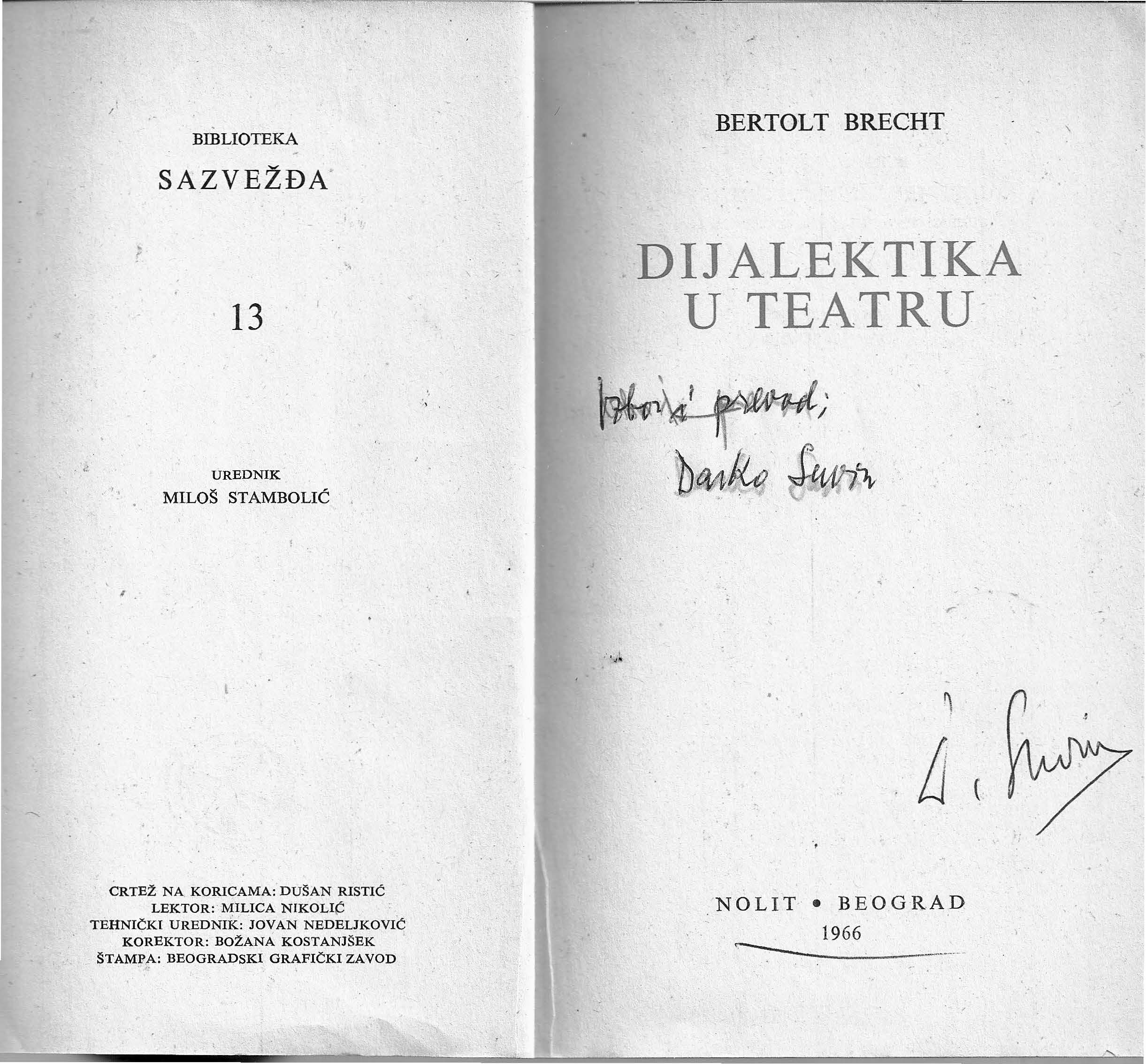


SB: I would like to continue the discussion with your translation and analysis of Brecht’s verse poem ‘The Manifesto’. You relate it to cognitive faculty of estrangement: “Poetry is here not only in strong opposition to the stifling superficial babbling of the reigning, totally ideologized doxa of the capitalist media or brainwashed common sense; it is above all a “stumbling block” (formulation of the poet Giampiero Neri) to the hegemonic babble—one which forces the reader/stumbler to stop and look at what is really happening at his feet. (p. 19-20)”
A: Brecht did a transposition of Marx’s Manifesto of the Communist Party into verse; which of course, if you believe in form being meaning, makes it a different animal. This is theoretically too interesting, because the style of the Communist Manifesto is also very artistic, it is a prose pamphlet style. Otherwise it wouldn’t have lasted for 150 years. Brecht was turning it into a verse translation/adaptation in 1944, when the Red Army was approaching Germany (later on he doubled the initial adaptation). He read everything he could get, both US and German émigré literature, and was struck by the fact that no one rebelled during the defeat of Hitler when the Nazi army was on the front, so a rebellion by workers should have been on the cards but did not happen. He was horrified by this, and thought (rightly) that the German working class had forgotten Marxism. Therefore it had to be re-acquainted with it in a way which would be interesting, that is to say in verse. In my opinion he also thought that Marxist prose, due to the abuse by the social-democratic (and I think also communist) party in banalities did not work so well any more. He was giving it a new lease of life, so to speak, by putting it into verse. He used the hexameter form based on some German translation of Lucretius’s De rerum natura from 1820s, which he had known in the Weimar era and taken with him into emigration.
This raises the huge question of the relation of poetry to history. I wrote in that analysis: “Surely, charity begins at home: poetry cannot exist without a relation to its own history. The poet — and the translator — must be cognizant of it, but not necessarily the synchronic reader who has to fry today’s potatoes today. For the reader, the relation is basically one of poetry to what Marx and Engels called the only science they knew — the history of relationships among people, in different social formations, in the struggles of classes differently shaping each formation.” I wish I could go on, but this needs a semestral doctoral course… Maybe this can be approached a little by the essay I recently wrote and which I propose you print in the same issue of RAB-RAB as this interview, “Epistemology, Science, Narration/Poetry”.
SB: Can we describe the adaptation of ‘Manifesto’ by Brecht as an instance of estrangement? In your text on the adaptation you describe it as a stumbling block, which is a term used by Russian Formalists.
DS: Yes, that is a term used by Shklovsky. That is what Formalists called zatrudnenie formy, making the form difficult, which prevents distracted reading. It is based on the simple idea that unless you concentrate on text, you will not understand it. If you stumble over a feature, you come to pay attention (or perhaps you throw it away). Furthermore, the form is difficult not only or primarily because it is baroque and complicated, but because it introduces new images and concepts. Then you ask “what is this?”, you de-automatise your relation to the artwork. On the contrary, if you automatise the concept as a cliché, and discuss it through automatically expected images and concepts, then nobody will pay full attention to it. So the text or its style has to be refreshed by putting it in some other way, which will be vivid enough to make the reader stop (stumble) and ask about the text. As I said, Brecht also introduces some new things that were not in The Communist Manifesto. Of course they are Marxist terms, concepts, and images, but certainly they were not in the original Manifesto. For example he introduces the “God of Profit”, something like Moloch or Baal. He sits there ruling the people, he is blind but very powerful. Literally, he is a blind God sitting in a temple, certainly a vivid image. Marx himself was not bad at finding vivid images, ‘the spectre is haunting Europe’ for example. That spectre is more or less a spectre of Hamlet’s father, because Marx loved Shakespeare whom he recited to his children when they were riding on his shoulders on Hampstead Heath. There are also spectres in German tradition, but with Shakespeare it is related to revenge righting an old wrong. Also Marx speaks often about theological or supernatural caprices of the Capital, a dead thing bearing fruit and so on. Therefore it is easy to make a parallel with a religious entity out of it. Of course Brecht reworks also Mammon from Bible, false god of gold and riches, since he was a very close reader of Bible, the Luther translation which is the beginning of modern German literary language.
SB: In your book on Brecht you criticize the work of Lee Baxandall on Happenings as nihilist estrangement, as no more than a renewal of sensual perception without cognitive values. Or you even say that this is a right-wing estrangement.[9]
DS: Well mythology is primarily, for us at least, an estrangement. By right-wing I mean basically some kind of mythical approach. For example Hitler believed in the occult science of I think seven moons, six of which have already disappeared, each in a catastrophe where the Earth changed; in the last one the Aryans had to retreat to North Scandinavia, but before that they were ruling all Europe, and they should come back and start to rule again. This myth I would say is an estrangement, of course this is not a part of the normal bourgeois world, but from the Right. So, there is nothing in estrangement which makes it automatically progressive or left-wing. It is a technique of perception. If you gave me a little time I could find you more sophisticated examples of right-wing estrangements from literature. Ezra Pound’s Pisan Cantoes, say, have a section against usury, which is the right-wing, traditionally Catholic name for capitalism. Right-wing is, to put it in general terms, a reaction against French revolution, freedom, equality, and democracy from below; it can easily be ideologically anti-bourgeois too. Fascism has always had a left wing, such as the SA of Nazi Germany whom Hitler had killed in 1934. They were sincerely anti-capitalist, so they thought, and horrified that Hitler made a compromise with capitalist industrialists. They really thought that it was a national socialist party. So, right wing estrangement exists too.
As to nihilist estrangement: by the way, I was a good friend of Baxandall, he was a left-wing guy in New York. And I got interested in these Happenings while in New York City. I saw a few, and they also published very good small pamphlets describing various Happenings by Kaprow and others. After studying them I wrote that critique for TDR (Theatre and Drama Review). Basically I understood happenings as a-political estrangement, that is to say, they are dealing with individual re-orientation to the world, and whether this has anything to do with politics is none of our business. Once we re-orient you can go out and do whatever you want, something or nothing, left or right. I thought that this was a variant of estrangement which was formally interesting, and up to a point maybe even useful, but certainly insufficient. I didn’t know what to call it except nihilist estrangement, by which I was referring to Nietzsche — certainly not to the Russian nihilists who killed the Tsar.
SB: Baxandall’s theory of Happenings is actually similar also to his interpretation of Eastern European political cinema (particularly of Makavejev) which he calls cine-marxism.[10]
DS: In these writers it is all approximate, because they didn’t know too much about Eastern Europe.
SB: Apart from not knowing, they were also reproducing certain Western stereotypes of Eastern Europe avant-gardes. For Baxandall, Makavejev’s estrangement techniques are better than Godard’s, because he has a sensual, non-mediated, and non-cognitive approach.
DS: I am all in favour of sensuality in arts. It can provoke a gut reaction. But gut reaction is, more or less, semi or un-conscious. How do you then go on, what can it orient you toward? Everything or nothing. Also I don’t think that Baxandall is right about Makavejev. True, there is a little bit of what Baxandall was getting at. I can tell you that Makavejev was very much impressed by Deleuze and Guattari. While I was staying with him in Paris in his apartment I saw on his working table their Anti-Oedipus book, which he praised to me as a great revelation. I have some very basic doubts about them, even as I think that A Thousand Plateaus and also Guattari on his own are better. Certainly not all of Makavejev is as Baxandall wants to portray it. For me Makavejev is a utopian communist, as redefined by the New Left.
SB: In your text you describe this nihilism as pseudo-biological values substituting for the historical ones.
DS: Exactly. For they are not truly biological, as I was saying earlier that 90% of what is inside us is not biological. I don’t have much to add to this text; probably today I would define more accurately what I meant by nihilism, but in first approximation it may be OK. I wrote somewhere that political economy, including politics pivoting on political economy, is our version of the Greeks’ ananke, destiny. As you know in Greek tragedy destiny decides what will happen, that Oedipus must do this and that, and there is no escape from it. Our version of it is probably pretty near to the Greek one, but where the ancient Greeks said destiny we say political economy. It is what the actantial system calls the Mandatory, the supreme power which determines your world. I think that even the Marxist concepts of political economy describe a horribly alienated way of life. Of course, in order to change it, you have to first describe it. But in order to describe it well, which is from a value-based point of view, you have to have lot of doubts about it – as Marx had. You simultaneously posit and deny, a tough thing to do formally.
SB: Can you tell bit more about your concept of cognitive estrangement, how it is related to knowledge and politics?
DS: Brecht said once, in his optimistic phase before Hitler, that he wanted to make his audience into an audience of statesmen – in other words, people who are able to build and rule a State (there are astounding parallels between him and Gramsci, unbeknownst to both). We should today add to these people who know how to build a State also people who know how to keep and maintain this State as a non-State, a dialectical democracy from below. But Brecht was not so far wrong. What he meant is roughly similar to Lenin saying (in his fiercely utopian State and Revolution) that every cook, svaka kuharica, which is female, is going to be able to rule the State. In other words Brecht and Lenin take the plebeian society or classes and believe they can do what was the prerogative of rulers, which is to know how collectively to rule and maintain the State or a society. How do you do that? You must learn a lot, about finances, about military matters, about psychology, etc, which the ruling class knew, in their own brutal and imperfect ways. You cannot say that Disraeli or Bismarck didn’t know how to rule. But we are talking about different kinds of learning and knowing. For plebeians or proletarians, to know how to rule is, if you boil it down to a minimum common denominator, to make people willing, interested, eager and able to learn by saying that what exists now is not the only possibility. So this is cognitive estrangement. For example, to see that what exists as State is not what it seems it is but is a machine of exploitation, or a killing machine. It is maybe a very rough kind of estrangement, but still it is an important estrangement. Basically today the State is two things: a machine for extracting money out of the ruled in favour of the rulers, for keeping and maintaining this exploitation and killing of people, and a killing machine; it kills people in prisons or in the wars. Marx somewhere says that each government has two basic departments, the army and the finances. That is, how to extract money from people and then how to dominate them and other people by means of moneys you have extracted from them, which is by an organized army. That is true for any State that ever existed.
SB: So cognitive estrangement is to rethink about the world where we are living in.
DS: Yes, to rethink, not only conceptually but also sensually, to see anew and to understand what you see something as (this is what the mature Wittgenstein was about). I arrived to this through defining science fiction. I disliked the adjective scientific, a futurological function, which was in the West identified with militarism – science and futurology work for the army. And in the East it was identified with a Stalinist type of pseudo-Marxism, which was also supposed to be a science. In both cases there was a 19th-century view of science that I disliked, which is this asymptotic arrival at absolute truth or certainty instead of situatedness. So cognitive, as adjective of understanding, suited me better than science as describing estrangement. It refers to a process, as cognition which has to be gained. But science usually meant something which already exists, and we had to apply it successfully. And the Stalinists added that only the stupid bourgeoisie thought science was confined to natural sciences; whereas we know also that there is the social science of Marxism.
SB: What you explain is part of your two horizons, Einstein and Lenin…
DS: Yes: Einstein with Marx as precursor, and the best Lenin, which is the Lenin of State and Revolution.
SB: Is communism a horizon for all utopologists?
DS: Yes and no. Empirically no, utopological stances span the whole political gamut, though most of it is somewhere on the Left. But if you want to be radically consistent, and you refuse the status quo, then it is the final horizon. However, let us be careful and first define what we mean by communism! I wrote an essay three years ago, which I haven’t managed to publish in English yet but should come out in Critical Quarterly, about the Janus nature of communism. There is the sense of Marx, Brecht, Bloch, Gramsci and the best Lenin, which I call C1; it is plebeian communism by direct democracy from below, the original Soviets. And then there is what was “really existing” communism as it ruled after the Russian, Yugoslav, Chinese, Cuban, and a couple of other revolutions, which I call C2; it is State communism by an elite (soon becoming a bureaucratic oligarchy and a ruling class) from above, and this is ambiguous: at first mainly liberatory, it grows into an alienated and corrupt form of C1. So what I am talking about here as a horizon, which means a final line when you look as far as you can, or as a Weberian “ideal type”, is C1. This communism as the coming about of de-alienation is of course the horizon of all utopologists.
SB: I found your text on Engels and Utopia very useful and interesting.[11]
DS: The essay on Engels is one I really like, I would today write it in the same way. It seems to me that I proved, at least to myself, that there is an unsaid part (a non dit, as the French say) in Engels, a blank where I put my question marks – if you remember – which falsifies his argument. I can understand why he and Marx were on the one hand very respectful towards people like Owen and Fourier, and on the other hand quite exasperated by their followers in practical politics of the 1840s. So, you have to say they were socialist, they were well-meaning, they had good insights, but they incorporated something that was insufficiently thought out. How do you call that which was insufficiently precise? Well, they called it as it was called by everybody back then in England, which is utopian, and it meant being nowhere (u is no, topos is place), being up in the air. That to my mind is, if you read Metamorphoses of Science Fiction, a bourgeois definition of utopia. It is wonderfully put by Macaulay, great ideologist of England in 1820 and 30’s, he wrote the Indian Education Act, and so on: ‘An acre in Middlesex is better than a principality in Utopia’. One is concrete and empirical bourgeois possession, worth a lot of money (London is in Middlesex); whereas the other is fumisterie, as the French would say, hot air. Well, this is very convenient from the bourgeois point of view: utopias are cobwebs in the mind, get solid possessions! But that totally denies the emancipatory potential of utopia, which is exactly put by Raymond Ruyer: ”les choses pourraient être autrement, things could be different”. Thinking this way then, in Utopia you would have more than in Middlesex. You would have other and better things. Maybe you would not possess acres in Middlesex, but you would have use of the fruits of the whole country, plus solidarity with the other people who grow and use them. The whole Lockean tradition of knowledge and possession is turned upside down in the terms of utopia. This is the first point, that Marx and Engels had to find a bad adjective for Fourier and Owen, but not as being reactionaries and enemies, simply using a term available to them then that would describe them as not sufficiently “scientific”. However, there are two problems here, and beyond the bad definition of utopia there is also a bad definition of science. The bourgeois definition of science is perpetual progress in the asymptotic form; it is the science (both science of society and natural science) which led to – or gave no problems in being used for — Auschwitz, Hiroshima, today the bombing of Ukraine. I don’t buy this! That’s why I didn’t like to use word science, and instead used the wider term cognitive, referring to the striving to understand.
This procedure of splitting a single semantic concept into a good and bad pole was first used by Hesiod in Works and Days, so far as I know. Of course you could use the same Hesiodean procedure I used for communism also for science, and have S1 as wisdom and S2 as corrupt bourgeois positive truth which can be capitalised. I wrote an essay about that too, called “On the Horizons of Epistemology and Science” (Critical Quarterly 52.1 (2010): 68-101; //onlinelibrary.wiley.com/doi/10.1111/j.1467-8705.2010.01924.x/full). What does this procedure or stance basically imply? It implies that originally, in pre-class or lower-class or even liberatory intellectual semantics, there was a first usage and interpretation of the concept which was usable for de-alienation. Then in bourgeois or monopolistic capitalism, a second usage and interpretation came about, which was totally alienating and must be rejected if the human species is to survive barbarism. It is a historically well-known and most important development in semantics, in which for example sub-iectum, that what is below you and on which you base yourself, becomes the “subject” that looks at the now inert object; Williams has several more such examples in his wonderful Keywords.
SB: You mention also a heuristic aspect of this estrangement.
DS: I am very much taken by little games in psychological optic illusions, for example when you have a line which is put between arrows, and then you have same line which is put in reverse arrows. The lines seem longer between reverse arrows though they are exactly identical. If you extrapolate this to the huge illusions we are living in, then heuristic is to say “take a centimetre measure and you will see that they are the same.” This is heuristic to my mind: take a value system, measure by it, and you find X.
SB: What about your novum? In your chapter ‘SF and the Novum’ from Metamorphoses of Science Fiction, in order to delineate the singular condition of literariness of a SF you propose a term novum as “differentia specifica” of the SF narration. You distinguish SF “by the narrative dominance of a fictional ‘novum’ (novelty, innovation) validated by cognitive logic.” This specific novelty of SF, as far as I understood, has one very productive epistemological effect, which keeps the notion of empirical (i.e. science) and the notion of fiction (i.e. utopia) as in some kind of strange irresolvable tension. Further, this tension and unfamiliar relation implies also certain estrangement through novum of SF.
DS: Well, we hadn’t yet got to turbo-capitalism which is full of fake novums every year. So what I later added to this text from my Metamorphoses of SF book, in an essay in Defined by a Hollow, is to again split it into the fake novum (continuous with the capitalist status quo) and the true novum, radically different. As you may notice, I love such dichotomies, though I think that this could be refined. So it would be nice to have a reasoned typology of novums, I wish somebody would do it.
SB: In the reprint of your text in 2008 on defining the literary genre of science fiction (originally published in 1973) you add a new line concerning the discontented social classes. What was reason of this? The earlier text defines the literary genre of utopia as: “Utopia is the verbal construction of a particular quasi-human community where socio-political institutions, norms, and individual relationships are organized according to a more perfect principle than in the author’s community, this construction being based on estrangement arising out of an alternative historical hypothesis.” Now you add: “it is created by discontented social classes interested in otherness and change, in it, difference is judged from point of view or within their value system”. How should we describe an interest of social classes in relation to the specific narrative of SF, which is novum? Is this an echo of Marxist thesis that class struggles are engine of history?
DS: The earlier definition was up in the air without any social anchoring, it was supposedly eternal rather than longue durée (a fossile remnant of scientistic universalism). The addition is in historical longue durée, “as carried by a discontented class”. It is not enough to say simply a discontented group, then you can have reactionary utopias as well. I read a number of them by Russian White émigrés, for they too can be discontented. It must be a sufficiently important social class to produce a viable ideology. In other words if we accept a socio-formalist vocabulary, I lacked the social part in first definition.
SB: From your ‘Memoirs’ on Yugoslavia: “In another place I hope to speak about the Communist Party vocabulary which on the one hand soon grew rather wooden but on the other had surprisingly spontaneous aspects.” What would you say about political slogans from the perspective of conceptual discussions we had until now (estrangements, novum, etc.), especially about slogans in Yugoslavia?
A: I never researched that in any systematic way. First of all I know of no collection of political slogans, there is no corpus of material on that issue, so that research still remains to be done; it may of course be difficult to collect this corpus. Second, I fear we would need a rather elaborate theory on ideology and language in order to do this. So I personally won’t do any serious research about it. But I did remark on this issue here and there. For example in Samo jednom se ljubi I briefly discussed how the wartime (and later) slogan “Brotherhood and unity” (Bratstvo i jedinstvo) melds the French revolutionary fratérnité with the necessities of 1941, of countering murderous fascist and quisling chauvinisms in an extremely divided ex-Yugoslavia (not so dissimilar from today’s frozen exploitation). The brotherly unity has a connotation and a denotation – one can illustrate this with the old model of the atom: connotation is the nucleus, and denotations are all electrons dispersed around the core. Connotations in this case are Croats, Serbs, Slovenes, Bosnians, Albanians, Montenegrins, Macedonians, all ethnic groups; and the denotation is that which can bring about the unity, which is nothing else but the Communist Party, an Aristotelian unmoved mover. It is a core which didn’t assert itself openly; throughout the whole NOB (Liberation War) there is no talk about the Communist Party, except in very confidential documents. There are three reasons for this: most Yugoslav communists were formed in illegal circumstances during the monarchist regime when communists would be shot at sight without further reasons; so they had that reflex of secrecy in order to survive. You have to read Krleža’s memoirs about meeting Tito in the late 1930s: it was in some village, veiled with mystery and precautions, Tito had a revolver in his pocket. The two other reasons were not to offend Stalin and the Western powers. I think this was a correct strategy until 1945/46, which afterwards turns to its opposite. It becomes what I call in my latest book abominable secrecy (mrska tajnovitost), meaning bureaucratic secrecy.
The French revolutionary liberté was present in the parallel slogan of “Death to fascism, liberty to the people” (Smrt fašizmu, sloboda narodu). Both of these are parallel constructions, much like the distichs in classical Chinese poetry, with identical syntax but variant — in this case strictly antithetic — semantics in the two halves. Thus, the unitary brotherhood fights for freedom (quite rightly not for égalité, which is both philosophically and politically dubious).
Or take the wonderful voluntary work brigades’ slogan at the Youth Railways 1946-48: “We build the railway, the railway builds us” (Mi gradimo prugu, pruga gradi nas)! Of course this establishes the ideal horizon only, people are always more complex than slogans; I was there in all three years; you can read it in my Memoirs. This is a full-fledged case of feedback, similar to what we were talking about earlier. It means that while people change and renew things around them, these things and doings change and renew the people who do them. All three slogans are strokes of genius. No doubt, some agitprop section staffed by (published or not yet published) writers first coined them, but those particular ones survived a kind of Darwinian selection to prove very durable memes. I wish I knew who imagined them.
As you rightly remarked to me, there was also the Partizan song “Padaj silo i nepravdo, narod ti je sudit zvan”, I well remember its mellifluous music. It has an especially good text, alluding to the Hvar Island revolt in the 16th Century, very Benjaminian (it can be found at http://lyricstranslate.com/en/jugoslovenske-partizanske-pesme-padaj-silo-i-nepravdo-lyrics.html). And yes you’re right, “Fall down thou violence and injustice, the people is called to be thy judge” is the program of NOB, both a national liberation struggle and a plebeian revolution. This whole matter of the Partizan cultural revolution by means of songs, dances, little theatrical sketches, and a lot of improvised printed leaflets with articles, poems, and even black-and-white drawings is now being investigated, for example by the excellent Slovene essayist Miklavž Komelj. It is the matrix within which the slogans of the time should be considered.
* Copyright (C) Darko Suvin 2015
[1] “Naši ‘socijalistički larpurlartisti’, kako ga više ne mogu, kao što su to ždanovci činili, nazivati formalistom, sada mu paradoksalno zamjeraju sociologiziranje, nedovoljni formalizam, neučestvovanje u ‘vječno-ljudskim’ problemima’.” Darko Suvin, ‘Paradoks o čovjeku na pozornici svijeta (praksa i teorija Berta Brechta)’, Forum: Casopis Odjela za suvremenu književnost Jugoslavenske Akademije Znanosti i Umjetnosti, 1965: 7-8, p. 586. (ed. note)
[2] Tom Stoppard, Travesties, London: Faber & Faber, 1978.
[3] “These ruptures in literary history takes place for reason that have nothing to do with chronology. No, the real point is that the legacy that is passed from one literary generation to the next moves not from father to son but from uncle to nephew”, Viktor Shklovsky, ‘Literature without a Plot: Rozanov’, Theory of Prose, Dalkey Archive Press, 1990, p. 189-190. (ed. note)
[4] Darko Suvin, ‘Naučna fantastika i utopizam,’ Umjetnost riječi, 1963:2, pp. 113-115. (ed. note)
[5] Paradoxically, all the lessons of Russian formalism without which we can’t begin making sense of action, belong here under the heading of materialism (albeit a partial and inconsistent, not yet a dialectical one). Formalism is the A and B of any integrally materialist approach to art, from which we should then proceed to C, D, and so on.” Darko Suvin, ‘Can People Be (Re)Presented in Fiction? Toward a Theory of Narrative Agents and a Materialist Critique beyond Technocracy and Reductionism’, Marxism and the Interpretation of Culture, (eds.) C. Nelson and L. Grossberg, Urbana: University of Illinois Press, 1988. (ed. note)
[6] “In the case of the arts, it is well known that certain periods of their flowering are out of all proportion to the general development of society, hence also to the material foundation, the skeletal structure as it were, of its organization. For example, the Greeks compared to the moderns or also Shakespeare. It is even recognized that certain forms of art, e.g. the epic, can no longer be produced in their world epoch-making, classical stature as soon as the production of art, as such, begins; that is, that certain significant forms within the realm of the arts are possible only at an undeveloped stage of artistic development. If this is the case with the relation between different kinds of art within the realm of the arts, it is already less puzzling that it is the case in the relation of the entire realm to the general development of society. The difficulty consists only in the general formulation of these contradictions. As soon as they have been specified, they are already clarified. … But the difficulty lies not in understanding that the Greek arts and epic are bound up with certain forms of social development. The difficulty is that they still afford us artistic pleasure and that in a certain respect they count as a norm and as an unattainable model”, Karl Marx, Grundrisse: Introduction to the Critique of Political Economy, Translated by Martin Nicolaus, London: Penguin Books, 1973, p. 110 – 111. (ed. note)
[7] Suvin, ‘Can People be (Re)Presented’, p. 667.
[8] Ernst Bloch, ‘Entfremdung, Verfremdung: Alienation, Estrangement’, translated by Anne Halley and Darko Suvin, TDR/The Drama Review 15.1, 1970, pp.120-125.
[9] “It is a beatific vision of the discontinuous flux of things, related to a consciousness of the limits of philosophical humanism and of the positive meaning of alienation. As such it is the horizon of all consistent nihilist estrangement”. Darko Suvin, ‘Reflections on Happenings’, To Brecht and Beyond: Soundings in Modern Dramaturgy, Brighton & Totowa NJ: The Harvester Press, 1984, p. 253. (ed. note)
[10] Lee Baxandall, ‘Toward an east European Cinemarxism’, Politics, Art and Commitment in the Easth European Cinema, ed. David W. Paul, London: Basingstoke, 1983.
[11] ‘”Utopian” and “Scientific”: Two Attributes for Socialism from Engels’ (1976)’, Defined by a Hollow: Essays on Utopia, Science Fiction and Political Epistemology, Oxford: Peter Lang, 2010.
Posted in 4. SFR YUGOSLAVIA
Leave a comment
THE ECONOMICO-POLITICAL PROSPECTS OF BORIS KIDRIČ: A BETRAYED DISALIENATION (2011-14, 6,200 words)
Darko Suvin (2011-14, 6,100 words)
In this essay I wish to draw out the significance of Boris Kidrič’s approach to political economy and radical democratic perspective for the incipient socialism in Yugoslavia.1/ It was in a way decisive for the creation of the SFRY (as I shall for brevity call the whole period of 1945-89) as well as for its aporias – which also means for our glance at the horizons of that society, and what we can learn from them today. I start from the axiom that any intelligently argued emancipatory alternative is worth careful consideration, and especially indispensable today, in the age of a savage and misanthropic capitalism. Thus I am not here dwelling on my objections to some aspects, for example to the notion of „Socialism“ as a separate societal formation,2/ but on Kidrič’s horizons and his argumentation. His second major and most significant field of activity, that is, the organization and implementation of the People’s Liberation struggle and revolution in Slovenia by means of founding and leading the Liberation Front, shall remain wholly outside my purview. Therefore this first approach of mine to a largely forgotten figure does not pretend to a rounded off conclusion about the significance of the revolutionary and statesman Kidrič.
- I shall begin by focussing on Kidrič’s „Theses on the Economy of the Transitional Period in Our Country“ („Teze o ekonomici prelaznog perioda u našoj zemlji“), which appeared at the beginning of 1951. It can be inferred that the text was written at the end of 1950 as a summa of Kidrič’s experiences as the leading official in charge of economic policy in the Party and the government of Yugoslavia from the beginning of 1948. That period was one of a sudden turn from State to self-managing socialism, and he was one of the main champions of this turn.3/
The „Theses“ constituted a theoretical self-understanding for Kidrič – and most probably for a crucial portion of top members of the Communist Party of Yugoslavia (CPY) and the overlapping State leadership – and provided a basis for significant action. The essay consists of four parts, each part having five to eleven theses. Bearing in mind the length of single theses, which – particularly in the first part – encompass two or three printed pages or 1000 words each, we would today probably call his work rather a „Tractate,“ in the wondrous Arabic and Jewish tradition reactualized by Spinoza and more recently by Wittgenstein (though Wittgenstein was probably unknown to Kidrič). The name of the genre is of course not essential, but one can feel in this text an oscillation between the tradition of brief theses and of an article. A second general characteristic and permanent method of Kidrič’s writing is a fusion of scientific argumentation, radical democratic-socialist horizons, and orientation towards immediate applicability. I shall limit myself here to a discussion of the first part, which is of fundamental theoretical importance; the other three parts are „Planning,“ „Prices,“ and „Money.“ The first part is untitled in the book but we might call it „General and Basic Considerations.“ I shall here follow the order of his theses, while at times using some of Kidrič’s later work.
The first brief thesis begins with the definition of „a socialist enterprise” (poduzeće), an entity that acts „within the socialist commodity exchange… as an economic and legal individual under the legal regulations of the State of the working people (the dictatorship of the proletariat). These regulations ought to correspond to objective economic laws….“ (79) The single enterprise is here both an empirical and an axiomatic agent, “a fictive person” in burgeois legal jargon, important as the nodal point for action, yet acting only within a definite and defined frame or field of force in a polity. Already this first step is a decisive notional breakthrough, because it proceeds inductively from the working collective, that is, from below upwards, as opposed to the Soviet way of proceeding from the State apparatus of titanic central ministries and their branchings downwards. In other words, for Kidrič the socialist enterprise is no longer an object of State administration and State acquisition of accumulation from surplus work, which in the USSR took the place of profit. To the contrary, the enterprise is the subject of creating income for the whole society, within which accumulation is still its largest part, withdrawn by the State for the purpose of planned distribution. The accumulation itself is not determined by the State a priori but to a large part a posteriori: it depends on the success of the enterprise’s work and is defined by a prescribed percentage of State withdrawals. The enterprise’s success thus does not increase the percentage but only the total size of the accumulation withdrawn (cf. Lipovec 269-70). This represents the axiomatic or fundamental stance of orientation towards the popular initiative from below (as in the wartime Liberation Struggle) as against the Stalin-type command system of monocracy from above (odinonachalie). Kidrič situates Yugoslavia within the horizon of plebeian creativity as an alternative to the horizon of command power (Gramsci would have called this set-up a hegemony based on consensus rather than on naked coercion).
The field of societal forces within which the enterprises’ self-initiative operates is „socialist commodity exchange,“ discussed in Theses 1.2 to 1.6. It proceeds as regulated by a State that Kidrič has no qualms in calling „dictatorship of the proletariat.“ This was rather unusual among the CPY leadership of the time, as the term was backgrounded in the Popular Front strategy before, during, and immediately after the war. It testifies to Kidrič’s deeper understanding both of Lenin and of the history of Soviet struggles after Lenin’s death, within which Stalinism arose. This is to my mind an indication that he was striving for a democratic communism led by a vanguard, and not at all for a „market socialism.“ Be that as it may, for Kidrič socialist commodity exchange flows out of „objective economic laws“ and is seen as the best realistically available variant of material life in „the State of the working people“ as defined in postwar Yugoslav practice and theory. Socialist exchange is opposed, as Kidrič constantly stresses, not only to capitalist commodity exchange but also to Soviet-type totalized administrative planning which pretended to do away with commodity value. It had however become manifest that the liquidation of commodity exchange led not only to violent oppression and exploitation of the working people, but also to poor results in production: to shortages of goods, their abysmal quality and limited variety, etc. (80-81). The USSR example shows that „State socialism,“ after its initial necessity immediately after the revolution, necessarily grows into „the strengthening of a privileged bureaucracy as a social parasite, the throttling… of socialist democracy, and a general degeneration of the whole system,“ so that there comes about „ a restoration of a specific kind… a vulgar State-capitalist monopoly“ (84).4/ In other places, as in Kidrič’s long article „On the Drafts of the New Economic Laws“ („O nacrtima novih ekonomskih zakona,“ 116-42), he explicitly stressed that the Yugoslav experience in the years 1945 to 1950 was of the same type: it was then still necessary „to throttle the law of supply and demand as well as the law of value.“ It is clear now that these laws, though being „an avowed remnant of the past,“ must necessarily operate, albeit within the limits of societal planning, on the „present-day level of material productive forces, which is relatively still very low“ (Socijalizam 124).
At the same time Kidrič manages dialectics well and does not shy away from the inner contradictions of his system.5/ Both “the socialist enterprise” and “the commodity” represent, on the one hand, societal property as against private property, first as “socialist State property, and then increasingly as all-people’s property managed by freely associated direct producers, only under [general] control and protection of the State“ (80). On the other hand, within this large novelty there exist four „elements of the past“ (or „remnants of capitalism,“ 82): „commodity exchange as such”; the “socialist enterprise as an economic and legal individual“; „economic measures of a State-capitalist character in the socialist sector“ (which he however holds to be transitory and optimistically believes are on the whole subsiding); and „the appearance of the socialist State and its enterprises on the world market“ (80-82). It should also be stressed that he clearly characterized the accumulation taken (taxed away) by the State as the „alienated“ part of the surplus labour, and defended it as unavoidable at a time of primitive accumulation. All the same, here as well as later, Kidrič stresses that „The law of value and commodity production still bear within themselves the danger of some tendencies towards restoration“ (113). Kidrič meant here primarily a restoration of capitalist relationships, but he was quite clear in his own thought, and made quite clear to his readers and in his policies, that dangers could also nestle in the federal administration and that of the constituent Yugoslav republics. This understanding and contemning of “restoration” was later accompanied by the harshest attacks on Stalinian „bureaucratic counter-revolution, which anti-dialectically denies that within the socialist sector itself… there necessarily exist contradictions and a struggle between the objective… elements of the capitalist past and the communist future“ (128). He even postulated that „the economic and societal role of the Soviet bureaucratic caste was quite similar to the role of the capitalist class“ − if the role played by the USSR rulers was not worse (230). A position so radical was rare in Yugoslavia, and it was totally forgotten after the leaders of CPY were reconciled with Krushchov in 1955.
His conclusion from the first five theses in part 1 is
„Socialist commodity exchange is… a dialectical contradiction valid for a given time in the transitional period between capitalism and communism.” And further: „It appears as the basic inner contradiction of the whole societal economy…. It certainly gives rise to contrary interests but does not necessarily lead to class antagonism.” (82-83, italics by Kidrič)
Thesis 1.6 then discusses the character of an „economic association” of enterprises that represents a „higher association of the producers” and comes about by transferring certain rights of the enterprise to the association’s “planning and operative administration.” And Thesis 1.7 proposes, very radically, that the State can immediately begin a transfer of certain planning and operative rights to the enterprises through such „higher associations.” In Thesis 1.8 this is articulated, in what Ernst Bloch would call a perspective of concrete utopia, as the possibility that such an association „covering an entire economic branch in the whole of Yugoslavia” could be run by a super-ordinate or highest workers’ council elected by the lower councils of the local “higher associations.” This highest council of the whole branch „would consist of the workers from the enterprises; the only payment would be given to its chairperson with a small apparatus of two to six people…” – presumably specialists hired for planning and coordination purposes. Each full or highest branch association and its council would, on the one hand, be subject to the general rules of the State organs nominated by the Federal Assembly, and on the other hand, the branch association would have the right and the duty to participate in the „federal councils for individual economic branches [the equivalent of ministries, DS].” (87). In a later article, Kidrič defends this hierarchy of plebeian democratic authorities by citing at great length the measures, documents, and rules of the Paris Commune of 1871 (148-52).
As far as planning is concerned, the „Theses” insist at length on the necessity of only basic planning on the federal scale and level, that is, the determination of some key economic proportions for distributing resources among branches and regions, while the micro-planning is left to the enterprises and their higher associations on the basis of the market’s law of supply and demand. Kidrič broaches here the whole problem of „market socialism” which was to become dominant in the 1960s and later − unfortunately bereft of his careful framing within a plebeian and planned horizon. He insisted, however, that even the basic planning ought to be speedily de-etatized, so that the branch associations and their articulated organs „gradually grow from purely State organs into mixed ones with the participation of direct representatives of associated producers“ (90). In a lecture from 1951, he foresaw that the State − the federal government − would then immediately leave 50-70% of investments to the planning by direct producers and their associations (104): the same percentage was aimed at by the apparently sincere but lukewarm proponents of the 1965 socio-economic reform (such as Kardelj and Bakarić).5/
The macro-economic independence of enterprises was accompanied by a second permanent novelty that characterized the history of socialist Yugoslavia, the micro-economic division of salaries into a fixed component − that is, the mandatory part which corresponds to the minimum use of productive capacities − and a variable component, which is proportional to the rise of labour productivity up to a federally-fixed maximum (in percentage of salary, 105). Within such given parameters, salaries are not fixed by State regulations but set by the enterprise itself − through the workers’ councils system Kidrič was just introducing − as a function of their sales, where the prices are again (within given limits and regulations) determined by each enterprise. This new way of operating led at the beginning of the 1950s to an exceptionally high rise of production and productivity, and the competition among enterprises led also to lower prices. However, this could be managed only by technologically better equipped enterprises, which led to a quest for better technologies; to this end, Kidrič introduced a new „Law on Inventions and Technical Perfecting“ (cf. Puharič), a policy that ingloriously perished in the ‘60s in favour of uncontrolled import of foreign licences.
Within the enterprises tensions lessened between the director, nominated by the municipality, and the workers, since the management and the workforce had more interests in common. Historically speaking, the division of income into a fixed and a variable component was potentially a step towards abolishing the exploitative wage relationship. In fiscal terms, Kidrič‘s system meant passing from direct (that is, administrative) financing by the State to lending, to a system of credits. All of these actions opened the door to additional processes and further contradictions that characterized the Yugoslav economy from that time on.
In his Theses and policies, Kidrič envisaged a synergy of two processes. The first one, thoroughly discussed in his Part 2, is to continue the centralized planning of certain basic proportions, starting from the necessity of „a single centralized plan“ for the country (91), but a de-etatized or democratized one (a detailed project is in Thesis 2.11). The second process is to use within such a centralized plan the good aspects of the markets which possess, within limits, the capacity of automatic adjustment between supply and demand, that is, of correcting the planning errors. Should the overall plan not be fulfilled, „be it because of newly arisen conditions, or because of a low degree of consciousness in the working collective, or because of still slack socialist relationships,” the central administration might introduce supplementary planning instruments. However, their „every detail shall have to be minutely justified,” with a right of appeal by the direct producers, to be adjudicated by mixed panels of the two parties, panels required to consider both the appeal and the mandatory justifications by central administrators of their supplementary instructions (106). The mixed top Councils with a strong participation by the direct producers and all such attendant proceedings were however never instituted; instead, the economic instruments, proportions, and regulations were arrived at without public participation, by means of behind-the-scenes struggles between the federal and the republican powers.6/
The conclusion of Kidrič‘s first part in Thesis 1.9 clearly sums up his main thrust:
It is necessary to introduce as soon as possible workers’ councils in each economic branch for the whole of Yugoslavia…. Without introducing at the same time centralized and democratic association of working collectives, that is, of the direct producers, the decentralization of operative management away from the State does not lead forward but leads inexorably back to State capitalism—in fact, to several State capitalisms [in the republics] which would be particularistic in relation to the whole [of Yugoslavia] and bureaucratic-cum-centralist towards below, in relation to the working collectives. (88)
A few months later, this was supplemented by the general statement that the discussion on the economic system deals with the basic question „of exploitation of man by man in… the system born of the socialist revolution, that is… who disposes of the surplus labour − and behind this questions sooner or later the even more fateful one arises of who in fact appropriates the surplus labour” (122).
Beside using a kind of bridled law of value, an initial development of „socialist societal relationships needs,” Kidrič insisted, „two more matters.” First, all levels of the SFRY had to respect and adopt “at least some elements of management by the direct producers of the basic productive means,“ and second, the society had to incorporate deeply “at least some elements of socialist democracy in the content and character of power” (128-29 − I speak further to his political and class stance in ”Diskurs” and a forthcoming book). Kidrič proceeds also to the important category of monopolism as the most dangerous enemy of socialism, strongly denying it is identical with a planned economy but educing it from „a blind empiricist adoption of Soviet practice,” and even deeper from „monopoly capitalism… brought to a peak in Soviet bureaucratic centralism“ (70; on monopolism − especially as exercised by the banks! − cf. 229). Socialist democracy is for Kidrič „most deeply connected with… the process of abolishing monopolies“ (200-01). I assume the category of monopoly was borrowed from Lenin’s Imperialism, where it plays a major role not only as the hallmark of that phase of capitalism but especially as a source of blockage and decay in economy. „The socialist democratic rights of the direct producers“ cannot at all be reduced to territorial self-government (Kidrič 201); for them “basic is − the right of the working masses to self-management at all levels of socialist State power” (221-22). It might be remarked that integral dismantling of monopolies, in particular, cries out for further development, but Kidrič was not granted time for it.
These propositions by Kidrič were deeply prophetic for the future and fate of SFR Yugoslavia. The disposition of surplus labour was clearly the central societal and political problem in the development of workers’ self-management, and of socialist democracy from below. I do not see how, even today, both the rise of republican State capitalisms and the need for a strong interaction between self-government in production and in civil society could be formulated more clearly and pithily. Thus, the failure to adopt Kidrič’s bedrock principles of democratic socialism and its planning led by steps to decentralization without democratic association of working collectives, „several State capitalisms” in the republican mini-fiefs, economic failure, and finally to the dissolution of Yugoslavia and the horrors of the Yugoslav Secession Wars.
- After Kidrič‘s death, his approach to planning and in general to the economic system was forsaken. It was in force from September 1951 to 1954, less than three years. In my view, Kidrič‘s insistence on a single centralized plan of developing Yugoslavia, in constant feedback with the direct producers, was fully right, whatever additions and corrections would need to be incorporated into it by experience. Like all proper cognition and science, Kidrič‘s system possessed built-in possibilities for self-correction (cf. Lipovec 273 i 275). Without such a plan (which is the central, potentially fertile project of all communist economic horizons), Yugoslav economy necessarily found itself in a blind alley. Jettisoning democratic de-alienation of socio-economic structures in favour of incompatible stresses on profit and on full employment exacerbated friction between the federal centre and the republics and finally led precisely to that economic and political anarchy that Kidrič proposed to avoid.7/
PHOTO: Boris Kidrič, Kočevski Rog (Spring 1944)

In SFRY Kidrič‘s set of proposals and horizon, clear in the “Theses” and other cited works, did not have time to be tested and developed in practice. To the contrary, the dark alternative which he so well foresaw came into force. Kidrič‘s detailed counter-proposal formulated very clearly, at the beginning of the Yugoslav self-managing trajectory, the overriding need for an integral self-government as not only an economistic or productivistic measure but as a political and organizational one. As opposed to local self-government and self-management in production, victory fell to the conservative current in the Communist Party and the power centers, which brought about an ossified oligarchic monopoly in politics and a slow but sure de facto (and at the end also de iure) return to the capitalist profit principle. An atomised self-management confined to the ghetto of basic enterprises − which had even so raised great hopes and at its beginning been an essential factor for great economic successes in SFRY − had by the latter 1960s become a minor economic sop to working people in compensation for their disempowerment, for the denial of effective and permanent democratic control from below. SFRY thus fell prey, in spite of all the difference between it and the USSR, to a variant of Brezhnevian stasis, leading to an equally inglorious end.
After Kidrič, there remain some cognitions to be treasured and some open problems. I shall mention only one, which appeared also in the USSR and PR China after the revolution and coming to power of the communist party, so it might be a central one. In all Leninist revolutions, the mainspring for the great majority of participants was the slogan with which the Italian partisan song Bandiera rossa ends: “Evviva il comunismo e la libertà!” (Long live communism, long live freedom!) In the Yugoslav popular uprising this mainspring was encapsulated in the omnipresent slogan „Smrt fašizmu–sloboda narodu!“ (Death to fascism, liberty to the people!). For communism as liberty for the people, the post-revolutionary system clearly had to break down the hypocritical sundering of (officially) water-tight compartments of economics and politics. The huge concentration of economico-political power ensuing upon Party/State control of the economy was initially necessary both for a revolutionary conquest of power and for the material reproduction and development of a backward society. But how was that seizing of power to be harmonized with a political democracy that would not be a fraud in the interest of the ruling class − as is mostly the case in indirect (parliamentary) democracy and more or less in all “socialist” imitations of such parliamentarism? How might a revolutionary movement avoid the fateful split between communist theory and practice, or between communism and the plebeian democracy it was supposed to usher in (cf. Lenin’s State)?
I mentioned earlier that Kidrič quickly arrived at the central question which will incessantly plague SFRY and any other would-be socialist polity: „who in fact appropriates the surplus labour”? In Marx’s terms, we are speaking about de-alienating the real decision-power about central questions of life in society, about their quick and decisive transfer into the hands of a fully articulated vertical system of associated producers (which Kidrič strongly urged). In China, for example, there were serious discussions during the 1960s and 70s and before Deng’s turn towards capitalism − that is, just before and during the so-called Cultural Revolution − about the expropriation of the workers’ decision-power and their surplus labour by the commanding political heights. Even more important, on the agenda was the structurally perhaps deeper problem about the incompatibility between the interests of working people and the oligarchic management of economy within which the reproduction of capital still reigns. In Leninist terms, the question is: should the revolution, made in the name of the proletariat and led by the communist party, only carry out the failed bourgeois revolution while topping it up with a dispossession of the bourgeoisie – that is, by abolishing private exploitation – or does this revolution have deeper aims? Does not the first alternative, in conditions of economic and cultural backwardness, usher in a new type of etatist exploitation and alienation? Is socialism only an economistic and productivistic alternative to bourgeois society or is it also a cultural alternative in the widest sense of this term − the coming about of a different relationship between people as well as of people with nature? Does the revolution lead to a new Leviathan or to the replacement of Leviathan with a society of all-sided citizens as Marx imagined it?
Decisive for these processes are depth economic and psychological currents that can be theoretically identified as the “law of value” and an economy based on commodity exchange. Kidrič was without doubt the pioneer of a protracted discussion about these processes in SFRY, which in the decades after his death came to no satisfactory conclusion. The theoretical and highly practical question remains: does Marx’s opus equate commodity production with capitalism, or does commodity production, once begun, continue forever, that is, after capitalism too? In SFRY theoretical thought there were conflicting stances about this question. One group, the official view whose main spokesmen were Edvard Kardelj and, among social scientists, Miladin Korać, held that Marx does not criticise commodity production per se but only its capitalist „form,“ so that a socialist political economy whose object is „socialist commodity production” is possible. A second group, mainly composed of Praxis collaborators such as Gajo Petrović, Vanja Sutlić, Ljubomir Tadić, and Žarko Puhovski, held that in a truly Marxist analysis only a socialist critique of commodity production, as well as a critique of political economy, is possible. I hold that in a careful Marxian analysis, and in fact, capital is not merely an economic category but a given historical way of producing a human community and its metabolism with nature − the regulative principle of a specific way of life. That capital has been taken to be only an economic category flows out of a historically unique constellation, a hegemony of capitalist thought in which it is believed that “the economy is not a means for developing other human activities; on the contrary, other human activities become a means for developing the economy“ (Divjak 67). Thinking in dialectical opposition to such hegemonic ideas leads to the realization that socialism is not a historical epoch on a par with capitalism or feudalism but a transitional period (which may last for generations) between exploitative capitalism and communism – with communism defined, following Marx, as a society putting into effect the full slogan, Jeder nach seinen Fähigkeiten, jedem nach seinen Bedürfnissen!”, emphatically including “to each according to her needs.” If this is correct, „socialism is simply the historical practice of communist interventions into material and productive [as well as moral and imaginative, DS] presuppositions of the bourgeois world“ (Divjak 13).
We cannot know of which camp the realistic Marxist and statesman Kidrič would approve. He was certainly for the horizons of the second camp, but also for a realism of transitional measures which the first camp often advocated (or took as an excuse). Still, I finally hold that theoretically the first group’s stance is untenable, since for a Marxian commodity exchange is not at all simply a legal or technical activity but a way, as Kidrič understood, for people to live together that determines their lives.8/
Notes
1/ Biographical note: Boris Kidrič (1912 – 1953) was born in Vienna as the son of the prominent progressive Slovene academic and literary critic France Kidrič. In 1953, he died of leukemia in Belgrade. In this short span, he achieved two major historical feats. First, he organized the liberation of Slovenia through underground and then increasingly partisan struggles. Second, he was the main driving force in creating and outstanding theoretician of the modern Yugoslav economy, in which he was the main theoretician and practical introducer of the Workers’ Councils..
Kidrič became in his late teens a member of the illegal and harshly persecuted Communist Party of Yugoslavia and soon rose to be one of the leaders of SKOJ (League of Young Communists). He studied in the 1930s for a time in Prague but mainly devoted himself to underground work in his country, during which Tito picked him for one of the inmost circle of leaders for the small but agile and increasingly influential C.P., and assigned him to work in Slovenia. During the Italian and German fascists’ occupation of dismembered Slovenia after April 1941 he became the secretary of the C.P. of Slovenia and the chief organizer of the Slovene underground resistance. He became the leader of the Liberation Front of the Slovenian people, forged together with a number of other patriotic groups and party fragments. Operating underground in the city of Ljubljana under his political guidance, the “Osvobodilna fronta” became probably the best organized European city resistance, the chief of Security and Intelligence being his wife Zdenka. Following this crucial role in the antifascist liberation struggle in Slovenia between 1941 and 1945, he was between 1945 and 1946 the first Prime Minister in history of the independent Slovenian Republic within federal Yugoslavia. After 1947, he was called to Belgrade as the chief responsible for the creation of Yugoslav economics, and became a member of the CPY Politburo in 1948.
At his death, Djilas rightly called him “the most daring mind of our revolution.” In 1959, a large monument was erected in his honour in front of the Slovenian Government Office in Ljubljana, where it still stands despite some protests.
Of his four main achievements in life, the theory and the practice of liberation struggle in Slovenia and of socialist economy in Yugoslavia, this essay deals only with the theory of the latter.
2/ See Suvin, “Death,” and my forthcoming book on SFR Yugoslavia, in particular the essay „15 Theses.” In that book I treat at length notions such as “the working people,” also the work of the Praxis periodical.
I have not been able to check the Slovene edition of Kidrič’s essays and so do not know whether the Serbo-Croatian or the Slovene variant was the „original.”
Unless otherwise indicated, citations in the text are by number of page in Kidrič’s Socijalizam (1979). Where there might be confusion, I repeat Socijalizam.
The term „republican“ denotes here, following SFRY practice, the six federal republics.
My thanks for help to get texts to Srećko Pulig, Matko Meštrović, and Marko Kržan, and for discussion to Richard D. Erlich.
2/ At the time of Kidrič’s first works on economics in 1946-47, on pp. 1-54 of his Socijalizam.book, the only and unavoidable set of sources for ideas on „building socialism“ was a one-sided interpretation of Soviet experiences (see on this Stalinist context Bilandžić 95-131). The official theory of Soviet practice (after Lenin) held not only that the State plan determines prices, salaries, and quantities of produced goods; this theory also implies that politics can more or less fully determine economics. Under Stalin this − never argued − voluntarism was equated with the abolition of commodities and all possible exploitation. The only exception on the Left to such theorizing was Oskar Lange’s On the Economic Theory of Socialism in 1938 (which Kidrič may not have known). Very early on, Kidrič began modifying the Stalinist traditions; nonetheless in the speech at the Fifth Congress of CPY in 1948 he still claimed that „there is no surplus value in the socialist sector [the State-run enterprises]“ (O izgradnji 24). His works from that period are of interest because they point not only to key issues in the social history of the SFRY and USSR – and beyond – but also to the gigantic turn in Kidrič’s stance, which he swiftly and radically effected in 1948-49.
3/ I leave by side here the vast, and to my mind inconclusive, debate on the real economic character of USSR after the victory of Stalinism. For this article it suffices that Kidrič correctly identified both the economic and political consequence of the Stalinist system.
5/ Kidrič’s stress on the central role of contradictions within socialist development itself precedes by seven years Mao Zedong’s speech on „contradictions within the people“; to my mind, Kidrič‘s treatment is deeper though less systematic. Mao’s two articles on practice and on contradiction from 1937 were at the time unknown in Europe.
6/ It should be added that in 1946 Kidrič formulated, as one of his first orientations in the capacity as head of the Federal Planning Commission, a very interesting ideal model for the dynamics of the republican economic development, having as its presupposition a socialist equalisation of per capita income in the future. It foresees that when the average income will in year N (its number is not specified) be tenfold as compared with a present base level, then the per capita income of all republics will be equal, which would mean that the income of for ex. Slovenia would grow 6.75 times, Croatia 9.5 times, Bosnia 13.25 times, and Kosovo 18.75 times (adduced in Hamilton 138-39, who cites Ekonomist no. 3-4 [1963]: 608-09). As I debate at length in my book, such a truly revolutionary horizon was sadly and foolishly forgotten after Kidrič‘s death.
7/ The early historian of SFRY Bilandžić allows that Kidrič took an important step by using „the socialist enterprise” as the keystone of his economic theses (instead of a small cog in the centralized machinery), but faults him for insisting on firm planning proportions that limit the enterprise’s independence (172-73). However economics is based on interdependence, and the end result of the jettisoning of federal proportions (which Kidrič wanted to be decided by panels where representatives of citizens meet with representatives of workers’ councils) has been demonstrated by the ensuing chaos in SFRY history. Bilandžić was a representative of a republican oligarchy, so that for him any federal organization or rule is automatically reactionary; this is dead wrong. The central problem was the degree of direct democracy to be achieved, for which was needed open confrontation between various socialist programs and teams. Only when this confrontation was repressed did the problem of federal centre vs. republics take centre stage.
9/ I have not found thorough discussions of Kidrič on economics, but a first approximation may be found in the well-balanced Milenkovitch 55-59 and 77-89, also in Lipovec. Boffito rightly writes that he put into his anthology about socialism and market in Yugoslavia of nine essays between 1949 and 1967 three by Kidrič, „because he clearly had the main role in introducing the new economic system based on self-management“ (19 − see also 21-22 and 26-27).
Works cited
Bilandžić, Dušan. Historija SFR Jugoslavije: glavni procesi. Zagreb: Globus, 1978.
Boffito, Carlo. „Introduzione,” in his Socialismo e mercato in Jugoslavia. Torino: Einaudi, 1968, 11-49.
Divjak, Slobodan. Roba i revolucija: Marks, kritika političke ekonomije i socijalizam. Beograd: SIC, 1982.
Hamilton, Ian F.E. Yugoslavia: Patterns of Economic Activity. New York: Praeger, 1968.
Kidrič, Boris. O izgradnji socijalističke ekonomike FNRJ: Referat na V Kongresu KPJ. Beograd: [Borba?, 1948].
—. Socijalizam i ekonomija. Ur. V. Merhar. Zagreb: Globus, [1979].
Lenin, Vladimir I. The State and Revolution. www.marxists.org/archive/lenin/works/1917/staterev/
Lipovec, Filip. „Nastanek dohodkovne mere v Kidričevem sistemu stopenj akumulacije.” Ekonomska revija br. 3-4 (1979): 265-79.
Milenkovitch, Deborah. Plan and Market in Yugoslav Economic Thought. Yale UP, 1971.
Puharič, Krešo. „Boris Kidrič o pomenu izumiteljstva in novatorstva.” Ekonomska revija no. 3-4 (1979): 325-30.
Sednice Centralnog Komiteta KPJ (1948-1952). Ed. B. Petranović and others. Beograd: Komunist, 1985.
Suvin, Darko. „15 Theses about Communism and Yugoslavia, or The Two-Headed Janus of Emancipation through the State.” (forthcoming in Critical Q).
—. „ Death into Life: For a Poetics of Anti-Capitalist Alternative.” Socialism & Democracy 26.2 (July 2012): 91-105.
—. “Diskurs o birokraciji i državnoj vlasti u post-revolucionarnoj Jugoslaviji 1945.-1974 [A Discourse on Bureaucracy and State Power in Post-revolutionary Yugoslavia 1945-74].” Politička misao no. 3 (2012): 135-59 and 4 (2012): 228-47.
Abstract
The economico-political writings of Boris Kidrič from 1947 to 1953 are analyzed to indicate their innovativeness as concerns democratic but firm socialist planning. using the market for correction only. His theory proceeds inductively from the „socialist enterprise“ basic unit and its working collective. Within „socialist commodity exchange“ it creates income, of which the largest part will be withdrawn by State planning as „accumulation.“ The planning should very soon be done by interaction between citizen and workers’ councils’ democracy These are contradictions which “bear within themselves the danger of some tendencies towards restoration.“ After his death, his ideas were forsaken and the disalienation they bore betrayed.
Posted in 4. SFR YUGOSLAVIA
Tagged Boris Kidrič, disalienation, planning, SFR Yugoslavia, State capitalism
1 Comment
THE USE OF LUCIO MAGRI (2014, 3,290 words)
Magri, Lucio. The Tailor of Ulm: Communism in the Twentieth Century, translated by Patrick Camiller (London: Verso, 2011).
Magri, born 1932, was a leading member of the Manifesto group which was kicked out of the Italian Communist Party (PCI) in 1970 and, together with Rossana Rossanda, its most prominent theoretician; he rejoined the PCI with the small Left PdUP party in 1984 and fought against its harakiri in 1989. He was then a deputy in Parliament of the small Rifondazione Comunista party, and retired in 2004 to write this final book. Among his copious journalistic and analytical works, this is, as it were, his political testament. He committed assisted suicide in Switzerland in 2011. Il Manifesto still exists as the only general daily in Italy that can be read without revulsion.
In the Introduction plus 21 chapters Magri weaves together three strands: a chronological history of “some decisive events” in and around the PCI from 1944 to its suicide, the world political and economic context, and theoretical analyses or at least doubts and questions, which culminate in the final impressive Appendix of 45 pages, written in 1987 as the position paper of the Left at the final PCI congress. I must be brief about the well-known international context of the Cold War, USSR degeneration, and the constant US pressures which were especially virulent in Italy, ruled de facto by three forces: the Catholic Church, inner political forces, and the US ambassador who set the limits of what could be done (prominently: not to let the too strong and dangerous communists into the government after 1948). No doubt, Magri has interesting views about the world context: he pins the blame for the Cold War squarely on the USA and stresses the real danger of nuclear holocaust say up to 1961; he singles out the major rigidities and stupidities first of the 3rd International, including Lenin’s attacking focus on the “centrist” Kautsky and Austromarxism, predicated on a non-existent revolutionary imminence in Europe, and then the much heavier ones of Stalin’s forced collectivisation, 1930s’ terror waves, and the permanent cultural deformation into apathetic masses and cynical bureaucracy; but he gives short shrift to the thesis that fascisms in general were simply caused by bolshevism – certainly the Italian one was not. However, like the whole PCI, Magri overestimates the positive role of the USSR as “the ‘driving force’ of world history” at least in the late 1950s, since its usefulness was by then confined to being a power alternative to the USA for countries such as Egypt and Cuba, with many serious mistakes right up to the entry into Afghanistan. He rightly approves of Khrushchev’s “peaceful coexistence” thesis, but the critique of his “destalinisation” is brief and tepid in view of what I would call a class revocation of the CPSU alliance with the Russian plebeian masses. Finally, Magri has much sympathy for Mao’s slogan “to rebel is justified” but concludes that Deng’s line, while meeting great pragmatic success, was a Thermidor or counter-revolution. This strand is only touched upon as background, and the only factual mistakes I found in the book belong to it.
Magri rejects the two dominant readings of PCI history: that it was from 1945 on “a social-democratic party without saying or perhaps even knowing it”; or that it was, despite its role in the resistance and in laying the fundaments for democratising Italy, “a prolonged hand of USSR policy and intimately tied to its model.” Neither of them can explain the most relevant facts of this history; both obliterate what was unique and interesting in it. Rather, the PCI tried seriously, though imperfectly and fitfully, to tread a “third road” toward socialism: a fusion of reforms within a parliamentary democracy with bitter class struggles from below and an explicit critique of capitalism.
The historical overview begins with Togliatti’s 1944 return to Italy from Moscow and his appeal for a wide antifascist coalition and resistance. The PCI’s strong role in these and its subsequent correct (if not quite clarified) slogan of a new – that is, non-insurrectional – way to socialism resulted in a mass party of two levels, held together by a strong common belief: a backbone of professional cadres, at first coming mostly from partisans, schooled in Stalin’s Short History of the Soviet CP(b), much Engels, some Lenin and Marx, and much Togliatti; and the other members, of whom a good many were activists, comprising leading intellectuals and defectors from the high and middle bourgeoisie as well as many workers from industry and agriculture. These proletarians were at the beginning “often without full elementary schooling…, who learned writing in the Party sections, read a first book, got an idea of national history, and fascinated by a new passion filled the city squares each evening in spontaneous discussion groups to get a sense of things.” It was confronted with formidable and unslackening pressures from enemy bosses: a “largely incompetent and parasitic bourgeoisie,” the Vatican and its capillary organisations from each village to universities, the US as world military and economic power, and their unanimous apparati of mass persuasion in a pitiless Cold War. The PCI as an original “people’s party” was quite different from the Leninist vanguard idea. At its height it comprised 2.5 million people including half a million youngsters, most of whom took their bicycle or scooter to the Party session, to read the daily Unità, attract new members, eat perhaps chitterlings or play boccia (bowls) in the trade union hall, a part of that “counter-society.” In 1956, after Khrushchev’s “secret speech,” Togliatti defined the Party strategy somewhat further as “structural reforms” won by struggle from below and enshrined in the legal system empowered by a progressive Constitution.
Magri argues that the death of this vital 1960s’ PCI as a coherent organisation was avoidable. That decade was still open. He divides it into 1960-65 and “the long 1968” lasting nine years. In both cases, amid a short-range crisis, “the PCI could or would not take a leading or directly encouraging role,” but it was clearly in some ways involved, influenced by and influencing them, and had to bear their breakdowns. The first half of the ‘60s saw the “economic miracle,” based on a mixed economy of independent State corporations and private ones, a technological leap forward into Fordism in some industries such as steel and petrochemicals, and extra-profit from relatively low wages (in 1969 only 6% higher than in 1938 while productivity had risen over 50%), allowing for competitive exports. The workers and peasants paid the bill for it and profited least, responding with a wave of new struggles from below through the very independent Left CGIL trade union strengthened by full employment, and as a rule bypassing political parties. Nonetheless the new prosperity, however relative and one-sided, gave rise to consumerism, with mass acquisitions of small FIAT cars, home appliances, and TV sets transmitting a strictly censored RAI monopoly.
Magri gives a stimulating sketch of this Italian neo-capitalism and its fusion of modernisation and backwardness, as well as of the bitter and uncoordinated protests of 1968-74 – first by workers, accompanied by white-collar employees and technicians, and then by students and a new, strongly leftist young generation smarting especially from the semi-feudal inefficiency of universities – that wanted to bring about a new social order from below. He concludes that the PCI missed the opportunity to understand the synergy of innovations from above and from below in new needs and life-styles, and to insist on a political restructuring based on flexible planning and tax policies, strategic public investments, and workers’ participation in decisions. However, its understanding depended on really listening to the protests from below by reforming the party’s decision-making process. This seems to me the key to answering the central question: “how was it possible that a force that came to ripeness in the 60s and that followed an autonomous and ambitious project… began to decay and finally dissolved itself?”
I shall slight the well-known developments of the Berlinguer era, faced with the post-1973 crisis which destroyed the last hindrances to full capitalist restructuring, and made even “keynesianism in one country” impossible, as discovered early on by Mitterrand. Magri rightly condemns Berlinguer’s early “historic compromise” thesis as a mistake but finds his last years very promising and unfortunately cut short. Not until the PCI dissolved itself in 1989, under the nondescript Occhetto, did its ill-prepared left wing at last dissent, much too late. As a result, by the end of the 1980s around 800,000 former members despaired of politics (my estimate would be closer to 2 million, or four fifths of PCI at its height). As to those remaining in politics, to the above question one could then add a corollary: How come that the middle cadre (e.g. the 1990s PD leaders coming from the Communist Youth, such as the ineffable D’Alema and Veltroni) were not even socialist, never mind communist, but turned into full-blown Atlantists and neo-liberals?
Here we enter into Magri’s theoretical strand, to my mind the most interesting one. There was a history of PCI before his, and several volumes have been published just after this 2009 book of his. Not slighting the pioneering historical insights from his privileged oscillation between a marginal insider and a marginal outsider, the lessons for our present and future are to be found in these reflections. Except for the final Appendix, to which I will return, this strand is not formulated as a coherent longer argument but as comments on concrete historical dilemmas, which has its advantages and limits. But its core seems to me the discussion of the two “genomes” or determining inheritances of the PCI, the Gramsci and the Stalin genome.
“Gramsci(anism) as genome” is his influence through writings – and through a few top leaders who were his collaborators – on “the gradual shaping of the identity and strategy of Italian communism,” rendered possible by a conscious and risky operation of salvage and publication of his prison writings masterminded by Togliatti, who is here defended from accusations of having bent that publication to tactics of the moment, though he naturally had his own slant on them, did not emphasize their divergence from Stalinism, and confessed late on that Gramsci had been reduced to the PCI needs while he “thought much further.” But the founding of an independent and very competent Gramsci Institute eventually rectified that bending, and without Togliatti we would have had no Gramsci as a worldwide cultural authority. His genome in the PCI consists for Magri of two main chromosomes or foci: on the 19th-Century Risorgimento as “an unfinished revolution” without agrarian reform and mass participation but with a compromise between the bourgeoisie and parasitic rent-gatherers; and on the polemic against vulgar Marxism which meant “a relative autonomy and weight of the ‘superstructure’, thus major attention to the role of intellectuals, political parties, and State apparatus.” However, his Americanism and Fordism and his passion for the Turin consigli was in the decisive decades backgrounded, which led to a refusal to face the huge modernising changes in neo-capitalism as well as to a party far from the “collective intellectual” Gramsci found necessary as a partner for movements from below.
Stalinism as genome is my own diagnosis of the directly contrary strand in the PCI, transmitted to it by the founding leaders returned in 1944 from Moscow and the whole experience of the Third International in the preceding two decades. Its fulcrum lay in Togliatti’s contradiction between a flexible strategy in Italian power struggles and a “bolshevik” discipline from above on the party cadre, though without Stalin’s paranoia and terror. Indoctrination in Manicheanism was of course largely due to Cold War pressures but became a forma mentis in the ruling majority, blocking definition and development of the “third way.” The ideological rigidity of the leadership persisted through the Khrushchev years, stymieing understanding of developments in the USSR and its bloc and privileging compromises with bourgeois parties in Italy over dialogue with workers and students. This included a strong defence of the USSR, stressing its undoubtedly real achievements in industrialisation, culture, and international relations (as in Togliatti’s interview after 1956), but excluding the at least as important black zones.
The unhappiness in PCI cadres, including a majority of the Central Committee, became clear from 1961 on, yet it was never allowed to grow into an open debate, remaining encoded in articles and speeches opaque to the party as a whole. The Manifesto group was first marginalised and then excluded for the sin of publicly debating what everybody at the top knew was at least a problem. A stronger participatory democracy might have led to an openness like that of the Bolshevik party between 1917 and 1921, with real currents, competing programs, and democracy from below (as Magri puts it: “for a responsible pluralism and not rigid fractions”). But most important, without it the PCI had no ear for similar deep yearnings in the youth and the workers: only some intellectuals grew interested in Yugoslav self-management, or in Mao’s initial impulse in the Cultural Revolution, or in the Polish debates about planning. The self-censorship of the non-Stalinist Left at the PCI top, often identified with Ingrao, amounted to sterility, for it never held even informal internal discussions but left the “Amendola” bureaucratic Right as victors by default. On the international scene, this also meant that the PCI had little to say about the Sino-Soviet conflict except to try and minimise it. And inside Italy, at a time of huge social clashes in the mid-60s, the number of worker and young members in the Party fell drastically. The openness of many party intellectuals to “Western” Marxism, from Marcuse and Sweezy through the UK New Left to Mallet and Gorz, remained without political consequence, while obversely the badly digested models of Che or Mao led some exasperated young people into counterproductive armed groupuscules.
What was the alternative, say of an updated Gramscianism for the 1980s-90s? An articulate statement of it is to be found in the 1987 Appendix, “A New Communist Identity.” It asks “what remains from the strong identity of Marxism and the Left in general” at a time when industrialism loses ground to services and non-material goods, when productivity depends ever more on organisation and consumption rather than on general labour or capital, and when this system is exported worldwide from metropolitan countries as an international division of labour corroding the poorer countries? The working population is being fragmented into different categories, and a huge cultural offensive has persuaded the political Left, as well as the peace, ecology, and women’s movements, that capitalism is no longer the problem but a necessary horizon. On the other hand, today’s technologies and access to information make possible both reduction of work and decentralisation of power – that is, “today the idea of communism in its original and richer meaning of emancipation is for the first time historically mature,” without the fixation on economistic progress and on the State as the only alternative to a dominant market. It is what Brecht in the 1950s called the possible habitability of our planet.
Magri then discusses ecology (”Development and Nature”) and “Superfluity and Poverty, Needs and Consumption” in two overviews that could still today provide a useful basis for updating. In the first section he stresses that capitalism cannot deal with the environment, since that needs long-term planning and a distance from the profit motive. In the second one, he argues that qualitative instead of quantitative production is within reach but foreclosed in favour of a “production of illusions and of the ephemeral” that denies the needs of health, education, or space planning. He then focuses on work, whose subsumption under and metamorphosis into capital is the determining Novum or novelty of the epoch, and the mobilisation of whose energies has led to the successes of the 20th century as in Japan (and some sectors of Italy). The redistribution of labour is to him the central social theme, and he concludes that even in a post-industrial future the class conflict between labour and capital will persist, if in new ways, having to do with the quality and quantity of employment and with the possible prospect of liberation both of and from work. Pragmatically, the destiny of workers will depend less on trade unions and more on political projects and instruments involving the State and the strategies of technological development and of education. “Is this [aspect] of a radical but up to now barely sketched Marxist critique of capitalism – the liberation of human labour from its commodity character – not a sufficiently solid basis for a new communist identity?”
“The Helplessness of the Sovereign” is rightly the longest Appendix section. The sovereign is of course Rousseau’s “people,” and its historical avatars in all movements from below within capitalism, culminating in revolutions from the French to the Chinese. So this is a reconsideration of democracy as real political freedom, “which is impossible as long as all citizens do not have a minimal education, income, and security.” The workers’ movement has since Marx traditionally fought both for liberal constitutional freedoms and for more radical and deeper forms of democracy. However, the social-democratic parties totally forgot about those deeper forms, while “really existing socialism” with its Party/States, total centralisation, and identification of dissent with class enemy led to a grave defeat, proving that “the full development of political democracy is not less but more important for socialism than it was for capitalism.” And today’s capitalism has for its structural precondition the irrelevance of politics, used as a hollow ritual for decisions reached by the new rulers, a small economic and technocratic oligarchy in the international economic and political centres, bereft of any democratic influence. This is a new world of direct global power by financial capital and multinational corporations, which would logically need an international opponent, “a collective political subject able to implement a long-range overall project… [with] a new political sovereign.” And that opponent would need a Gramscian party (or group of parties) as “stimulus and synthesis of a complex system of autonomous and permanent political movements.” This does not mean denying Lenin’s and Togliatti’s call for liaison between democracy and socialism. To the contrary, these two elements represent a necessary feedback: “Is this not a strong basis to re-establish a communist identity also for… institutions and politics?” The section ends, however, on a realistic note that the sociopolitical forces needed for this project are in a deep identity crisis, whose overcoming will require years or decades of rethinking.
Since the paper was written to counteract Occhetto’s defeatism, it ends with a discussion of “The Party Form.” In brief, Magri concludes that what is needed for real societal reforms is “an autonomous organised subject” able to change while acting, so that the Gramscian theme “of a mass party that is also a fighting party, a collective intellectual, cannot be laid ad acta.”
My overall judgment on this Appendix is that a new communist manifesto (to my mind much needed) could do worse than to incorporate it in an updated version. And the book as a whole is necessary reading for those who want to think about anticapitalist refounding (whether similar or different). We cannot, as the readers of Brecht’s early would-be flyer from Ulm, wait for several centuries. However, for an overall judgment on Magri it will be necessary to take into account also his articles and speeches, of which several volumes have recently been published. Probably Perry Anderson’s necrological conclusion (in New Left R. no. 72 of 2011) is right: that Magri was the most prominent revolutionary intellectual in Europe able to think in harmony with the mass movements that came about during his lifetime.
ON U.K. LE GUIN’S SPEECH AT NAT. BOOK AWARDS (2014, 1,860 words)
A/ URSULA K. LE GUIN, SPEECH [AT NAT. BOOK AWARDS 2014]
B/ ON LE GUIN AND HER DECLARATION OF THE ARTS’ INDEPENDENCE FROM CAPITALISM [DS COMMENT ON HER SPEECH]
A/
The Guardian, 20 November 2014 22.00 GMT
Ursula K Le Guin’s speech at National Book Awards: ‘Books aren’t just commodities’
To the givers of this beautiful reward, my thanks, from the heart. My family, my agents, my editors, know that my being here is their doing as well as my own, and that the beautiful reward is theirs as much as mine. And I rejoice in accepting it for, and sharing it with, all the writers who’ve been excluded from literature for so long – my fellow authors of fantasy and science fiction, writers of the imagination, who for 50 years have watched the beautiful rewards go to the so-called realists.
Hard times are coming, when we’ll be wanting the voices of writers who can see alternatives to how we live now, can see through our fear-stricken society and its obsessive technologies to other ways of being, and even imagine real grounds for hope. We’ll need writers who can remember freedom – poets, visionaries – realists of a larger reality.
Right now, we need writers who know the difference between production of a market commodity and the practice of an art. Developing written material to suit sales strategies in order to maximise corporate profit and advertising revenue is not the same thing as responsible book publishing or authorship.
Yet I see sales departments given control over editorial. I see my own publishers, in a silly panic of ignorance and greed, charging public libraries for an e-book six or seven times more than they charge customers. We just saw a profiteer try to punish a publisher for disobedience,[1] and writers threatened by corporate fatwa. And I see a lot of us, the producers, who write the books and make the books, accepting this – letting commodity profiteers sell us like deodorant, and tell us what to publish, what to write.
Books aren’t just commodities; the profit motive is often in conflict with the aims of art. We live in capitalism, its power seems inescapable – but then, so did the divine right of kings. Any human power can be resisted and changed by human beings. Resistance and change often begin in art. Very often in our art, the art of words.
I’ve had a long career as a writer, and a good one, in good company. Here at the end of it, I don’t want to watch American literature get sold down the river. We who live by writing and publishing want and should demand our fair share of the proceeds; but the name of our beautiful reward isn’t profit. Its name is freedom.
[1] Hannah Ellis-Petersen: Amazon and publisher Hachette end dispute over online book sales, The Guardian, 13. 11. 2014.
B/
Darko Suvin
ON URSULA K.LE GUIN AND HER DECLARATION OF THE ARTS’ INDEPENDENCE FROM CAPITALISM
Ursula K[roeber] Le Guin, born October 21, 1929, is a US author of poetry, essays, and prose fiction. mainly in the genres of science fiction, fantasy, and children’s or “young adult” literature. She has also written remarkable essays and ten collections of her sensitive verse — that have to my mind not received sufficient attention, and which I must slight here in order to speak mainly about what I can do in brief, her work in science fiction and Fantasy.
Le Guin’s work has been strongly interested in alternative worlds with different politics, natural environment, gender, religion, sexuality, and/or ethnography. In SF and Fantasy she belongs to the “warm current,” based on anthropological sciences and estranging ruling certainties. One of her critics has characterised it well as “identifying the present dominant socio-political American system as problematic and destructive to the health and life of the natural world, humanity, and their interrelations” (E. McDowell). The best known of her numerous SF works are the novels The Left Hand of Darkness (1969), which I’m proud to say I spotted in a review as the best SF text of that remarkable peak year, and The Dispossessed (1974), which is to my mind – as I argued in a lengthy essay – the culmination and in a way end of the SF Golden Age 1960-74. Her most complex, and I think her own preferred novel is Always Coming Home (1985). She also wrote a number of brilliant short stories, my favourite being “The New Atlantis”: I have written about it as a coded parable of our times, and it is the highest praise I can imagine to say that this applies to all her works, no doubt in different ways and to a different degree. Her numerous forays into Fantasy fiction culminate in the Earthsea series, six novels that to my mind fall into two “trilogies,” one published 1968-72 and the other 1991-2001, of which the second uses a womanist point of view to largely take back the earlier one. Characteristically, when asked for her opinion on the Harry Potter novels, she said that she found the first Harry Potter book to be a “lively kid’s fantasy crossed with a ‘school novel'” but also found it “stylistically ordinary, imaginatively derivative, and ethically rather mean-spirited”; a commentator said that “Rowling can type, but Le Guin can write.” See for more bibliographical info http://www.ursulakleguin.com/Biblio-Short.html
Her youth was spent in Berkeley. Her father, Alfred L. Kroeber, a famous anthropologist and theoretician of culture of German descent, was professor of anthropology at the University of California, and her mother, Theodora born Cracaw, was a remarkable writer best known for her books The Inland Whale, a retelling of California Indian legends, and Ishi in Two Worlds, a biography of the last member of a California Indian tribe. Ursula Kroeber got a B.A. at Radcliffe College (the female wing of Harvard University) in 1951, and M.A. from Columbia University in 1952, in French and Italian literature. On ship in 1953 to study for a Ph.D. in Paris on a Renaissance writer, she met Charles Le Guin, a historian, whom she married. They settled in Portland Oregon in 1958 and have lived there since (three children).
For her 80th birthday a book of homage to her, which include some poems and stories was edited by Karen Joy Fowler and Debbie Notkin, with 40 contributors, most of them women authors in or around SF. All those of reading age when The Left Hand of Darkness was published adduce it as their eye-opener, but there are comments on a number of later novels too. The critical highlight for me was Eleanor Arnason’s piece, “7 Ways of Looking at Ursula K. Le Guin,” that asks in which areas would SF be diminished without UKLG. Her persuasive answer is: in feminist SF, in anthropological SF, in anarchism or systematic self-realization including Taoism, in realism, in description of aging, in style, and “in my own writing.” This encompasses a lot of terrain and it could be further developed, but I would certainly apply it to myself. (For an example, I learned from her splendid The Word for World Is Forest how gods – or if you wish divine heroes to be venerated by later generations — are made and usable in human history.)
XXXXXXX+++++++XXXXXXX
Le Guin has won many significant literary awards. The speech which follows was pronounced in 2014, when she was awarded the National Book Foundation Medal for Distinguished Contribution to American Letters. It was preceded, significantly, by her resignation from the Authors Guild in 2009, protest its endorsement of Google’s book digitization project: “You decided to deal with the devil”, she wrote in her resignation letter. “There are principles involved, above all the whole concept of copyright; and these you have seen fit to abandon to a corporation, on their terms, without a struggle.”
I shall try to analyse from my vantage point, no doubt coarsening and making blunter, her brief but rich and lightning speech at being awarded this prestigious prize, before a full house of writers, editors, and other people dealing with literature. It begins by breaking a lance for her comrades in the genres she is best known for, Fantasy and SF, the “imaginative writers.” The reason for this is, first, that we are witnessing the coming about of most difficult times, which means a serious peril for the freedoms not only of imagination but also action and I would say even survival of millions of people, including prominently the best minds of our generation. Such “visionaries, realists of a greater reality” are desperately needed to counteract a most dangerous society, generating a rising tide of blind panic amid quite destructive technological possibilities: to my mind, a nuclear war (we cannot know how limited or unlimited) is today quite conceivable, while the destruction of planetary ecology proceeds apace by a blind and frenzied capitalism. A second reason that imagination is the beginning of all wisdom is the endangering and erasing even of the memory of freedom, the damnatio memoriae of all the most rich and multifarious achievement of the age of Lenin and the Keynesian Welfare State, from bread and butter for almost everybody (in some privileged Northern parts of the world at least) to magnificent achievements of arts and science enlightening billions of people. In a way, thus, Le Guin’s speech is a call to revive truly liberating liberalism, that of J.S. Mill and Garibaldi for example, as against the fake “neo-liberalism” of today, that brings freedom only to profiteers at a huge cost in misery of billions. It is clear that we have to ”see through our present society” – that is, see what could be different from and what is hidden by it. (Let me add that all readers of Le Guin know that her cosmic vistas transcend present-day politics: they are shaped by an update of Daoism, and scathing about organised religion.)
Since she is speaking at and about a book award, Ursula Le Guin focuses then on “the difference between commodities for the market and [true, DS] literary activity,” or creativity. I shall not comment each sagacious part of her indictment: let me only say that I read this speech as a radical indictment of capitalism from the privileged option for the arts. If I should be accused of oversimplifying, I shall take leave to ask you what is the central feature, lever, and movens of capitalism? Obviously it is profit. And, Le Guin tells us: “often, profit is in conflict with the ultimate ends of art”! Gently, clearly, but inexorably, the finger has been pointed. Furthermore, capitalism is expressly named as a tyrannical force analogous to the divine rights of kings against which the 1776 revolution of Washington, Paine, and Jefferson was fought. At the end of her life, at the age of 85, a prominent intellectual writes as it were her ideological testament. What does she end it with? With the final recompense work can have, beyond (but of course including) nourishing the worker: which is Freedom. As the French revolutionaries said in the Marseillaise: Liberté, liberté chérie. This revolutionary liberalism shakes hands across centuries with socialism and anarcho-communism (as you can read at length in Le Guin’s masterpiece of The Dispossessed).
This, dear Reader, is a concise but precise Declaration of Independence of the Arts from Capitalism.
Lucca, September 2015
(With Federico Pianzola) FORMS OPEN TO LIFE (2013, 8,640 words)
Darko Suvin, interviewed by Federico Pianzola
FORMS OPEN TO LIFE (2013) (8,640 words)
[FP] In this conversation I would like to move from the general to the particular and although I am aware that you have implicitly or explicitly dealt with these topics over the years, I would like to raise these questions anew, asking them with regard to the present time and looking to the future.
In your career you have contributed to discussions in many fields of human knowledge, proposing interpretations and models in performance and literary studies, political theory, social theory, linguistics, and cognitive studies. I think your transdisciplinary work is thought-provoking and really valuable in each of the fields you entered but, following your example of constant awareness and critical attitude, I would like to ask you: on what ground and on the strength of what knowledge can humanists intervene in social and political issues? I am alluding to your claim: «No valid epistemology (perceiving, understanding, culture) without politics – and viceversa» (“Utopianism from Orientation to Agency” 260).
[DS] Well, we are living, in my opinion, in apocalyptic times: you see fascism rising in the whole Europe and beyond, you see a savage kind of capitalism making for exasperated conditions everywhere, especially among the intellectuals. So I am not sure I see a special role for humanists here, except if it were to bring to bear their specialist knowledge, insofar as they have it, on the huge problems happening already and growing at the speed of computer communication every day. As different from the 1930s or 40s there are no countervailing forces on the horizon that I can see at any rate, so we have to get enthusiastic about Bolivia or Venezuela because there is nothing to get enthusiastic about nearer to us… maybe about Iceland that voted for control of banks? What I am saying as gently as I can is that the background of your question is somewhat naïve: what can humanists do? Be antifascist, I guess.
That said, as a humanist I still believe we have some potential contribution to make, which is basically what Marx did and which I call «demystification», or «demythologisation», if you wish. If a myth is in force, once you examine it in terms of historical semantics, semiotics, narratology and all the other tools we have acquired in the last three hundred years, it is possible to see not only where it comes from, but who is using it, for what purposes, and to what profit. In that sense, if we ever find a movement that is willing to listen to us, we could do something, or if we could contribute to found such a movement – I mean a political oppositional movement. Otherwise, for example, Derrida in his book on Marx (Specters) – which I think is in some ways very important, not least for him, it is a change for the better in Derrida – talks about a «New International», and so far as I can understand the New International is Derrida and his disciples around the world holding lectures. Obviously this will not change too much, it will make for interesting readings for some hundreds of us…
What I am trying to say is that where I come from and with the experiences that I have had, having seen fascism at first hand, the real one, I now see that we have again fascism, a somewhat less open but not too much less, not in Hungary and in Ukraine, and certainly not in Croatia where war criminals are blessed by bishops, and so on. We have fascism, and in fact clerico-fascism, a syntagm people once thought was a product of propaganda but now you see they are holding up the world. Therefore, my answer would be: we can act as humanists only if we can contribute with our specialist knowledge to some kind of anti-capitalist movement, which will have to be also an antifascist movement, otherwise it is nothing.
[FP] You are thinking more about a militant attitude of humanists but I was also thinking about the role that humanist knowledge can have in debates in different fields. How can humanists have something to say, for instance, about the policies of scientific research, about bioethics? How can they intervene in debates about human rights?
[DS] To talk about human rights or bioethics when a sixth or more of the world population is starving is just hypocrisy. I do not want to participate in such dialogues. First you have to say: let’s nationalise the banks and feed the people! Only then we can have real debates. I do not see the point of all these intra-humanist dialogues, which possibly help our careers but otherwise help nobody.
[FP] So humanities are something like a closed system, in your opinion?
[DS] By definition every discipline is up to a point a closed system, and I have spent my all life talking against closed systems, first of all in politics, which I saw at first hand, and in teaching or research disciplines. This is why I went to Comparative Literature, because it is so ill-defined that it is practically an open system: you can do whatever you want, if you can get away with it. I am not thinking about what is called «letteratura comparata» in Italy, which is a purely bureaucratic dodge, I mean the ‘real’ comparative literature like it is done in France, the USA and a little bit in central Europe or Latin America. It was a way to talk about stuff which was not canonical, that is to say literature of other continents, plebeian literary forms like science fiction, movies – which are not literature at all but another sign system. And it was also very easy to have a cross dialogue with theory, which began in linguistics and then burgeoned into whatever we have seen in the last 60, 70 years, beginning with structuralism and semiotics and so on. In that sense, if there were a use for such knowledge then there would be a possibility to gain knowledge through professional interests and achievements of the so called ‘human sciences’.
[FP] You mentioned your defence of open systems, with respect to this I would like to refer to your work “On the Horizons and Epistemology of Science”, where you claim that ‘good science’ must be based on holistic understanding. I think this is precisely what you are pursuing in your work…
[DS] Well, «holistic» is a kind of stenography and abbreviation. It means going beyond what is considered canonical in your own discipline, looking for inspiration and knowledge at the meeting points of disciplines. I still believe Marxian thinking can and must be an open system. I have just written a book about the ex-, in a way ‘socialist’, Yugoslavia which I think is at the meeting point of politics and epistemology. In that sense you can use the tools of political science, the tables of statistics, the identification of social classes, debates about political parties, and so on. And you can say: has this anything to do with the alienation of people, with the dispossession of people? And how do people justify such a system: Yugoslav rulers, the so-called Communist Party or League? You can have an immanent critique of their discourse, which can use historical semantics à la Raymond Williams, or semiotics somewhat less formal than Umberto Eco, and everything that we have learned in these last years. The talk about «socialist capital», for example, should have alerted somebody of some contradictions, which are possibly fertile and can be defended, but then you have to defend them, you cannot just presuppose them because you are in power, saying that if you dispose of the capital, then it is ipso facto socialist capital. This is an old Stalin trick. So, I do not say I am in favour of knowledge, I am in favour of using knowledge, I am in favour of people having and teaching knowledge. But I do think that we should very soon find our horizons closing down, first economically and then politically. Finally, if you wish in a police way, where what you want to say is called «terrorism» and then you get into jail. Therefore, if you want to go on talking as a humanist then you better find some allies, who will try to get you out of jail, or to get you published.
You might think I am exaggerating about jail, this happens only in poor countries – we shall see that in the near future, but certainly I am not exaggerating about getting published and distributed: who can get new stuff distributed today above three hundred copies? Yes, you can do an examination of Leopardi or Shelley and you can have that published, or you can publish your own book on demand (I have done it and sold thirty copies): but anything that would be usable for mass understanding and leading to action is strictly controlled. Furthermore, in our de-schooled world, the rulers have understood what, for example, Stalin never understood: that written words per se (without, say, images) are not so important. Stalin had the tradition of Tolstoy and Dostoevsky, where the written word was important, but if you have the television, and the videos and the movies, then you can say whatever you want by means of written word, you will be read by three hundred people, and who cares? I am much more attuned today to the whole process of communication – which is: who says what, to whom, why, and for what effect – not simply to the central link in the chain, which is «what is being said». Because what is being said cannot be understood to any degree of precision without knowing who says it, in what situation and for what reason. This is very clear when you talk about a novel: it is always told by somebody. If Uriah Heep in Dickens (David Copperfield) tells you something, you know you should not believe that. But it is not always clear outside literary fiction. For instance, in the movies it gets to be much less clear, and in everyday discourse it gets to be even less clear. I am not sure we have enough tools for that, because the tools would have to be largely bastardised with politico-epistemological tools. And then of course you would be accused of doing politics and not humanistic work, of being ‘unprofessional’ – a very convenient bourgeois shibboleth.
[FP] This brings me to ask you about your epistemological approach: I think you have been coherent throughout your career, since the ’60s you adopted a constructivist approach, considering the context and the whole process of communication in understanding plays, novels, short stories, but also other communicative and social phenomena that you studied. You also argued for the necessity of abandoning the idea of an «All-Encompassing Truth», of «Monoaletheia» (“On the Horizons and Epistemology of Science”). Your models and theories, as well as your interpretations, reflect this urge. Drawing from one of your models (“On Cognitive Emotions and Topological Imagination”): it seems to me that your activity of rational conceptualisation is done in close connection with the conscious use of topological and analogical thinking.
[DS] I have always been fascinated by the concept of «model». For example, a «type» in literature is a model, a very particular kind of model (“Levels of Narrative Agents”). In some way all our theorisation proposes models, whether it knows it or not, which are abstract figures that can explain a lot of concrete things. They are not simply abstractions, as Platonic ideas, they retain some features of the particular that they propose to explain, they set up relationships and so on. A «type» should not have more than three or four traits. You retain the traits that you can see in everyday life: for example, Pantalone is a type from the «Commedia dell’arte», which is nice because it is so clear cut. He has three or four traits: he is «avaricious», he is «old» and he is «amorous». This leads one, more or less clearly, to epistemology, in the broader sense of a theory of cognition, not only as a theory of science. I have done nothing nearly as systematic as, for example, Meir Sternberg did (“Telling in time (II)”).1/ Einstein said that all his life he thought about two things: a man running on a train in the direction opposite to where the train was going, and a man falling in an elevator and trying to go up. If you think about it, they are one and the same thing, not two – they differ in presence or absence of gravity.
A fragment from the old poet Archilochus runs: «The fox knows many things, but the hedgehog knows one big thing». I have always liked more the fox. In a way I have always admired, for example, Roland Barthes, who started out as a “depth reader” in his wonderful Michelet and advanced from there to his perhaps most important work, Mythologies, and then became a structuralist, then became a semiotician, then improvised as a nipponologist, and in the end became something for which there is no name, I mean his work on photography with the topology of the punctum (Camera Lucida). Not that I would dare compare myself, in terms of importance, breadth or understanding, to Barthes, but I always admired him because you can see how he was forced by the political situation in France – the ideological situation between Gaullism and a very stupid form of Marxism – to invent for himself various ways to understand things. You could not believe the orthodox bourgeois stuff, which was the Gaullists, you could not believe the stupid Stalin stuff, which was the Communist Party, so what would you do? Well, you are on your own. Possibly with a very important background of predecessors.
My background is Marx and some people in that tradition – Brecht, Bloch, Benjamin and on – usually the kind of heretics considered at the margin of that tradition, but not really there. Well, I think Benjamin was really on the margin, but Brecht and Bloch to me are orthodox marxists, they are what I would like to see Marxism be. In that time there was a very important tradition that various of us had, and we also had a very favourable climate, that of the «Welfare State» – roughly from 1945 to 1973 – which was a direct consequence of the October Revolution. The terrible fright the Western capitalists took led them to say: let us introduce some panem et circenses. Before the masses turn to communism, the real one, let us give them a watered down kind of social stability, good salaries and the possibility of talking, as long as we have the army and television, and we will outmanoeuvre them. This has worked very well: until the capitalist rulers decided they were safe because the Soviet Union was failing, and so they did not need it anymore.
But in that period – in 1945 I was fifteen years old and beginning to think – everything was open, everything was questionable. The horizons were open. Fascism had been defeated. All of us tried to understand things in a context which was economically favourable, even in poor Yugoslavia – you did not have to pay to go to university, you received some financial help, it was not difficult to get published – in fact in socialism you got paid for it, because when you write you are working and so you got paid. On the other hand, we had the experience of two world wars. That is to say, you must think holistically to understand. Even the US Republican Party understood it: a famous book when I was young was One World by the Republican Party’s candidate Willkie, who ran against Roosevelt in 1944. That is: there is one world… and we have to dominate it. Everybody understood that we are in a holistic system, which became photographable when the first picture from the Moon was taken. This little blue planet in an infinity of darkness, blackness… this is holistic! Of course, it depends on what you mean by «holistic»: if it is just a mishmash of everything it does not mean anything. I take it to mean: relating it to other matters of importance to human destiny – what the Greeks called ananke, the fate. Which today is roughly the stock market or the killing drones.
What I am trying to explain is the context in which I was working: an extremely favourable context as opposed to the context beginning in the ’80s which became very unfavourable, both materially and morally. Whereas the one from, say, 1940s to mid -’70s was favourable both materially and morally. The rest is a matter of happy instances and personal preferences: I was always fascinated by theatre, also by movies but it seemed to me that the skeleton of what happens in movies could be found in dramaturgy, which is the way of writing drama and could be applicable to all performance genres. I wanted to make a theory of performance genres but I never managed to do it. I was fascinated by drama in theatre because there was potentially an intrinsically utopian element in theatre, where communication – I do not like the word «communication» but still – interaction, feedback happens between two groups of people. Those giving the message and those receiving or refusing the message and sending it back, subliminally but quite clearly for anybody who knows anything of theatre. For example, when an audience starts coughing too much, your message is not coming across. There is this direct face-to-face relationship, which has something utopian to my mind, in the positive sense.
My major conclusion from the history of my childhood is that we live between the horizons of utopia and dystopia, the ‘very good place’ and the ‘very bad place’. These are horizons which will never be achieved, and you should not pretend ever that you live in utopia, nor do we live today in a total dystopia, there are always possibilities and openings (this is called dialectics»). I was always very interested in this business of «utopia» and «horizon» and in what you could relate it to, where you could find it. For example, you could find it in theatre. I was a participant in the student theatre movement in Zagreb and Yugoslavia, and Europe, from the early 1950s to 1964. It was a very important movement, whose guiding stars were people like Brecht, Mayakovsky and Hikmet, and I have been trying for years to get people to write about it. It fed directly into the 60s’ youth revolt. It was important in France, in Germany – East and West – in Italy… It was done and written by young people, with little money, expressing themselves. With a lot of chaotic nonsense mixed in between, of course, because you were at the borders of possibility, you did not know, you were advancing into no man’s land. That is why I went into theatre.
I also began to be interested in theorizing this: first of all, what is drama? I participated for a long time in European student theatre, I became a theatre critic. Later I was hired by universities – first in Zagreb, then in the USA and then at McGill, where I stayed for a third of a century – but it was a little bit difficult to talk about theatre institutionally, except if you were in the theatre academy, but then you had to talk about how to help the actors – who were the students of the theatre academy – and I was not prepared to do that. I was thinking about what Aristotle writes in the Poetics, where there is not a single word about the actors. So I had to decide: do I want to be primarily a theoretician or a theatre critic? Moreover, the situation in North America was not really favourable to theatre criticism, as different from Europe. There were two or three theatre critics who dominated everything, in The New York Times and two or three other newspapers, and later on TV. There I started to write about drama and at some point, when I thought I had said some things historically about drama, I began writing about ‘topological’ matters, say, the interaction between theatre and audience, and how could this be explained by some depth psychological theories on aphasia and similar. Because theatre lives in a very strange situation: it is a kind of pharmakon, as Derrida would say (“Plato’s Pharmacy”), it is a poison. The audience is prevented from acting and this is poisonous, the normal impulse is to move. If you see the famous Lumière Brothers’ movie of the locomotive coming towards you, you want to get up. You are trained not to get up because this is a movie, but the first audiences did not know it and they screeched and fled – at least, we are told so, se non è vero è ben trovato. So, it is extremely unhealthy and poisonous to be shown the killing of Hamlet or the humiliation of Shylock and not to intervene. There are many anecdotes about Jews in the audience getting up and screeching: «anti-Semite!» to Shylock’s tormentors – the happenings were unbearable for them. But this is a breach of the basic contract the audience has with the theatre: we are not going to intervene on the stage. This poison can be turned, as a pharmakon, into a very valuable type of cognition, which is «we are showing you a story you would not have so clearly understood without us». For example, in King Lear the ruler is stupid, as usual, but he is more sinned against than sinful, as people around him are even worse. And at the end the ruler understands how he went wrong, and we do too (the same trick as in Brecht’s Galileo): of not believing in the Christian communism of love by his good third daughter. This would not be without interest today! This is based on fairy tales: the three daughters, and the two brothers in the Manichaean dialectics, and so on. It is a very potent brew and you would not have got it in any other way except by means of dramaturgy. I am very sorry that the many things I did have not allowed me to write a theory of theatre, or a full theory of narrative agents, except for a few sketches (“Levels of Narrative Agents”; “On Fiction as Anthropology”).
I did write a theory of science fiction because people wanted it. Yale University Press jumped at my book proposal: how do you refuse that? People had written about science fiction before me but no one had ever written a book at a big university press; I may also have had the first graduate course about science fiction or I may not, I do not remember. Science fiction was directly about other possible worlds – which is a kind of definition of «utopia», and which is why I tried to argue that science fiction has intrinsically something to do about being or not being a utopia. When I wrote this it was thought of as total nonsense. Utopia is something ideological in the 16th-17th century and science fiction something literary that begins with Jules Verne, as we all know. So, how do you relate this two? I have always thought – and that was a thing I learned from Braudel (“Histoire et sciences sociales: La longue durée”) – that «long duration» is a historical relationship, just as «short duration» is. Why? Braudel does not say why but I have got a hypothesis: because it is all happening in class society. This is the famous question by Marx: how can the sun of Homer shine on us? Why does Greek tragedy still talk to us? He has some fancy answers, which I do not share – because it was the youth of humanity and so on (Marx started as a bad romantic poet) – but the question is a very interesting one: how come we can read Homer? After all, the Homeric Greeks were one step up from savage warring tribes, much before modern civilization, if you take history seriously. If you say there is a ‘human nature’ which is the same in all the ages, and Caesar is the same as Eisenhower except that the dress codes were different, then there is no problem. But this is liberal nonsense, to say that people have a fixed stamp, which is basically a theological idea: where would this fixed stamp come from? If it came from nature then it is dynamic, because it came – as Darwin told us – from primates, and if it has changed from the Australopithecus to man then it can change again. And it changes in little increments, not all at once, so it can change all the time. Unless you share the liberal idea, this watered down version of monotheistic theology, then your only answer is that there are long duration class constants, such as «war». How do you understand Troy? That is no problem: they have had a war. Of course you must understand the differences too: the type of armament is different, and the emotions going with it are different too, but there is a value – as I say in my schematic system (“Levels of Narrative Agents”) – about which the protagonist and the antagonist fight. And that is a long duration system.
[FP] What I find very interesting is that in every discourse that you make, in every model that you sketch, I see that the focus is on processes and relations, and not on objects or fixed categories…
[DS] Well, I have been like this for a long time. Let me just give you the political situation. I was born in the Kingdom of Yugoslavia, which was a dictatorship of one nation and class over the others. I then lived under the fascist Ustaše Croatian government for a few months, who wanted to kill me and did not manage. I then lived under the occupation of the Italian army, who were much nicer because except for the fascist camicie nere (black shirts) they did not go around killing people, unless they were in a battle. I then lived in Bari from ’43 to ’45 under the Anglo-American occupation of the supposedly ‘democratised’ South Italy. I then came back to Democratic Federative Yugoslavia, which was a kind of proto-socialist State and became proclaimed as Socialist Republic led by the Communist Party, with various contradictions inside the State, which I call «the plebeian search from below and the rule from above». I studied in the West: in Yugoslavia but also in Paris, in England and at Yale. I saw that at first hand. Then I had a fight in Yugoslavia and had to leave, first to the USA and then to Canada, which is a much more peaceful place. Well, how many systems are those? Seven, eight? Is it a constant? This is all in process! Some of them coexisted, some of them followed each other… so how do you believe in ‘fixity’? Only if you are very nostalgic or mentally retarded.
I am not even so sure that I like this dynamics so much. Dynamics has historically been introduced by the bourgeoisie – capitalism – and one great socialist, William Morris, wrote a book, News from Nowhere, whose subtitle is An Epoch of Rest. Let us have a little rest from all this progress and dynamics! «Rest» on a ‘high’ level, when nobody is hungry, nobody kills nobody, etc. So, philosophically speaking I am not sure I believe dynamics are the only model and the end of our modelling, however we do live in such an epoch and this has to be explained. Obviously not everything is like that: dynamics can only exist if certain things remain static, and other things change. Germany rules Europe, there is a war, then America and Soviet Union rule Europe. You have «ruling», you have «Europe»: these things remain. In other words, as theatre theory would say, the roles remain, the actors change. How do you explain these changes? Why was dialectics first invented in the Ionian cities when democratic tyrants fought the aristocracy? And why was it then reinvented by Hegel at the time of the French revolution? Because you have to explain contradictions. They cannot be explained by theology. Monotheistic theology has God and the Devil: that is fixity. Some other theologies are better in this regard, the Buddhist theology is better. That was another great lesson that I think my generation learned: something like dialectics (Hegel or Marx, or the new versions, whatever) has to be used in order to understand how the core of the Communist Party became a capitalist oligarchy in one month, as it happened in all Eastern Europe. This is a quality change, accruing from small quantities, but it was totally possible. Officially there are fixed categories – Communism, Capitalism – however there are contradictions. Contradictions are always two things which have a relationship, and the pulls of the relationship can shift. It is a kind of seesaw, as Brecht once said (Saint Joan of the Slaughterhouses): some are up because some are down.
Basically I tried to put into some forms the relationships which were assailing me, and my whole generation – as pertaining to literature and theatre and some questions of modelling in culture. Probably each generation in history could be explained that way. As Althusser says, you are «interpellated» by certain things (“Ideology and Ideological State Apparatuses”) – I am not a great fan of Althusser but two or three things are quite nice. The idea of «interpellation» is one of the few fertile theological ideas – Althusser came to Communism from Christian youth and he has this background. There is a lot of stuff in Medieval philosophy which is collectivist and is quite usable today, I think. So you are interpellated, and my definition of the «intellectual» is: somebody who answers, who is answerable to some things, to some groups maybe but certainly to some matters. Some groups insofar as they are bearers of some things: ideals, values, whatever.
[FP] I am not surprised that you correlate this way of thinking, of creating models and explanations, to your historical background but I am very positively struck by the fact that your theories of utopia and science fiction became so popular. I dare say that nowadays in science fiction studies your model is the main stream.
[DS] Yes. It is also shot at, but at least it is there to be shot at. Yes, I have not seen anybody who went beyond that. One or two people thought they could fix it by little changes, but I doubt this. You either take it or you leave it. However, I think it is increasingly unpopular insofar as science fiction studies per se are increasingly downgraded in favour of Fantasy. And the Fantasy people dislike my theory, as well they should. Some of them are on the Left, to my surprise! There is a famous English ex-Trotskyist who is one of the best Fantasy writers I know of: China Miéville. We are in a new game. I still have some basic doubts about the potential of Fantasy. Let me put it this way: if you have two thermometers, the one of Fantasy going to 40 degrees and the one of science fiction going to 100 degrees, this does not mean that there cannot be bad science fiction, which is at 30, and good Fantasy which is at 35. Do you see what I mean? But I think the potential to go over 40 is not there.
[FP] Does it mean that you do not see a horizon of utopia in Fantasy?
[DS] It is a very watered down wishy-washy utopia, usually a cynical dystopia. Of course the horizon of utopia always exists, just as the horizon of dystopia always exists.
So the challenge to my theory does not come from theory, it comes from practice, which is that people read more Fantasy today. Television is full of Game of Thrones stuff – which is very well done. I look at it with some interest as long as I can stand it, which is about one or two hours (it is basically about sex and killing in a barbaric ruling class). The practice has moved on because the social bearer of science fiction, the readership, is no longer there or is there in a smaller, relict way. It was the young people of the middle class – students, high school kids and continuing when they grow up – who believed the system of the Welfare State could be changed for the better, onwards and upwards. Like in Star Trek. Well, the present generation of precariato [precariousness] does not believe it any more, quite rightly. Why should they? So what do they believe in? Vampires, lycanthropes… stuff which is obviously impossible, because their own life is impossible. So why should they believe in the possible? But then they are in a dead end (literally, with zombies).
[FP] And these are all ‘monsters’…
[DS] That is a nice part that I like. How do you dialecticise a monster? I have never understood this. Of course there can be a lycanthrope in love with you, so when he turns into a wolf he will have a tough time not trying to eat you up. There is a certain amount of sympathy there: can he contain himself and think of himself as a young man who loves this girl, or as a wolf who wants some fresh meat? It would be very interesting for me to see, for example, how the young man remembers that he is a wolf and sees the girl as fresh meat, that is, roughly as a slaveholder. But then you have to understand the economics and the politics of slaveholding, and you are in science fiction, you are not in Fantasy any more. Otherwise it is worth nothing, it is psychological driblets: he is sorry but he has to do it anyway because it is his instinct and so on. This is also a de-schooled generation: what the ’68 has wanted has come back to haunt us. They know nothing about science, they know nothing about history, they know only the momentary impact on you now. It is now. That is a very unhealthy psychological frame. Of course, we live now, but now comes from then and goes there. And it is of great help to the rulers, because if you live in now you cannot imagine anything else, except a monstrous form of now. You can tell me that Marx wrote a lot about vampires – for him capitalists suck the blood of workers, I wrote about this (“Transubstantiation of Production and Creation”) – there is a whole strand of Gothic imagery in Marx. However, I think Fantasy is a good servant but a very bad master, and it has now become the master. So I have strong doubts.
Can there be very good Fantasy? If so, how? I would love to write a big essay on Kafka, which is the most superior form of Fantasy that I can imagine. What are Kafka’s writings as a genre? It is not realistic, it is not science fiction… it is a kind of philosophical Fantasy. In the same room or topos with Borges and a number of Latin American and other people. Very idiosyncratic in his own way because he is a great writer, he is the Dostoevsky of Fantasy, so to speak. I deeply love much Kafka. Perhaps I do not like the most famous story, the Metamorphosis, I think it is secondary. The central image and predicament of the bug is very vivid, it could be filmed, but the relationship with the family, which is the raison d’être of the story, is not clear. However, I would really like to write about some other things in Kafka, including his novels but even better his short stories. Yet now I have just finished the book on Yugoslavia (Samo jednom se ljubi) and I have to finish my memoirs.
In sum, on my theory of science fiction: yes, you are right, there is no better theory on the horizon, though, on the other hand, science fiction is declining beyond the horizon, so to speak. It is very ambiguous.
[FP] With my question I also meant that it was surprising for me that a theory focusing on dynamics and processes was so widely accepted and used in a whole field of study. I mean, a constructivist epistemology is not easier to accept and deploy in scientific inquiry than «‘Objectivism’, for which reason means the analysis of a permanently delimited object within a single neutral – value-free and simultaneously eternally valuable – framework for inquiry» (“On Cognitive Emotions” 171).
[DS] First of all there was no establishment in science fiction studies before my generation. We created it, people like Bruce Franklin and me, and ten others, usually in the journal Science-Fiction Studies which I co-edited. So there was nobody to stop you. On the other hand, there was an interested and intelligent readership. Of course, they were intelligent young Americans mostly. Young Americans are spottily educated, they have always been, though in the ’50s much better than today. In the 19th century and up to the 1930s you had to have German to have a university degree in the USA, because science was in German. Well, that went by the boards when science started developing in the USA: what do we need that for? «History is bunk», as Henry Ford said, what do I need German or history, or whatever, for if I have mass production? And Ford was the prophet of the age.
Still, it was a favourable conjunction. There was a large amount of people ready to buy books of science fiction. Certainly half a million, possibly one million or more. In fact, Yale University Press sold almost three thousand copies of my book (Metamorphoses of Science Fiction). There were debates, conferences, symposia, and even prizes. And the English departments thought: maybe we should recognise this. I was hired at McGill for two reasons: because they needed someone in drama, and because the students were demonstrating – that was in ’67-’68 – and they also wanted science fiction, among other things. So at McGill they said: this guy can teach drama and he can also teach science fiction. We do not give power to students but we can give them science fiction. And the students were extremely disappointed when I came the first day in a suit and tie. I came from pre-1968 Europe where a university lecturer comes in a suit and tie. Then we got to be friends but they told me they thought: what kind of a marxist is that in a suit and tie? I was a kind of Berlinguerian marxist – there is this movie about Berlinguer now in Italy (Quando c’era Berlinguer) – even though I was a little in advance of Berlinguer: I would not have gone in for the compromesso storico [historical compromise]. Let us renew this approach that we have! Which is historical, materialistic and dialectical. It is the only approach that we have. Maybe someone will invent something better than Marxism but it has not been done in two hundred years, so let us use it while it lasts.
There was no establishment in science fiction to overthrow, there was tabula rasa. There were some fans and writers – like James Blish, Damon Knight… and I read them all – who were writing about science fiction, most of it valuable stuff. But there was no systematic, it was a kind of positivistic approach, which is ok because you have to begin with the positivistic «this is here and that is there» and then you can go on and do relationships. We were on virgin land, a kind of crew of Columbus. You think it is China but it is not China, it is something else but at least you have discovered something. Later people found out what I think it really is, which will turn out to be false in a hundred years again, and so on.
[FP] With respect to these comments about your epistemological approach, I would like to ask you about your work on narrative. Reading your articles and books I have found two different definitions of «narrative»: on the one hand, you conceive narrative as «a finite and coherent sequence of actions, located in the space-time of a possible world and proceeding from an initial to a final state of affairs. Its minimal requirements would be an agent, an initial state changing to a commensurate final state, and a series of changes consubstantial to varying chronotopes» (“On Metaphoricity and Narrativity in Fiction” 63). On the other hand, you interestingly claim that «in its long history, the sjuzhet has at different times managed to do without many elements or aspects: overt action, individuality of narrative agents, linear causality, etc. Yet I cannot imagine any narrative – epic or dramatic, to use familiar terms – that would not have some form of chronotope» (64). Moreover, in the later “On Cognitive Emotions and Topological Imagination” you slightly modify the first definition adding a coda: «unified by a plot with metaphoric tenor» (190).
[DS] Well, the first one is a formalist definition of narrative. As I said, I do think that we have to start with formalism, there is no other way to start. What would you like to start with? Simple ideology? Content? Re-telling? If you want to talk valuably about art, fiction, etc. you have to start with forms. In the book Victorian Science Fiction in the UK I tried to apply the method of my great friend Raymond Williams, who was in favour of a social theory of literature. A social theory of literature means: who talks to whom and why? And how, of course. If the how is not interesting we would not talk about this matter at all. All the artists have told us that why and how are two sides of the same hand. This is my most advanced approach to literature, in my opinion: a non-formalist approach. This was possible because the Victorians were extremely self-conscious. In England you find tons of handbooks with data, biographies of all the writers, where they studied, their families, where they came from… the data are there. And I found out that out of two or three hundred writers, three or four were from working class or artisan families; a few dozens were from upper class, but the rest was middle class. I do not believe in automatic determination from your class to the type of thing that you write, nonetheless obviously there is a relationship. I tried to apply the Williamsian theory to a corpus of 450 books I pieced together in the basement of the British Museum library. It took me eighteen months of my life to write that book: to find the corpus, to read it all, to write about it. Eleven months of a sabbatical year, plus three summers of two-plus months: it is too expensive. And it was supposed to be just the introduction to a survey of 20th-Century science fiction from Wells on, which I then never did. To do the same with two or three thousand books you would need an academy of science, a group of well-financed people, roughly of the same ideological horizon – the one we are talking about here: things happening in processes, etc. – but we do not have this. We do not have a well-funded, independent, progressive, cognitive organisation. We have a lot of totally non-independent and reactionary cognitive organisations, they are called «think tanks». Very few of them are anti-capitalist. It is one of the reasons for which the great experiment of the October revolution – including its consequences (Yugoslavia, China, etc.) – has failed. Because they did not have think tanks. They did not give the intellectuals independence and they did not give them a cognitive orientation.
I admire – by contraries – people like Meir Sternberg, Thomas Pavel or Lubomir Doležel, who dedicate their whole life to one thing, narrative theory, doing it well, and in the best cases, such that of Sternberg, they insist that it is relational. Although in order to make his point he may downplay the formalism a little too much, for my taste, but of course every pioneer has to make his point, he cannot be just. My relational horizon is not the same as Sternberg’s. When I wrote about science fiction theory, about ten years ago, I supplemented my old definition of utopia – «The semiotic construction of a particular community where sociopolitical institutions, norms, & relationships between people are organised according to a more perfect principle than in the author’s community; this construction being based on estrangement arising out of an alternative historical hypothesis» – with a codicil: «the ‘perfection’ is judged from the point of view or within the value-system of a discontented social class or congeries of classes, of people who suffer of the existing system and think how to change it» (“Theses on Dystopia 2001” 188). Sternberg speaks with great effect and to great results about a kind of general reader, like in the case of unreliable narration conceived as an effect on the reader (“Reconceptualizing Narratology” 47). But where do the different readers that will believe or not the narrator come from? Have their response anything to do with social class, profession, age, gender? This is a too abstract model for my taste. I would like to see this correlated to actual readers. How do you read Dostoevsky today, is the Russian people really the incarnation of Christ? In the 17th century, how would monarchists and republican have read Andrew Marvell’s great ode on the beheading of king Charles (Ode upon Cromwell’s Return from Ireland)? Obviously very differently. Marvell was a Puritan fellow-traveller speaking about his enemy as magnanimously as Aeschylus spoke about the Persians (The Persians). This is the humanizing trait of poetry. Most probably Marvell as a Machiavellian politician would have voted for the beheading of the king, but he could also appreciate his chivalrous qualities. What I am saying is that, if I would have time to write a theory of literature, I would focus on the forms issuing from stances of such and such groups – which do not have to be full-grown social classes. This was pioneered by two people I would claim as my teachers, Lucien Goldmann and Raymond Williams, and I tried to write in this vein when I wrote about «types» (“Levels of Narrative Agents”; “On Fiction as Anthropology”). In that sense I would totally agree with a relational, as against a static, formalist approach. Relations cannot exist unless you have a form that relates to something. If you have chaos, inconsistency, relations occur only in unaccountable ways. Chaos relates in chaotic ways. It is one of my great regrets that I have not managed to do a theory of theatre, or a theory of narrative agents. We are all traversed by history, and shaped by it, and there is a price to pay for everything you do. The price is your time, the supreme price. The human body pays in its energy, its possibilities in time.
I guess I also had a very bad trait in terms of power: I do not like being a boss, even in the research field. As a Brecht poem has it, I did not like to command or being commanded, my communism is semi-anarchist. I have had relatively few PhD students, because usually your PhDs are in your research team. I did this once in my lifetime, I started a huge project but I immediately repented: too much paperwork. I want to sit down and think, and teach and talk. I do not want to organise things and fill forms, which were bad even then and today are horrible, I gather. I resigned from Science-Fiction Studies after seven years because I was tired, it was an awful lot of work, page-long airmail letters to contributors with comments and so on. Sternberg knows it very well but he remained stuck to Poetics Today much longer, he said 40% of his life was devoted to it (“Reconceptualizing Narratology” 44). 40% of my life between 1973 and 1981 was devoted to Science Fiction Studies, so when does one write? Never mind what some laughingly called «private life». If you look at my biography, I have been vice-president of fifteen things, I have never been the president of one of them. Perhaps it is not a good trait, it is anti-collectivistic, but when you start writing and thinking you realise that ars longa vita brevis: «The life so short, the craft so long to learn» (Chaucer).
Note
1/ Mr Pianzola, an Italian young scholar, had before this just done an interview with my old acquaintance Meir Sternberg, editor of the important periodical of narrative theory Poetics Today in Israel, hence these references. The interview took place in Berlin, Summer 2013 (I think)
Works Cited
Aeschylus. The Persians. Transl. J. Lembke and C. J. Herington. New York: Oxford UP, 1981.
Althusser, Louis. “Ideology and Ideological State Apparatuses (Notes towards an Investigation).” Lenin and Philosophy and Other Essays. Transl. B. Brewster. New York– London: Monthly R P, 1971, 127–86.
Barthes, Roland. Camera Lucida: Reflections on Photography. New York: Hill & Wang, 1981.
—. Michelet. Transl. R. Howard. New York: Hill & Wang, 1987.
—. Mythologies. Transl. A. Lavers. London: Vintage, 2009.
Braudel, Fernand. “Histoire et sciences sociales: La longue durée.” Annales. Histoire, Sciences Sociales 13.4 (1958): 725–53.
Brecht, Bertolt. Saint Joan of the Stockyards [Slaughterhouses]. Bloomington: Indiana UP, 1969.
Chaucer,. Geoffrey. “The Parliament of Fowles.” Wikisource 22 Apr. 2011. Web access 14 July 2014.
Derrida, Jacques. “Plato’s Pharmacy,” in his Dissemination. Transl. B. Johnson. London: Athlone, 1981, 61–172.
—. Specters of Marx, the State of the Debt, the Work of Mourning, & the New International. Transl. P. Kamuf. London: Routledge, 1994.
Marvell, Andrew. “An Horatian Ode upon Cromwell’s Return from Ireland,” in The Poems of Andrew Marvell. Ed. N. Smith. Edinburgh: Pearson, 2003, 267–79.
Quando c’era Berlinguer. Dir. Walter Veltroni. BIM, 2014. Film.
Sternberg, Meir. “Telling in Time (II): Chronology, Teleology, Narrativity.” Poetics Today 13.3 (1992): 463–541.
—. “Reconceptualizing Narratology. Arguments for a Functionalist and Constructivist Approach to Narrative.” Enthymema 4 (2011): 35–50. Web access 14 July 2014.
Suvin, Darko. “On Cognitive Emotions and Topological Imagination.” Versus 68-69 (1994): 165– 201.
—. “On Fiction as Anthropology: Agential Analysis, Types, and the Classical Chinese Novel,” in J. Hall and A. Abbas eds., Literature and Anthropology. Hong Kong: Hong Kong UP, 1986, 116–46.
—. “On the Horizons of Epistemology and Science.” Critical Quarterly 52.1 (2010): 68– 101.
—. “Levels of Narrative Agents.” Theory of Poetic Form: Proceedings of the X Congress of the International Comparative Literature Association. Ed. C. Guillén. New York: Garland, 1985, 227–32.
—. Metamorphoses of Science Fiction: On the Poetics and History of a Literary Genre. New Haven & London: Yale UP, 1979.
—. “On Metaphoricity and Narrativity in Fiction.” SubStance 48 (1986): 51–67.
—. Samo jednom se ljubi: radiografija SFR Jugoslavije. Belgrade: Rosa Luxemburg Stiftung, 2014.
—. “Theses on Dystopia 2001,” in R. Baccolini and T. Moylan eds., Dark Horizons: Science Fiction and the Dystopian Imagination. New York & London: Routledge, 2003, 187–201.
—. “Transubstantiation of Production and Creation: Metaphoric Imagery in the Grundrisse.” Minnesota Review 18 (1982): 102–15.
—. Victorian Science Fiction in the U. K.: The Discourses of Knowledge and of Power. Boston: G.K. Hall, 1983.
Posted in 3. POLITICAL EPISTEMOLOGY
Leave a comment
“EXCELSIOR,” OR ON THE HORIZONS OF PARODY: SYNCHRONIC AIM AND REFERENCE (2012, 6,000 words)
Darko Suvin (1995-2012, 5,960 words)
Parody represents a complicated device of style oriented toward an at least two-dimensional critique, namely on the one hand toward the pre-text and on the other toward its own social context.
Abbé de Sallier, “Discours sur l’origine et sur le caractère de la parodie,” 1733
1.0. There are two minefields which I want to mention here in order to say that I shall carefully avoid it. The first is parody’s relation to cognate genres often mentioned when discussing it: burlesque, travesty, and of course comedy. Primarily non-political parody is sometimes identified with burlesque (from Italian burla), but on the whole I have not found much clarity in such usages. The only comparison which seems to be both important and clear is one to the pastiche, extremely popular in Post-Modernism. I have dealt with it in another essay, but it is both too long and, being based on texts from medieval Japanese poetry, too complex to be here entered upon.
If we begin to look at history, tribal and oral literature which seems to have been full of parodies, so that the claim has been made they are as old as literary composition. In the Euro-Mediterranean tradition a first flowering occurred in Hellenic times: in mock-epics, where the foil was Homer, and in Athenian comic theatre, culminating in Aristophanes, where the foil was tragedy. The Middle Ages seem to have been another time chock-full of parodies of Church liturgy and ritual in both the counter-festivities of the Boy Bishop and Mystery episodes, culminating in the great Mak episode of the 2nd Shepherds’ Play, while Renaissance literature seems to have retreated into parodying the Petrarcan love-romance, the pastoral, and the courtly tradition. The rest will be dealt with in incidental remarks.
However, even from this first approach, it will be clear that there is one major theoretical rock, threatening to sink our notional ship, which is so hard that I shall here avoid it: parody without a prior literary (or semiotic, say pictorial or performed) text to ridicule, say the anti-Puritan verse of Butler’s Hudibras or indeed prose of Swift’s The Tale of a Tub, and earlier Rabelais’s scathing attacks on scholasticism in Gargantua and Pantagruel (even earlier there were analogous Italian works, say Boiardo’s Morgante Maggiore or Gelli’s Circe). The problem has been sometimes avoided by calling this satire rather than parody, while burlesque is used for either. However, I am not aware of any convincing investigation about this thorny matter, which requires fundamental definition and orientation within a cultural semiotics. Thus, short of maybe a full semester or term of discussions, I have to leave aside both this crucial matter and the matter of genres cognate or interlocking with parody. I shall concentrate on the usual definition of parody in literature, which is, roughly, a literary composition in which an author’s characteristics are ridiculed by a modified reproduction which clearly allows identifying the source; the derived transitive verb “to parody” means to ridicule by doing so. Its root is in the ancient Hellenic parōidia, which is composed of para-, beside, beyond, + ōidē, sung, where the name arose from such a composition being sung “beside”—that is, immediately following upon—another straightforward one. It is usually allotted to the comic mode as opposed to the serious preceding text.
1.1. The best overview I know of complained in 1977 that we do not really have a satisfying theory of parody or pastiche (Karrer 15, 24, and passim). True, central contributions to a theory of parody probably begin with the Russian Formalists, when Shklovsky proclaimed that parody’s “parallel and contrast to an existing model” (67) is–e.g. in Tristram Shandy–the paradigm for literature in general, while the more balanced Tynianov still took the Bergsonian automatization and deautomatization of devices in parody as a general principle of literary evolution. And since Karrer wrote, there has come about a flurry of renewed interest hitched on to the bandwaggon of “post-modernism” and proclaiming –in an unconscious parody-pastiche of the Formalists–that not parody but pastiche is the model of all literature (e.g. Rose, Hutcheon; most famously, Jameson). Finally, of course, much sterling work on which we all build has been done both before and after 1977. Still, I do not think all of this has solved our problems. Thus anything short of a long book can today only be a teasing out of one or a few significant problems as a contribution to something more encompassing. I wish to focus here on the fact (to my mind central, though not exclusive) that parody in literature–and in art in general–seems to present itself as dual, as oriented towards two time-horizons, confusedly implying also two aims or ends for it.
1.2. I shall begin with a definition of parody both old enough not to be suspected of fashionable trendiness and apparently speaking against my thesis:
A deliberate imitation of a literary work that burlesques the distinguishing qualities of the original…. The aim of the parodist is entertainment or satire. (Barry & Wright 66)
Even this rather confused, circular and heavily formalistic, entry has the merit of identifying, malgré soi, two constant problems in studies of parody: its aim (Zielsetzung) and its reference. Its dubious duo of entertainment and satire–the ludic and debunking aspects–is ubiquitous: in Weisstein’s formulation, it is parody’s “humorous and/or critical intention” (811); in Rühmkorf’s, the “stylistic and exemplary” (i.e. sociocritical) parody (119); in Hutcheon, the range from playful to scornful (6); and it is assessed as “Komik und Kritik” in Verweyen-Witting (195-99). The entry’s synchronic end, fortunately, forgets its monolithically diachronic beginnings: for, both entertainment and satire cannot but be addressed exclusively to a present readership. In both parody and pastiche, it is only in the case of either an officially hegemonic master-text, such as the Bible in the European Middle Ages (cf. Jackson 229ff. and Stock 88ff.), or in rather esoteric (though quite possible) cases of coterie or inner-circle writing, that such a readership would be overwhelmingly oriented toward connoisseur judging of how “the original” was handled. Even in those cases, I would maintain it is probably extremely rare that the focus of parody could be simply on desecration (or other handling) of a–paradoxically timeless–original: the desecration is at least balanced by the ineluctable fact of being perpetrated right here-and-now, at a nexus of human relationships different from that which gave rise to the earlier text. That nexus is both the reason and the horizon of the critical distanciation (Hutcheon 10) effected by the new product upon the “original” (or perhaps better “hypotext”; I shall return to this terminology). If parody necessarily has a different tone, horizon or value-system from its “source/s/,” the reason and aim for these differences is the author’s and intended readers’ hic et nunc nexus.
Though inductive examples can only suggest conclusions, I propose to take in my first example as the “original” the beginning of Longfellow’s once famous “Excelsior,” and, as what I have symmetrically to call the “derivation,” Housman’s to my mind rather funny uncrowning parody of it (an equally funny but less gentlemanly French example would be Apollinaire’s parody of Verlaine’s “Il pleure dans mon coeur,” see Hutcheon 45). This example participates in the frequent case of parodying only part of a specific text, as opposed to the parody of a whole text– for ex. the perhaps unfortunately forgotten parody of Victor Hugo’s Marie Tudor whose quality may be gauged by the title, Marie tu ronfles (cf. Issacharoff 315). I shall argue later that a second and more important category of parody (just as of pastiche) is the reference to a diffuse, syncretic, often or primarily anonymous topos of social discourse, and that parodies of “Excelsior” are usually a case in point. In fact it should be noted, also in fairness to Longfellow, that the complete poem, comprising nine stanzas which lead to the death of the lonely and heroic pioneering youth in the mountain heights, is more an allegory of the misunderstood loner (e.g. artist) than of the Horatio Alger myth, from rags to riches: in other words, it could be read as an allegory of the deadly cost to the individual of upward mobility in capitalist society, which is nonetheless reaffirmed in the final divine voice from above. But the poem was then throughout the 19th Century unanimously vulgarized into the go-getting myth through an overwhelming fertile misreading throughout its reception history, by high lit. and popular or trademark reception alike. I shall in the present case call this always synchronic topos one of “excelsioricity,” and argue that most parodyings start from this rather than from any original, past isolated unit–here Longfellow’s 1841 poem (see my brief summary in Section 4 of data from the OED between 1850 and 1902). To adapt Francastel’s precise argument about Botticelli’s Primavera (which is in this reading, intriguingly, both a pastiche and an undoubted novum), “he refers to fragments of separate texts, fluctuating in memories, whose connexion is not part of a fixed code but of an atmosphere; and furthermore, from time to time, to contexts of the new culture and living forms…” (278). If I had scope for a proper spread of inductive examples, I would examine the hypothesis that such recourse to reconstructed scraps of fluctuating social discourse is the general case in parody (and pastiche), of which a direct reference to the “original,” when the hypotext happens to supply a sufficiently durable springboard for parodying, is merely a–so to say –“zero reconstruction” case. This would be, at least initially, Housman’s case.
It should be at least broached here that “Positivist” treatments comparing one present unit to one past one are identical to (and probably derived from) the copyright-law stance, oriented toward “atomic” units such as one poem. The latest such case known to me is the US Supreme Court ruling of March 7, 1994, on the “2 Live Crew” group’s 1989 parody of Roy Orbison’s rock song “Oh, Pretty Woman” (known also from its use in the eponymous movie). The parody uses much of Orbison’s music and the first line of lyrics: “Pretty woman, walking down the street”; 2 Live Crew shift then to “big hairy woman,” “bald-headed woman,” and “two-timin’ woman” (AP byline in The Globe and Mail, March 8, 1994, E5). The court ruling was, by the way, that the parody was not theft.
- Here then is the juxtaposition of the Longfellow and Housman stanzas:
LONGFELLOW
The shades of night were falling fast,
As through an Alpine village passed
A youth who bore, ‘mid snow and ice,
A banner with the strange device,
Excelsior!
HOUSMAN
The shades of night were falling fast,
The snow was falling faster,
When through an Alpine village passed,
An Alpine village pastor.
I submit no reader (not even a specialist in English poetry) can make sense of this qua parody unless the partial reuse of the first two Longfellow lines is collocated within Housman’s telos of ridiculing the abstract and high-flown rhetoric of liberal optimism3/ from the radically blacker perspective of an Oxbridge ruefulness. In other words, the reason/s/ for burlesquing or parodying are the ends, and the textual “imitation” or “derivation” a–no doubt consubstantial–means. (I am speaking here from the perspective of an ideal intended reader; the contingent sequence of creative composition may start from any point that happens to strike the parodist, even from prosody.) Only within a given teleology can the quantity and quality of segments and aspects taken over be evaluated as functional (i.e. successful) or not. Such is the case here, e.g., with the shift from insistent acatalectic iambic tetrameter to tetrameter plus anticlimactic catalectic trimeter, and also from succeeding masculine rhyme to a cross-rhyming where the feminine rhyme (“faster-pastor”) is a micro-parody of the “imitated” masculine rhyme (“fast-passed”) by addition of the minimal phonetic unit of a semi-vowel. Or indeed, this is the case with evaluating and even understanding what I would in Housman read as a chronotopic and agential allegory for his epoch –the night and snow falling faster–, and for Longfellow’s role in it –the Alpine village pastor, the redundant preacher. (Urbanely, Housman neglected Longfellow’s tempting “bore”….)
Thus, it would seem necessary to begin the discussion of parody (and pastiche) by disambiguating a double reference: a diachronic one to anterior propositions (e.g. Housman’s “derivation” from Longfellow), and a synchronic one to contemporary imaginary entries in the encyclopaedia/s/ of possible readers (e.g. the invraisemblance of triumphalist Idealist liberalism). An important difference is that the first referentiality is often to fixed, neatly identifiable denotations in semiotic texts (verbal, pictorial, musical, etc.), such as my Longfellow quote, while the second one is always to a semi-precise system of overlapping connotations which meld currently floating bits and pieces of the supposedly past referentiality with more inchoate but present feelings, discursive networks or topologies about human relationships. The easier identification of a previous text makes it technically much more economical, though not necessarily more precise, for criticism to start from that hypotext and then infer the telos for the whole procedure only in a second moment (cf. Karrer 36). But second easily becomes secondary and indeed, alas, dispensable and dispensed with. Thus I fear that both this easier identification and the previous text’s status of hegemonic or “high lit.” from a previous epoch, account for what one must sorrowfully call a major historical delusion in our profession, the “professional idiocy” of substituting semantics for pragmatics, or of being fixated on a precisely delimitable semantic unit rather than adopting a more supple view of the situation which is colouring any and all participating text/s/. Its European roots are in Humanist exegesis of the Bible, then the French and English Classicistic literati’s discussions of hierarchical genres and styles, and then the ambiguous Romantic shake-up of those hierarchies: in fact, most present-day attempts to define parody go back to Scaliger and A.W. v. Schlegel (see von Stackelberg 59). There is a Chinese parallel in the orthodox Confucian fixed canon of classical texts as “sources” and “origins” for imitation, in particular for yung tien, “allusive borrowings” (cf. an updated critique in Wang 3-10 –and for a related Japanese parallel in the honzetsu and “honkadori” hypotexts in my essay on pastiche). This tradition of looking toward a past as the constant source for imitation or desecration was then taken into both the Chinese and European academic Establishments as Positivistic source-hunting, and one of its results is a stifling overestimation of “originals,” “timelessness” or diachrony, rather than an orientation toward what a text actually does within necessarily changing meanings of sociohistorical human nexuses.
1.3. What I am arguing, not the least from my own creative practice in poetry, is first of all (but not only, see 1.4 below) that as a rule the telos or end for parody is supplied by synchronic intervening in current relationships, in which the reference to anterior texts is an important means. Pace Todorov’s hermetic vraisemblable, the verisimilitude of parody is thus not simply (or to my mind even primarily) a “mask that conceals the text’s own laws and that we are supposed to take for a relation with reality” (3). Pace the much better Ben-Porat, her quite valid analytic distinction (“Method” 247-48) which I would rephrase as one between representing a world found in an artistic model or representing a world found in other, as a rule less focussed, discursive models, is to my mind in actual parodic practice melded or collapsed. Pace Hutcheon (49 and passim) there is no exclusively “intramural,” aesthetically self-referential, parody. If parody is to be called centrally an intertextuality, I think the notion of text has to be taken in the widest possible, Ecoan and Angenotian, sense of a congeries of all discourses accommodated and rubbing off each other in given entries of a shared imaginary encyclopaedia. This encyclopaedia is located in the cultural presuppositional network and is thus not fully or permanently spelled out, though a user is able to call up (by what Tynianov calls “underlining” and Eco “boldfacing”) pieces of its usually “narcotized” discourse in a written form when necessary. A good example might be D.H Lawrence’s “Up […he goes] like a bloomin’ little Excelsior!” discussed below, which refers to an anonymous present topos of “excelsioricity” rather than to Longfellow’s original, past poem.
In sum, it is a shortsighted short-circuit to assume that Housman is satirizing Longfellow’s stanza rather than the “Longfellovian”–i.e. not only Longfellow’s!–stance, bearing or Haltung (cf. Suvin “Brecht”). So that, if Scarron’s Virgile travesti and Boileau’s Le Lutrin parodied Virgil, I read their substitution of bourgeois for aristocratic manners as interested less in Virgil than in 17th-Century Paris; if Gay’s Beggar’s Opera parodied the reigning Italian “opera,” I read it as primarily interested in the underworld of his London, and when Dostoevsky parodied Gogol, I read him as interested in Gogol because of the fate of their Russia and its people. Perhaps even more clear is the case of Cervantes: no doubt, his novel parodied courtly romances such as Amadis of Gaul, but surely its interest even at the time was overwhelmingly in the juxtaposition of his high-flown idealistic hero and the sober, if not sordid, everyday world depicted in Don Quixote—and after Amadis of Gaul and suchlike ceased to be read, the reader’s interest is exclusively in this opposition. Thus, “The idea that at least the parody with a literary model relates only to literature and not to ‘reality’ can only be upheld at the price of a violent sundering of literary life from the Lebenswelt [life as experienced]” (Verweyen-Wittig 101).
Indeed, the proper locus for a theory of parody would, I think, be in an interdiscursive theory of textual variants, adaptations or rewrites within given systems of ideological maxims and horizons connected to specific social fractions, such as the approach I adumbrate in my essay on pastiche (cf. beside theoretical arguments some concrete hints from the great masters Nestroy and Brecht in Rommel resp. Wirth and Verweyen-Witting 140-47). Within such a theory of rewritings, we could then probably distinguish changes of hypotext such as pure rewriting of lines, omission (Housman’s parody functions in good part by omission of the key word “Excelsior”), or indeed addition. An example of the latter is Bret Harte’s sequel to Whittier very popular long sentimental poem (what Mark Twain called “girly girly romance”) Maud Muller, that ends in the famous couplet:
Of all the words of tongue and pen
The saddest are “It might have been.”
Harte changed this in “Mrs Judge Jenkins” by strategic rewriting in order to fit a contrary addition, into:
If of all words of tongue and pen
The saddest are “It might have been,”
Sadder are these, we daily see,
“It is, but hadn’t ought to be!”
Stressing the chronotope of a parody’s production—that is, both the moment and the concrete environment of who it was intended for, their synchronic sociohistorical situation–is, of course, not a totally new stance in parody studies. To the practitioners in and students of the 18th Century this nexus was crystal-clear, e.g., to Diderot or to my epigraphic de Sallier, and their stance still echoes in Hegel (1: 578). Even today a number of people suspect or assume, though without much articulation or follow-through, that one can parody a whole class of texts, the style of an age, a plot-schema, a formal system or even a world-view–and therefore, I would argue, a horizon (see Karrer 84). And I could claim a series of at least partial modern precursors. Shklovsky and Tynianov, for example, insisted on the present existence of a model to which parody is opposed (and cf. the stress on the intention of the parodist in Verweyen-Wittig). However, this model was for them usually only another concrete work of art, rather than a stance, value-system, and horizon–which would render obsolete the interliterary vs. extraliterary dichotomy. Given all of this, it is a surprise to see that at the basis of Jameson’s, Hutcheon’s, and most current recollocations of parody and pastiche there still seems to be not only Russian Formalism and French Structuralism but even a reliance on pre-Formalist, Romantic views such as that of A.W. v. Schlegel. An intermediary may be seen in Jonathan Culler who, following Todorov & Co., defined parody as formal “imitations and exaggerations of the original” that “produce…a distance between the vraisemblance of the original and its own” (152-53, emphasis DS). The underlined term is both highly characteristic of most theories of parody and highly suspect, and I shall return to it in the final section. In order to show this, I shall leave aside for the moment theoretical debates about individual authorship and originality, and just “do a Raymond Williams” by giving a brief semantic history of the “keyword” in the first quatrain quoted–“excelsior.”
4. I suppose it may sound banal to say Longfellow did not invent any English word used
in his first stanza, not even the Romantically elided word “‘mid” (which the OED glosses with Scott’s Marmion, cf. s.v. “mid prep. 2″). Yet the stories (e.g.) of “shades of night,” “falling,” “Alpine” or “banner” are not banal: the first one goes back to a Hellenic and Latin topos (Catullus used the coming night as death to persuade Lesbia into giving him a thousand kisses), the second one is probably as old as the beginnings of language, the third is Romantically charged, and the fourth was parodied already by Falstaff’s “Under which banner, Bezonian?”. In particular, the story of the bourgeois political, pseudo-theological adverb “Excelsior” is most instructive. The classical adjective “excelsus” could take a comparative and superlative, and did so in Caesar, Pliny, and Cicero as a flourish of style, but the medieval theological substantivized “excelsum” is already a superlative, “the highest [heavens],” probably best known from the Church hymn “Gloria in excelsis Deo,” so that “excelsior” makes as little sense as would, for example, “sublimer.” “Excelsior” seems to have been first “anglicized” as meaning “higher” (an ellipse for “tending ever higher”) by the assembly of New York State in 1778 which put it on the State seal accompanying the emblem of a rising Sun.1/ Then it was popularized in 1841 by our “original” poet, Longfellow, whence it passed into general use by means of “his” poem’s presence in genteel educational writing such as Miss Jemima’s Swiss Journal of 1863 and (one assumes) in school readers. The strivings of the pseudo-Longfellovian allegorical young man on the make can thus be deciphered as a kind of sanitized Faustian urge, without Goethe’s Gretchen and Mephistopheles, or indeed without final empirical success. The allegory, estranged (verfremdet) into a diluted Romantic landscape of mountain ice, was successful with its readers because Longfellow’s perishing but beatified striver, as well as the misreading that glossed over the deadly price paid, figured forth idealized character-types of rising industrial capitalism.
It is therefore understandable, and very significant, that the semantic fates of “excelsior” subsequently diverged in “high” and “mass” cultures. In the increasingly disillusioned high culture, and due to Longfellow’s extreme popularity in Victorian Britain, it is literarily alluded to in Trollope and Hopkins (see OED), and after Housman’s parody-by-omission-of-keyword (itself a theoretically highly interesting case!) it received a possibly final coup de grâce in the renewed parodic citation by D.H. Lawrence: “Up he goes! Up, up, like a bloomin’ little Excelsior!” (Pansies 1929)–where to my mind “Excelsior” does not mean the device on the banner but is a personification of what I have called the inchoate mass of “excelsioricity.”2/ But in the increasingly ad-dominated mass culture, British and especially US, the term “excelsior” was taken as itself an emblem or parable of success and therefore adopted as a trade-mark, a word that is legally private property (you can be sued for using it without permission)! Here it connotes ever-growing excellence for various articles of manufacture: Excelsior soap; Excelsior test cards; and especially the Excelsior wood-shavings, the mattress thus filled, and the machine for filling it and filling other upholstery items (all from 1851-88). In a final twist, the Excelsior wood-shavings begin then to be “cited” not from literary but from the everyday or pragmatic discourse by such Naturalists as Kipling and James Cain in 1928-34 (all citations and data from OED s.v. “excelsior”).
Midway between the high lit. and pop. lit. register is situated the strange little article “Excelsior” by H.G. Wells of 1895, reprinted as a rider to chapter 16 of his autobiography (343-46). Its fence-straddling is also homologous to the author’s position of a proletarianized lower-middle class person (his imaginary biographical protagonist is “a young proletarian”) striving to “rise in the world” as taught by the likes of Samuel Smiles. However, this particular protagonist voices his fears of the psychic cost to the “evil lesson of ambition”–what Wells in his prefatory comment pithily calls “this loss of dearness and nearness.” This is not a parody but an embroidery, narratively inverted adaptation of or counter-project to Longfellow, who has for a change been read well: the young ambitious proletarian “lifts his eyes to the distant peaks, and the sun is bright upon them and they seem very fair.” But nobody warns him of the penalties and “sorrows of success.” Many drop by the way “with bodies enfeebled by overstudy, underfed, who are lost amidst the mountain fogs of commercial morality,” Wells notes from personal experience; but the young man’s “concern is with those who win,” with the “Nebo incident” of succeeding to look upon the Promised Land (the article was written at the same time as drafts of the Time Machine whose protagonist was early on called Nebogipfel, and there are interesting homologies between the two works). The penalty is, surprisingly, class snobbery against the upwardly mobile, a Spencerian misadaptation of the declassé, which leaves him successful but withered, amid “the Dead Sea fruit of success.” And Wells returns to Longfellow’s climber’s fate at the end of his little allegorical biography: “Happy is the poor man who clutches that prize in the grip of death and never sees it crumble in his hand.” The role of Longfellow’s voice from the sky is then taken by the Wells of 1934, “add[ing] …only one word: ‘Nonsense’.” The double inversion works as the proletarian youth succeeding (not a genteel youth failing) but psychically perishing in the process: more clearly than in the hypotext poem, the price is foregrounded. It is achieved by ellipse and interpolation of new elements but also by subtle inversion of some narremes from Longfellow, so that e.g. his “spectral glaciers shone” becomes Wells’s sun on distant peaks. As in the trademark PR promises, pragmatic success is more readily achieved in Wells; however, as in the high lit. diagnoses, it leads to no contentment. While the article is certainly not a masterpiece, the author’s retrospective poormouthing from the position of one who “got on” does not dispose of the problem interestingly if sketchily raised.
Looking at these examples, and in particular at the trademark ones, it might be difficult today to say where does parody or indeed unconscious self-parody of an unselfconscious social discourse begin or end. It is difficult to sustain parody, remarks justly Cavell, when nothing can be counted any longer to strike a given social group or a society as outrageous (292). I find an excellent example in the English newspapers’ report of May 16, 1996, that a MS. of Bach’s cantata “fetched” at auction half a million British pounds: its title was “O Lord, look down from Heavens” (Ach Gott, vom Himmel sieh drein)… At any rate, if there is an origin/al in the “excelsior” semantic sequence, it is firmly anchored not in God guaranteeing meaning through His Book, His Church, or a Sun-King and His Academy, but in a fittingly anonymous New York State Senate member or clerk misremembering in the flush of revolutionary independence his small Latin. And this unoriginal original is then mass-reproduced by the anonymous discursive and semiotic apparatus of capitalist industry, commerce, and liberal admanship. It is all of this–a cat’s cradle of interlocking sememes, images, and connotations participating in a definite orientation and emotional colouring, and not an atomic stanza, isolated poem or even one writer’s opus–which is the referent of any “excelsior” parody.
I believe that only an approach generalizing from a wider spread of similar case studies would permit us to integrate into our theory of parody Benjamin’s fulminant and unavoidable insight that the behaviour of Nazis toward Jews parodied Leninist class struggle–and I would add that the behaviour of Stalinists toward the original Soviet plebeian democracy did the same (so that Stalin even had to concoct a pseudo-theory that success of socialism equals sharpened class-struggle).
5. What, then, could we today take as a defining hallmark of parody? Certainly, Tynianov’s insistence on an incongruity between what he very rightly calls its two levels, one “glimmering through” the other, might adequately distinguish it from the “neutral” stylizations of pastiche, where pieces of the two levels fit without incongruity. As Neumann observed, “parody is caricature by means of what is being caricatured” (cited in Verweyen-Wittig 78). The rhetorics of parody is sharply opposed to that of the hypotext. But whence and wherefore comes the use of this rhetorics, caricature or incongruity? Following the “Excelsior” discussion, my second argument–with which I shall leave this thesis about parody–is even more radical: I hope that this set of historico-textual examples might permit us to think about parody (and pastiche) having finally, in social practice if not yet in literary theory, only one HEGEMONIC referentiality, namely the synchronic one. For Housman and Lawrence to parody “Longfellow,” the latter needs to be non-positivistically present at the precise time of the parody itself for both author and intended reader/s/. What lived of “Excelsior” in 1929 as a Dawkinsian meme was probably no more Housman’s precisely known poem but an ideologically and affectively sufficiently precise, if meta-stable, fragmentary tag of social discourse and evaluation; had it not been so, Lawrence could not have used it as a springboard in Pansies. In other words, a hypotext may be referred to more or less precisely, but it stands for a precise pragmatic and axiological complex and orientation as normatively understood at the moment of parodying: the parodied stanza of “Excelsior” was important because it was a metonymy or exemplum for the “excelsioricity” I have been attempting to describe above, which proved insufferable to Housman and others (cf. Verweyen-Wittig 98 and 167). The rest seems to be, be it said with due respect, a professional illusion and delusion of chronological anthology-makers and other critics of that monotheistic stripe, concerned with origins in time rather than with relationships between people (for what else is any discourse?). As Condillac remarked in De l’art d’écrire, “you are comparing all these operations [of comparison, judgment, etc.] to streams, and the words source and flow are tropes….” And Valéry, acute as ever: “The origin, in all, is imaginary. The source is the fact within which the imaginary is proposed: water wells up there. Beneath, I do not know what takes place?” (both cited in Derrida 297; see Valéry 592)
Now time-flows (my own trope) do, of course, participate in human relationships; or perhaps better, such relationships are partly explainable by means of, as a swirl of, various and varying time-flows. Indeed, a synchronic coupe in relationships is from one point of view a constellation of time-flows and the correlative semiotics, dipped into at a precise sociohistorical moment constituted by pragmatic relations between people. But to believe that there is a single origin to practically anything, or that sources–which I myself as a rule find fascinating and indeed pregnant–by themselves explain consequences, is either a monotheistic or a mechanistic, in any case a banally deterministic, fallacy. Fortunately, those coming after can change, and indeed reverse, what originated earlier. How could there, otherwise, be parody?
Notes
*/ My thanks go to the SSHRC of Canada for a travel grant which allowed me to come to the Venice colloquium “Parodie, pastiche, mimétisme” in Oct. 1993, and to Prof. Patrick Parrinder who reminded me of Wells’s “Excelsior.” Unacknowledged translations are mine.
My late and mourned friend Chang Huei-keng gave me much advice on the Chinese “imitation” tradition, and I wish to dedicate this essay to her memory.
2/ I do not know how this revolutionary emblem of the rising Sun crossed into the iconography of the Second and Third Socialist International, and thence into the State emblems of all Soviet and “People’s Democratic” Republics. All data on the Latin uses of “excelsus – excelsior” come from Georges-Calonghi, and on English uses from the OED.
3/ Further interdisciplinary investigation could profitably start from James Thurber’s parodic drawings in Famous Poems Illustrated, which have had quite an echo, e.g. in comics, but this is beyond my essay’s scope.
Works Cited
Angenot, Marc. “Le Discours social,” in his 1889. Montréal: Le Préambule, 1989, 13-39.
Barry, Raymond W., and A.J. Wright. Literary Terms. San Francisco: Chandler, 1966.
Cavell, Stanley. “Being Odd, Getting Even,” in Thomas C. Heller et al., eds., Reconstructing Individualism. Stanford: Stanford UP, 1986, 305-12.
Compact OED. 1981 edn.
Culler, Jonathan. Structuralist Poetics. London: RKP, 1975.
Derrida, Jacques. Margins of Philosophy. Tr. A. Bass. Chicago: U of Chicago P, 1992.
Eco, Umberto. “Dizionario versus enciclopedia,” in his Semiotica e filosofia del linguaggio. Torino: Einaudi, 1984, 55-140.
[Falk, Robert P., and William Beare]. “Parody,” in Alex Preminger et al. eds., Princeton Enciclopedia of Poetry and Poetics. Princeton: Princeton UP, 1972, 600-02.
Francastel, Pierre. La figure et le lieu. Paris: Gallimard, 1967.
Georges, C.E., and F. Calonghi. Dizionario latino-italiano. [Torino: n.p., 1891].
Hutcheon, Linda. A Theory of Parody. New York & London: Methuen, 1985.
Issacharoff, Michael. “Répétition et création.” Riv. di Letterature moderne e comparate 46.4 (ott.-dic. 1993): 313-21.
Jackson, W.T.H. The Literature of the Middle Ages. New York: Columbia UP, 1960.
Jameson, Fredric. Postmodernism. Durham: Duke UP, 1992.
Karrer, Wolfgang. Parodie, Travestie, Pastiche. München: Fink, 1977.
Rommel, Otto. Die Alt-Wiener Volkskomödie. Wien: Schroll, 1952.
Rose, Margaret. Parody// Metafiction. London: Croom Helm, 1979.
Rühmkorf, Peter. Kunststücke. Reinbek: Rowohlt, 1962.
Sallier, Abbé de. “Discours sur l’origine et sur le caractère de la Parodie.” Mémoires de l’Académie des Inscriptions 7 (1733): 398-410.
von Schlegel, August Wilhelm. Geschichte der klassischen Literatur. Kritische Schriftn und Briefe, Vol. 3. Stuttgart: Kohlhammer, 1964.
Shklovskii, Viktor. “Sviaz’ priëmov siuzhetoslozheniia s obshchimi priëmami stilia.” Poètika. Petrograd: Opoiaz, 1919; rpt. in his O teorii prozy. Moskva: Federatsiia, 1929, 24-67.
von Stackelberg, Jürgen. Literarische Rezeptionsformen. Frankfurt: Athenäum, 1972.
Stock, Brian. The Implications of Literacy. Princeton: Princeton UP, 1983.
Suvin, Darko. “Haltung (Bearing) and Emotions: Brecht’s Refunctioning of Conservative Metaphors for Agency,” in T. Jung ed., Zweifel – Fragen – Vorschläge: Bertolt Brecht anlässlich des Einhundertsten. Frankfurt a.M.: Lang V, 1999, 43-58.
—. “Haltung,” entry in Historisch-kritisches Wörterbuch des Marxismus, Vol. 5. Hamburg: Argument, 2002, col. 1134-42.
Thurber, James. Fables for Our time and Famous Poems Illustrated. New York: Harper & Row, 1939.
Todorov, Tzvetan. “Introduction” to Le Vraisemblable. Communications no. 11 (1968): 1-4.
Tynianov, Iurii. Dostoevskii i Gogol’: K teorii parodii. Petrograd: Opoiaz, 1921.
Valéry, Paul. Cahiers 23–1940. Paris: CNRS, 1960.
Verweyen, Theodor, and Gunther Wittig. Die Parodie in der deutschen Literatur. Darmstadt: Wiss. Buchges., 1979.
Wang, Jing. The Story of Stone. Durham: Duke UP, 1992.
Weisstein, Ulrich. “Parody, Travesty, and Burlesque,” Proc. of the 4th Congress of the ICLA, Fribourg 1964. Ed. F. Jost. Mouton: The Hague, 1966, 802-11.
Wells, H.G. Experiment in Autobiography. London: Macmillan, 1934.
Williams, Raymond. Keywords. New York: Oxford UP, 1985.
Wirth, Andrzej. “Stufen des kritischen Realismus.” Neue Deutsche Literatur 5 (1957): 121-31.
Posted in 6. NARRATIVE THEORY
Leave a comment
Erkenntnis: KEYSTONES FOR AN EPISTEMOLOGY (11 THESES AND 1 INDICATION) (2012, 2,950 words)
Darko Suvin VERSION 8, 2,950 WORDS (2012)
These are some reflections as keystones for a usable epistemology. They are initial and amendable. These presuppositions and positions are divided into general or methodological approaches, approaches to “science,” and a brief indication how to go on.
In both, a double cognitive movement is necessary: destruction (deconstruction) of old ways of thinking, focussing on useless interpretation of key terms; construction of dialectically flexible usable meanings of such terms, with a constant denotative core yet pulsating (expanding and shrinking) periphery of connotations. The rhythm and direction of the pulsations is historically contingent, it is subject to phronesis (Fingerspitzengefühl, practical wisdom) rather than theoria.
Our tools are no doubt notional, they are regulative ideas, but in any richer case they repose on a metaphor (in the widest sense of a trope). They are all initially located in the imagination, but “imagination becomes reality when it enters the belief of masses” (Marx, slightly tweaked).
A/ METHODOLOGICAL PRESUPPOSITIONS AND POSITIONS
Thesis 1: GOODBYE EXTRAPOLATION
Old futurology was based on a rudimentary proceeding of early Baconian-Cartesian science culminating in 19th C.: holding the state of affairs still while adding to it one variable and observing where its extrapolation would lead. At best it could play with a very few variables (Boyle-Mariotte’s law of gasses had pressure, temperature and volume). This is of no use in a rapidly changing, polymorphically perverse (Freud) or polyphonic (Bakhtin) world.
Thesis 2: DIALECTICAL TOTALITIES
Old totality was stable; it changed only slightly in the fashion of Lampedusa’s Gattopardo novel: “everything changes [in politics] in order to remain the same [in economics] .” It was then perverted by Gentile and Mussolini into the ideology of “totalitarianism”, meaning total organization of society by the State from above, fusing the politics and economics. Stalinism largely came to follow a kindred idea. Such totalities were centrally aspiring to religious perfection — which any sophisticated theology knows is a heresy — relevant to times before the Industrial revolution and its huge changes within one lifetime, such as the Napoleonic wars (not to speak about the following revolutions in technology and cognition). Shocked by these two politics, Arendt and the liberal doxa of Post-Modernism not only rightly refused them but also threw the baby out with the bathwater, logically ending in “weak thought.”
It is much more economical to wash the baby: i.e., to retain the concept of flexible and imperfect totalities as the only possible objects of cognitive acts. Flexible = changeable in extension and intension; imperfect = not only unfinished but in principle unfinishable; in one word = dialectical.
Dialectics centrally means that any totality has inbuilt contradictions which make for changes, glacially slow or explosively sudden. The art or phronesis of planning,. i.e. of being ready for the unforeseeable future, is to find the dominant contradiction (Mao).
Thesis 3: POSSIBLE WORLDS
A Possible World is a provisional totality with a defined spacetime and agents — all else is open. Rather than pertaining to logic (à la Kripke, or the Eco-type semiotics following logics) a useful Possible World is philosophical: modelled on our historical world (i.e., on dominant conceptions thereof or on its imaginary encyclopedia) yet significantly different from it. The possible cognitive increment lies in the difference and in its applicability, direct or very indirect, to our common world.
All art and all planning deals implicitly with Possible Worlds. This is foregrounded in e.g. Science Fiction or Five-Year Plans.
A Possible World contains in principle no guarantees of success — or failure — for the agents and actions in it: on s’engage et puis on voit (Napoleon). Some variants may have inbuilt felicific rules (e.g. fairy-tales or Sun-hero myths à la St. George, or official optimism about a plan); some may have inbuilt horrorific rules (e.g. Horror Fantasy after Poe and Lovecraft, or much Kafka, all apocalyptic pessimism), but these are protocols superadded to its fundamental neutrality. These protocols are therefore special cases very limited in epistemic relevance and spacetime applicability. What remains of the wholly rosy and wholly bleak horizons is a use, first, for extreme moments (when they may be extremely relevant), and second, a propedeutic use at various other moments.
Thesis 4: VALUE AS KEY HORIZON AND GROUND
- Homo sapiens, who knows s/he will die, is a value-bound creature: this defines his/her exit from the purely animal world of infinite contingency and instinctual reaction. What is it all for?
Our personal and collective lives are barks, or at best sailboats, buoyed by the ocean of values, with conflicting cold and warm currents traversing it and us (most fish are to be found at their meeting points). Even if they were transoceanic liners or super-aircraft carriers, a tsunami groundswell is stronger. Remember the Titanic, the USSR, and Lehman Brothers!
Since we must use the long wave-roll of values, let’s pick one main one wisely. Surf it.
- “If God and Communism are dead, anything is permitted” (extrapolation from Nietzsche and Dostoevsky).
Yet people either live with values of freedom and friendliness (solidarity), or with values of violent domination and exploitation — whether well articulated or not. They may be more conscious in intellectuals, but operate and act just as strongly in everybody else. In that sense, as Gramsci and Brecht argued, everybody is an (at least latent) intellectual.
Value is co-extensive with productivity or creativity in the widest sense, encompassing almost all human action. A mother cares for the child because she values it, and herself for it. A worker cares for its work insofar as it and s/he are not alienated. A learner (such as most of us all through most of our lives) cares for his learning because it multiplies his strengths and delights. A lover cares for her beloved because the love enriches her being.
Given that human nature abhors vacuum of value, there are after the Industrial Revolution, and with increasing insistence, two possible clusters of non-perverted value: traditional and new, known or unknown. Creativity may be rule-governed or rule-changing (Chomsky); often, both interpenetrate in different proportions. In the former case the status-quo may be changed, while in the latter cases it cannot. In good times rule-governed values are to be preferred, in bad times — such as ours — the rule-changing ones.
- Exactly contrary to Nietzsche’s proposition that value increases where there are “more favourable preconditions for more comprehensive forms of domination” (Will to Power, cited at second hand), my axiom and presupposition is that value gets formed and expands where there are more comprehensive chances for and experiments with self-determination. The locus of self-determination is in each individual personality but its actualization and form is only possible through collective actions of production, circulation, and/or use. A believable collective project always lurks in the background, shaping the horizons of one’s individual life (or we are in anomie and pathology). This constellation results in non-violent meanings, meaningfulness.
Domination or lording it means enjoying the loss of self-determination in others. This inevitably perverts one’s own self-determination. In today’s inverted world most people in power follow this Satanic dictum on relation to other people and our natural environment. This is why we have to find and favour the exact contrary.
Thesis 5: LOCUS, HORIZON, AND ORIENTATION
Locus is the place of the agent who is moving;
horizon is the furthest imaginatively visible goal toward which that agent is moving;
orientation is a vector that conjoins locus and horizon, the direction of the agent’s glance and movement.
Locus is where a single personal or collective body is pragmatically or contingently at; it is a given that must be understood as to its potentialities but cannot be argued away. It can, however, be subject to orientative projection.
It is characteristic of horizon that it moves with the location of the moving agent (as argued by Giordano Bruno); it can therefore never be attained. Obversely, it is characteristic of orientation that it can through all the changes of locus remain a constant vector of desire and cognition; e.g. “Eine Utopie ist aber kein Ziel, sondern eine Richtung” (Musil, The Man Without Qualities — a text that is itself emblematic for its intended signification of permanent movement through various loci in a fixed direction which is also a movable, expanding horizon).
In the ideal case of a dynamic utopia, locus constantly tends toward and yet never fuses with horizon (e.g. the end of Brecht’s Badener Lehrstück vom Einverständnis).
These are spatial metaphors. Caution and flexibility is much needed for their temporal use, with periodical reappraisals — confirmational or agonizing, as the case may require.
B/ PRESUPPOSITIONS AND POSITIONS ABOUT SCIENCE AS TWO-FACED JANUS
Thesis 6: SCIENCE IS HISTORICAL, NOT TRANSCENDENT
The religious quest for Truth is a point of rest for the weary: “simple, transparent, not contradicting itself, permanent, enduring as identical, with no crease, hidden sleight, curtain, form: a man conceives thus the world of Being as ‘God’ in his own image” (Nietzsche). It is an ideal impossible to fulfil, thus finally a lie, that leads to faking and skepticism.
If success is measured in terms of duration and proper balance with nature, there have been many successful civilizations either without an institutionalized science (such as the ancient Roman one) or with science based on radically different presuppositions (such as the Chinese and Arabic ones). Most important: all scientific paradigms are temporally finite: the productions, enunciations, and applications of knowledge begin and end in function of interests within their societies.
Thesis 7: THE HEGEMONY OF VIEWPOINT OR STANCE (Haltung)
“Is water necessarily H2O?” For some purposes — of separating H and O or reconstituting water, and all understanding pertaining to such possibilities — yes, but for other purposes no (Putnam, Gendlin). Purposes change according to the situation, which is only understood as being such-and-such by the interests of the subject defining it. Interests and judgments necessarily contain both evaluative and factual aspects; truth — or better, correctness — is context-dependent. All modes of knowing presuppose a point of view. Therefore, we should responsibly acknowledge our own viewpoints and look critically at our own and other opinions. (Levins, Gramsci)
Though repressed into “intuition,” factors such as suppositions of relevance and plausibility, selection of problems recognized as valid, concepts of “projectability” of facts and theories, and so on, play a major role in science (Einstein).
Scientific theories are “underdetermined” by facts: “Many, indeed infinitely many, different sets of hypotheses can be found from which statements describing the known facts can be deduced…” (Harré). Even more radically, the “facts” of scientific theories are not fully determined and univocal but always already conceptually elaborated (this also puts paid to Popperian falsification as an overriding criterion), and furthermore it is quite unclear how univocal are the prevailing philosophical categories used in science (Castoriadis). As a whole current of philosophers has maintained since Gassendi, theories are not true or false but good or bad instruments for research. Reality is in principle prior to human thought, yet it is co-created by human understanding, in a never-ending feedback.
Thesis 8: THE CENTRAL VALUE CRITERION OF LIFE ENHANCEMENT
The huge limitation that defines capitalist technoscience, as institution and ideology, is that science is life-blind. In Tolstoy’s words, “science is meaningless because it does not answer >what shall we do and how shall we live<” (cited by Weber; Nietzsche said similar things). The horizons of such a science have been indifferent to destruction of people and the planet, and its results increasingly deadly.
“Scientific management” comported centrally the progressive alienation of the process of production from the worker, and “progressed” into the alienation of brainwashed consumers as well as all those engaged in the specialized and esoteric knowledge of new clerisies. As a hierarchical institution devoted to manipulation, such technoscience was easily usable for “human resources” too: the Nazi doctors’ genocidal experiments were only an extremely overt and acute form of such Herrschaftswissen (Müller-Hill and Leiss).
Thesis 9: TWO SCIENCES: DOMINATION VS. CRITIQUE
In sum, I propose that our best strategy is to differentiate the institutionalized horizons of science-as-is fully from those of a potentially humanized science-as-wisdom, which would count its dead as precisely as the US armed forces do. I shall call the historically firstborn, good science “Science 1” (S1) and the present one, whose results are powerful but mixed and seem to be increasingly steeped in the blood and misery of millions of people, “Science 2” (S2). Aquinas would have called them sapientia vs. scientia.
These are ideal types only, intermixed in any actual effort in most varied proportions: also, the beginnings of S2 are in S1, and it retains certain of its liberatory birthmarks — centrally, the method of hypothesis plus verification. Nonetheless, the fixation on domination and the consubstantial occultation of the knowing subject in S2 render it too dangerous. In Marcuse’s summary, the “method and concepts” of S2 have projected and promoted a universe in which the domination of nature was indissolubly intertwined with the domination of a ruling class over the majority of people.
To the contrary (in S1), “sever[ing] this fatal link would also affect the very structure of science…. Its hypotheses, without losing their rational character, would develop in an essentially different experimental context (that of a pacified world); consequently, science would arrive at essentially different concepts of nature and establish essentially different facts.” (One-Dimensional) In other words, it would be a critical and self-critical science.
Thesis 10: TWO SCIENCES: CONFLICT VS. COMMONALTY
The adversarial methodology of S2 is opposed to the “communal” nature of S1, to the truths and the horizon all of its practitioners hold in common, as any true cognition does. Cognition or understanding is necessarily non-exclusive, shareable outside a conflictual stance and incompatible with a zero-sum game. True, in every economy of efforts priorities have to be determined, and in that sense a confrontation between opposed interests will be with us forever. But this is perverted when conflictuality or adversariness, the antagonistic and warlike subspecies of confrontation or opposition, is posited as the central methodology. To “have” an idea, an approach or technique, a software or any other byte of knowledge, means others can share it without my losing it, indeed I can thereby gain enrichment, stimulus, perhaps even fame. Cognition is communist: it resists being fenced in like a piece of land or locked away in a safe like a financial share.
C/ FURTHER
Thesis 11: BODIES AND FREEDOM
Finally, the opposition S1-S2 is strangely, richly, and intimately interfused with the question of bodily freedom for one and for all, for our bodies personal and bodies politic. This would also deal with what was in religion called soul, with all its values and dead-ends, but subsumed, as in East Asia (cf. the Japanese kokoro), under the premise that behaviour and cognition are whole-body processes. This inquiry could be called “somatics,” and deal with a cluster of problems centering upon humanity’s vulnerable personal and collective bodies. Feminists and gay movements have foregrounded some of them (sex/gender orientation, birth/ abortion). However, a full discussion of — for example — drugging and prostitution remains to be done, for like Marx’s relation of worker to capitalist production each of these involves “the whole of human servitude” (“Economic and Philosophical Manuscripts”; cf. some hints in Suvin, “On Cognition as Art and Politics,” in Defined by a Hollow). It should advance from Marx, Nietzsche, Bakhtin, and Merleau-Ponty to Barthes and beyond, and could properly branch into all other mega-lesions of personal integrity, from war and other overt violence to hunger and alienation.
In the turbocapitalist age the body is being diverted from satisfaction of needs and enjoyment of glories to a double use. For the powerful and exploiters, it becomes a strategy for accumulation (Haraway): accumulation of capital, as a central model for possessions and domination (theoretically internalised even by Bourdieu). For the powerless and exploited — in war, toil, hunger, torture, and similar lesions or indignities — it becomes a site of pain (Scarry). For both, the body is the final perversely marketable commodity in horrible and obscene lives, also in horror and pornographic violence TV, movies, comics, novels. Inevitably, it becomes a supreme fetish. Somatics will become more and more neuralgic, for breathless capitalism is profoundly inimical to personal sovereignty and is working full out at new supertechnological means of ruthless somatic manipulation — biogenetics (in use) and nanophysics (coming fast). Yet it is humanity’s final “commons.”
Democritus’s atoms fell in a straight line from above to below; they come from a place of power not subject to human will, of whimsical Gods or blind Nature, and may break in upon any of us (Derrida). To this picture Marx preferred in his dissertation Epicurus, who scoffed at the anthropomorphic idea that in the infinite there is an up and down: the fixed destination of Destiny may be disturbed and deviated by some action. In Lucrece’s great poem De natura rerum (On the Nature of the Universe) the atoms swerve and break the chains of Fate; this sanctions “the free will of people living in the world /…By which we move wherever pleasure leads each of us” (II: 254-58). It opens a space for choice, for Being born from Non-Being, for a surplus of Being.
AUSKLANG
Much more needs to be gone into. What immediately comes to mind is Labour/Production/Producers; Capital (now Financial); Sex/Gender (Women); Nature (Ecology).
Whether I get to it depends on inner factors and outer response.
Lucca 2012-15
Note
*/ I have grown increasingly dubious of the notion of respublica litterarum: not as an ideal but as a practical possibility today. Who reads footnotes and follows leads from bibliographies any more under turbocapitalism, which takes good care intellectuals should not have time for radical questioning?
Therefore I have avoided footnotes. Hardy souls can get a bibliography at dsuvin@gmail.com.
Posted in 3. POLITICAL EPISTEMOLOGY
Leave a comment


 Darko Suvin